Daily vs Lifetime Budget in Meta Ads Is a Fixed-Cost vs Variable-Cost Decision, Not a Setting



Chapters
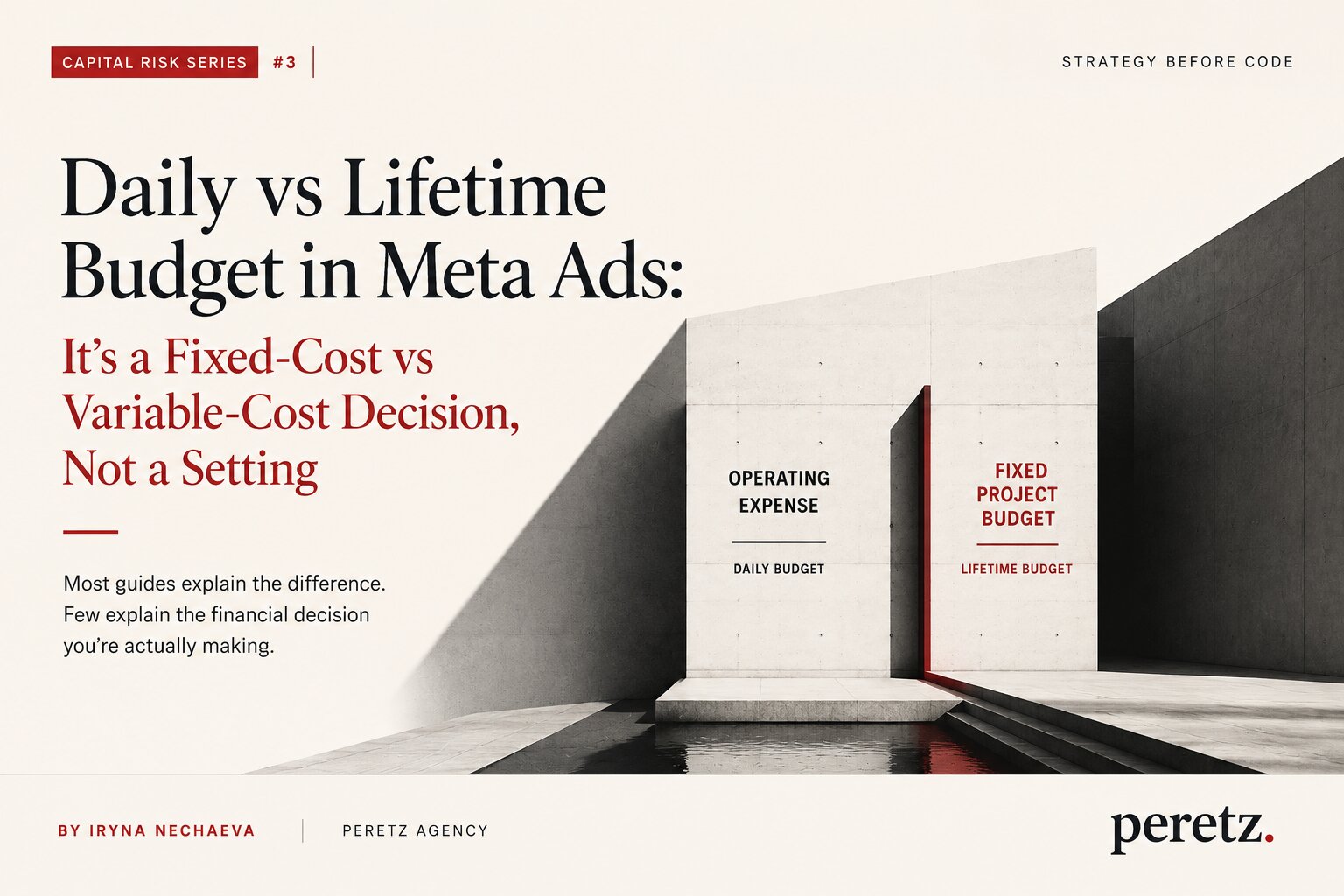
Setting up an ad set, Meta gives you two boxes to choose from: daily budget, or lifetime budget. Most guides explain the mechanical difference and move on. What they skip is the part that actually matters: this choice is the same decision a finance team makes every year choosing between an operating expense line and a fixed project budget, and most business owners are making it with no idea that's what they're doing.
Here's the detail that turns this from a minor setup step into something worth stopping on: once an ad set is published as daily or lifetime, that choice is locked. You cannot switch it later, the same way you can't change the optimization event after publishing. The only fix is duplicating the ad set from scratch. Get this wrong on a campaign that matters, and correcting it costs you the campaign's accumulated learning, not just five minutes of clicking.
WHAT EACH ONE IS
What Each One Actually Is, Past the Basic Definition
A daily budget is the average amount you're willing to spend per day, running indefinitely, with no required end date. Meta doesn't hold to that number exactly, it can spend up to 25% more than your daily budget on a high-opportunity day, balancing the excess against lighter-spend days across the week. It behaves like a recurring operating expense: ongoing, roughly predictable, easy to adjust incrementally as performance data comes in.
A lifetime budget is a fixed total amount attached to a defined date range. You're not saying "spend this much per day", you're saying "spend this much, total, by this date," and Meta decides the daily pacing on its own. It behaves like a capital project budget: a fixed pool of money with a deadline, where the finance question isn't "how much per day" but "did we get what we needed from this pool before it closed."
This is the framing I actually use with clients, because the standard advice, "daily for ongoing campaigns, lifetime for promotions," is true but incomplete. It tells you what to pick without telling you what you're actually choosing. A daily budget is an operating decision: you're committing to an ongoing spend rate you can adjust as you learn. A lifetime budget is a capital allocation decision: you're committing a fixed sum to a fixed window and accepting that Meta, not you, decides how it gets spent inside that window. Those are genuinely different financial postures, and the platform hides that behind two checkboxes that look equally casual.
THE FAILURE PATTERN
The Failure Pattern Nobody Warns You About
Here's what the basic comparison articles leave out, and it's the part that actually costs money: lifetime budgets don't spend evenly across their window. It's common to see slow, thin spending early in the period, followed by Meta rushing to use up the remaining balance as the end date approaches, because the platform's only real commitment is that the full amount gets spent somewhere before the deadline, not that it gets spent well.
This produces a specific, well-documented trap: a lifetime campaign performs well over its set period, so the obvious move is to extend the schedule or add more budget to keep the momentum going. In practice, this frequently backfires, the following period often performs measurably worse than the original. The budget mechanic that made the campaign look efficient in its first window doesn't carry the same efficiency into an extension, and "just extend the good one" is one of the most common Meta Ads mistakes precisely because it feels like the safe, obvious choice.
The better move when a lifetime campaign performs well: build a fresh setup rather than repeatedly extending the original, often on a daily budget, if the goal has shifted from a bounded promotion to something you want running indefinitely. Extending is renewing a lease with unknown new terms. Rebuilding is negotiating a new one with what you've already learned.
THE PRACTICAL MINIMUM
The Minimum Nobody Tells You Until You've Already Wasted a Month
Meta's platform minimum is $1/day per ad set. That number is technically real and functionally useless, a $1/day conversion campaign generates roughly 70 to 100 impressions daily, nowhere near enough for the algorithm to find your audience or exit the learning phase. The actual, practical minimum depends on your cost per action: Meta's algorithm needs approximately 50 conversion events per ad set per week to exit the learning phase reliably. At a $15 CPA, that's roughly $750 a week, about $107 a day, per ad set, not per campaign.
This matters directly for the daily-vs-lifetime decision: an ad set funded below its practical minimum takes far longer than a week to accumulate 50 conversions, regardless of which budget type you chose. A $20/day ad set at a $15 CPA needs roughly 38 days to hit that threshold, meaning the budget type debate is academic if the underlying number was never large enough to let either option actually learn.
REFRAMED AS FINANCE
The Decision, Reframed as a Finance Question
| Dimension | Daily Budget | Lifetime Budget |
|---|---|---|
| Financial posture | Recurring operating expense | Fixed capital project budget |
| Best fit | Evergreen, always-on campaigns with no natural end date | Time-bound launches, promotions, and fixed-window campaigns |
| Control style | Direct, you adjust the daily rate as data comes in | Indirect, Meta paces spend within your window on its own |
| Unique capability | None specific to this type | Ad scheduling / dayparting is exclusive to lifetime budgets |
| Main risk | Slower to react if you're not monitoring regularly | Back-loaded spend near the deadline; extending a good run often underperforms |
Ad scheduling, restricting delivery to specific hours or days, is worth naming as the one capability that genuinely only exists with lifetime budgets. If dayparting matters to your business (a restaurant advertising only during hours it's open, a B2B service only during business hours in its target time zone), that alone can settle the decision regardless of the fixed-versus-variable question.
THE FRAMEWORK
A Practical Framework, Not Just a Rule of Thumb
Choose daily if the campaign has no natural end date and you want to actively manage spend as performance data accumulates, this is the right default for most ongoing brand and demand-generation work.
Choose lifetime if the campaign is genuinely bound to a calendar, a launch, a seasonal promotion, an event, and you're comfortable letting Meta control the day-to-day pacing inside that window.
Before publishing either, calculate your practical minimum, roughly 50 conversion events per ad set per week divided into a daily figure based on your real CPA, not the platform's $1/day floor, which will waste a month before telling you anything useful.
If a lifetime campaign performs well, resist extending it as the default response. Build fresh, informed by what you learned, especially if you're now serving an ongoing need rather than a bounded one, which usually means switching to daily on the new setup, not stretching the old one.
The test I actually apply: am I funding an ongoing operation, or a project with a deadline? If you can't answer that in one sentence about your own business, the daily-versus-lifetime choice isn't really the decision in front of you, the actual decision is whether you know what this campaign is for.
WHY THIS BELONGS
Why This Belongs With the Rest of the Budget Conversation
This is the same pattern I keep pointing to across every part of a Meta Ads account: what looks like a technical checkbox is a financial commitment wearing a settings label. Spending limits are risk management, we cover that in Your Meta Spending Limit Is a Circuit Breaker, Not a Setting. Billing thresholds are cash flow management, covered in Meta Quietly Rewired How It Collects Money From Advertisers in 2026. Daily versus lifetime is capital allocation, fixed cost versus variable cost, made inside an ad platform instead of a finance meeting, by whoever happened to be setting up the campaign that day. And the same governance question sits underneath which spending model gets chosen in the first place, we go deeper on that in Campaign Budget Optimization Is a Governance Decision, Not a Toggle.
When I review a client's account structure, I look at which campaigns are running on lifetime budgets that have clearly been extended past their original end date, because that's usually the fastest way to find money quietly underperforming without anyone having decided that on purpose. Nobody chose for that campaign to keep degrading. Somebody just clicked "extend" because the alternative looked like more work.
HOW WE APPROACH THIS
How Peretz Agency Approaches This
Every campaign we set up starts with the same question before either budget type gets chosen: is this ongoing or bounded, and does the client actually know which one it is. That answer decides the budget type, not a default, not whichever option happened to be selected last time.
Every platform has defaults. Mature companies decide whether those defaults deserve to stay.
The counterpart to that choice, why a protected per-ad-set budget is sometimes worth funding even while it loses, is in Ad Set Budget Optimization: The "Losing" Ad Sets You Fund on Purpose.
The series closes with the setting that reveals it was never really about Meta at all, in Meta Ads Learning Phase: The Compound Interest Nobody Lets Finish Compounding.
Author: Iryna Nechaeva, Marketing Strategist | Analyst | Targetologist at Peretz Agency.
Not sure whether your account's budget structure matches what your campaigns are actually for? We review budget structure as part of every account audit.
- Share
-
-

-

-
Related Reading
-
07. 08. 2026
Campaign Budget Optimization Is a Governance Decision, Not a Toggle

-
07. 08. 2026

Your Meta Spending Limit Is a Circuit Breaker, Not a Setting
-
08. 08. 2026
Meta Quietly Rewired How It Collects Money From Advertisers in 2026
-
29. 06. 2026
Meta Ads in 2026: What Budget Do You Really Need to See Results?
-
28. 07. 2026

Why Your Cost Per Lead Keeps Going Up in 2026 (10 Fixes)
-
10. 08. 2026
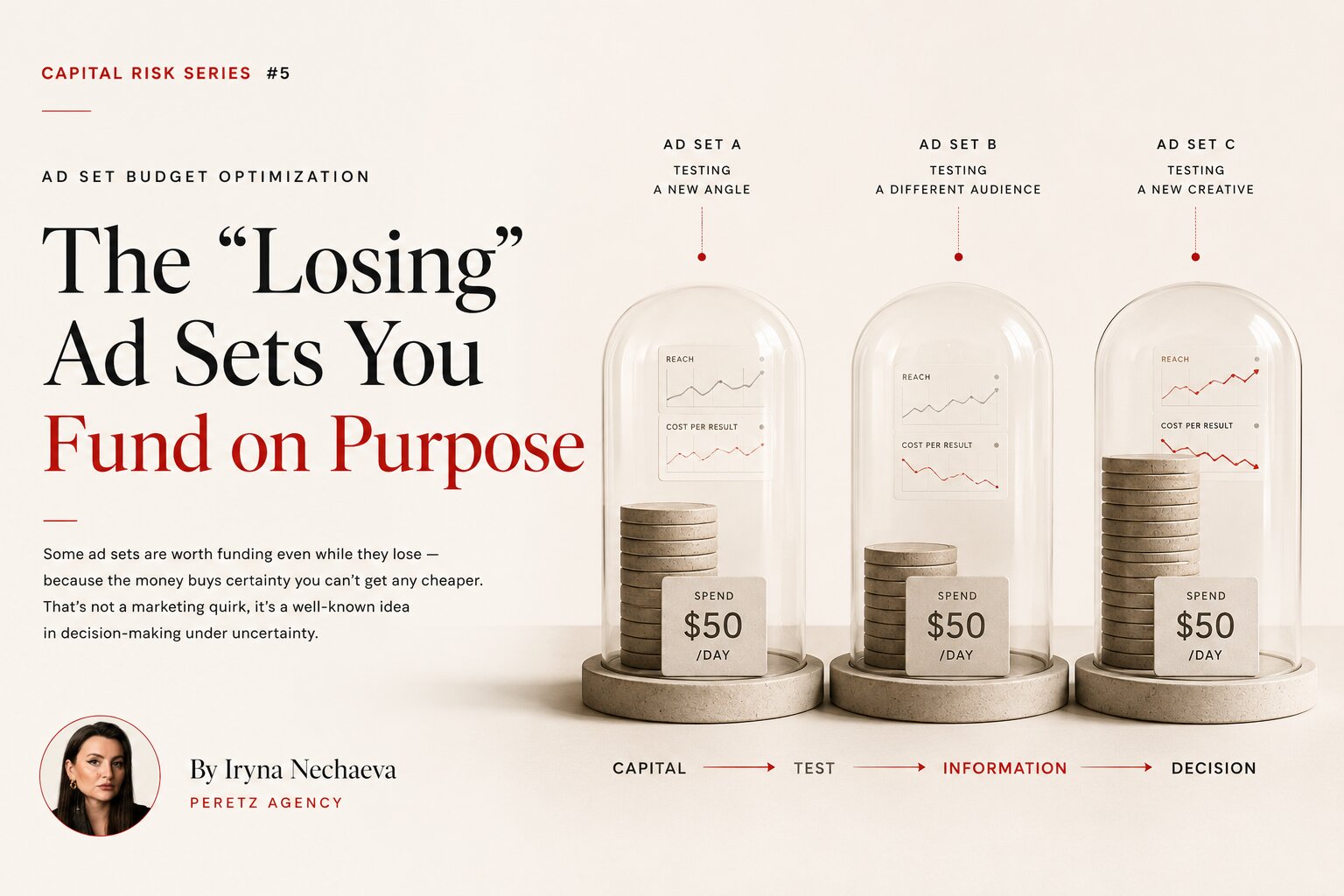
Ad Set Budget Optimization: The "Losing" Ad Sets You Fund on Purpose
-
11. 08. 2026
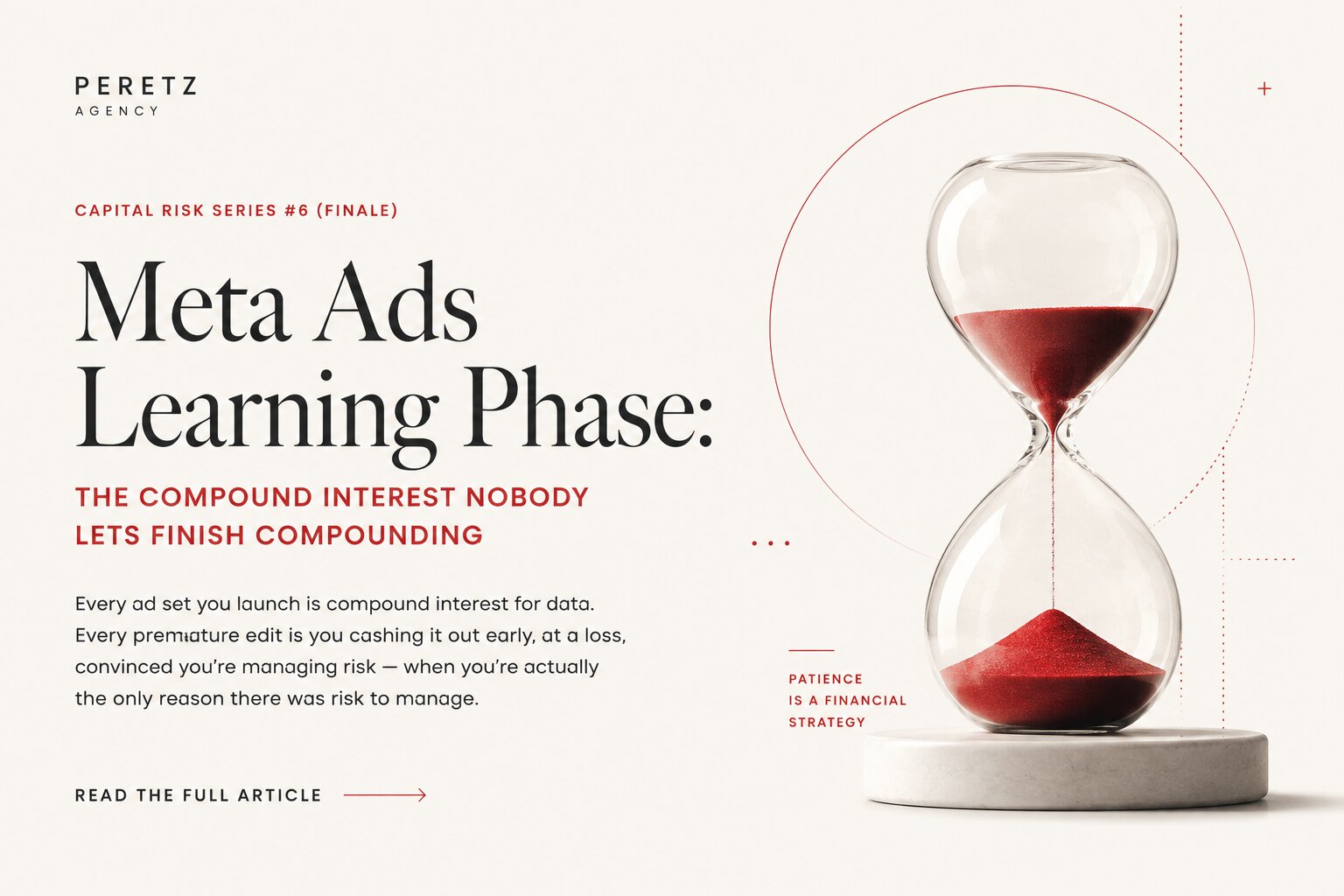
Meta Ads Learning Phase: The Compound Interest Nobody Lets Finish Compounding
-
06. 09. 2026
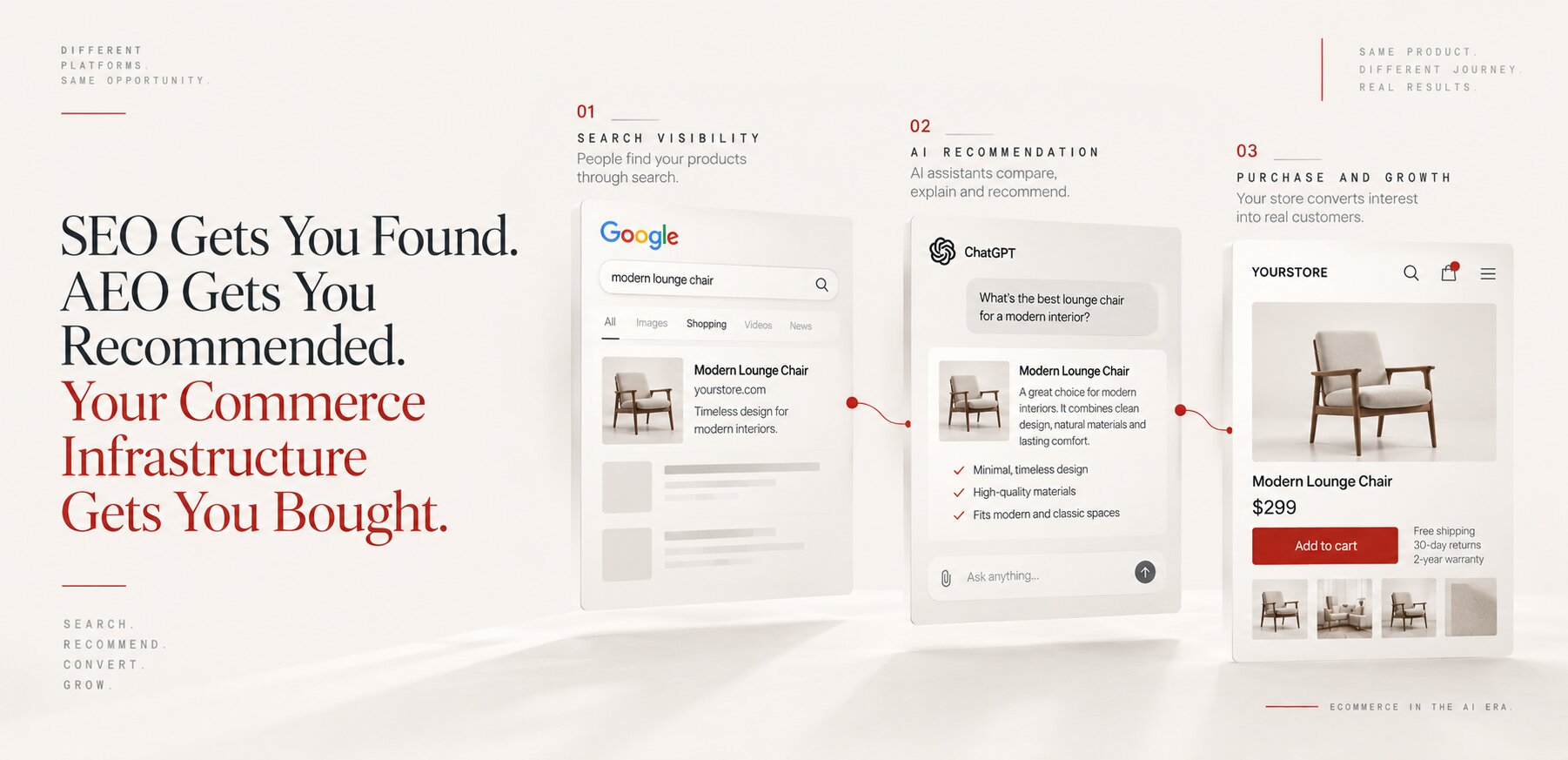
SEO Gets You Found. AEO Gets You Recommended. Your Commerce Infrastructure Gets You Bought.