

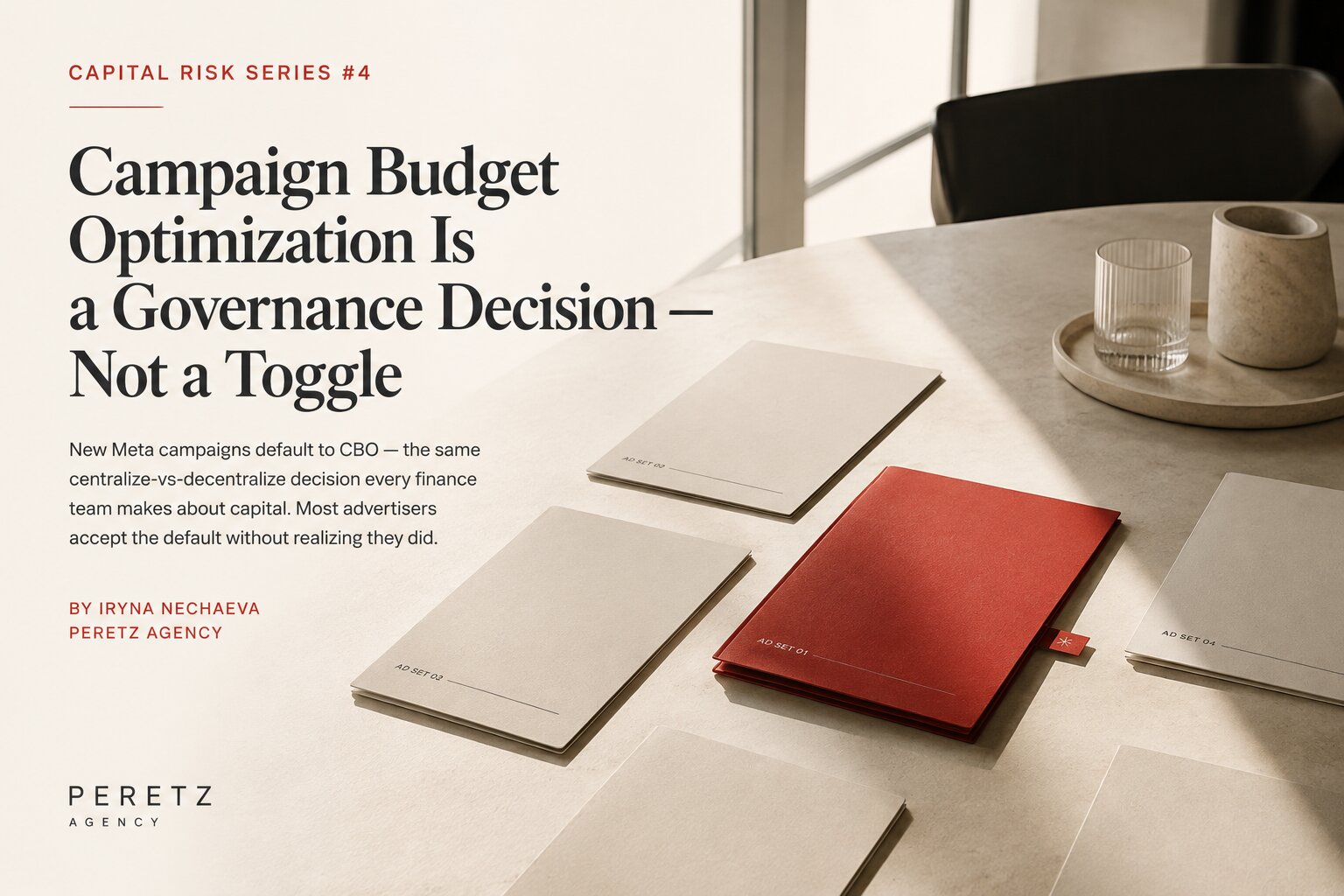
A few years ago, choosing between CBO and ABO was a setting. Today, it's a governance decision most advertisers don't even realize they're making.
New Meta campaigns default to Campaign Budget Optimization now, rebranded, somewhat confusingly, as Advantage+ campaign budget. You set one number at the campaign level, and Meta's algorithm decides in real time how much of it each ad set inside that campaign actually gets. To run the older model instead, a fixed budget assigned to each ad set individually, you now have to actively opt out.
Millions of advertisers changed how their budgets are governed without making a single decision.
Strip away the interface and this is a decision every finance team has faced in a completely different context: does a central authority allocate capital across business units based on real-time performance, or does each unit control its own budget and defend its own results? Corporations have run this debate for decades, under the heading of centralized versus decentralized capital budgeting. Meta just built it into an ad account and labeled it a technical default.
THE TWO MODELS
What Each Model Actually Does
Campaign Budget Optimization (CBO) pools a single budget at the campaign level. Meta's algorithm moves money between ad sets continuously, sometimes hour by hour, pushing more toward whichever ad set is currently delivering the lowest cost per result. Nothing is fixed underneath the campaign total; the algorithm is the allocator.
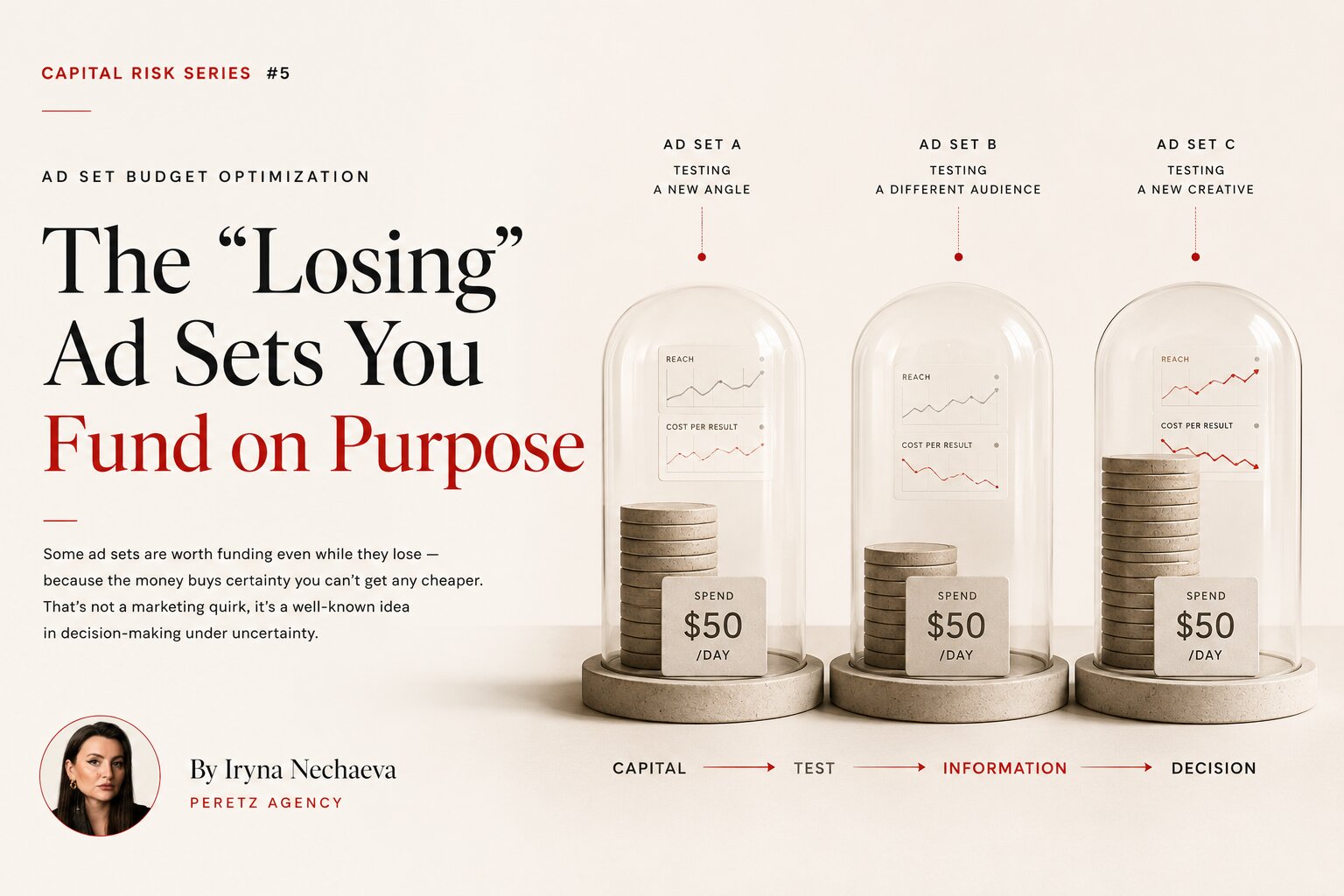
Ad Set Budget Optimization (ABO) assigns a fixed budget to each ad set individually. If three ad sets each get $50 a day, that's what each spends, regardless of which one is quietly outperforming the others. Meta is restricted from moving money between them, each ad set is, functionally, its own budget owner defending its own performance.
This is the framing I use with clients who ask which one is "better," because that question assumes a universal answer that doesn't exist, the same way "should a company centralize budgeting" doesn't have one either. CBO is centralized capital allocation: efficient at the aggregate level, but it can quietly starve a smaller, still-viable line of business in favor of whichever one already has the strongest signal. ABO is decentralized budgeting: it protects experimentation and gives every unit a fair, undiluted test, at the cost of somebody's time actively managing the allocation instead of letting the system do it.
THE EFFICIENCY NUMBER
The Efficiency Number, and What It Doesn't Tell You
CBO users see cost-per-purchase reductions of up to 12% compared to manually managed ad set budgets, according to platform-reported data. That number gets cited constantly as the case for CBO, and it's real, but it's an aggregate efficiency number, the same kind of number a CFO sees after centralizing procurement across business units. It tells you the average went down. It doesn't tell you which specific line item got quietly deprioritized to make that average happen.
This is the actual risk with CBO that efficiency statistics don't capture: the algorithm chases the ad set with the strongest immediate signal, which means a newer or slightly slower-warming ad set, one that might become your best performer given a fair, undiluted test, can get starved of spend before it ever proves itself. The aggregate number improves. The specific decision about which ideas got a real chance to compete was made by an algorithm optimizing for short-term signal, not by anyone weighing long-term strategic value.
We see the same pattern show up downstream, in accounts where cost per lead keeps climbing and nobody can point to why. We break down the other usual suspects in Why Your Cost Per Lead Keeps Going Up in 2026.
THE MIDDLE OPTION
The Middle Option Almost Nobody Talks About
Between full CBO and full ABO sits budget sharing, functionally ABO with a soft CBO layer on top. You still set a base budget per ad set, but Meta gets permission to shift up to roughly 20% of it toward stronger performers in real time. Think of it as ABO with training wheels: you keep the base allocation decision, but the algorithm gets limited room to correct for what it's actually seeing.
I use this middle setting more than clients expect, mostly on accounts big enough to have real signal but not yet mature enough for me to trust CBO with the whole budget unsupervised. It's closer to how sophisticated finance teams actually run decentralized budgeting in practice, business units keep primary control of their budgets, but a small percentage of discretionary capital sits centrally, available to move toward whichever unit is demonstrably outperforming in a given quarter. Full centralization and full decentralization are both simpler to describe than they are to run well. The hybrid is usually where the real operational maturity lives.
WHEN EACH FITS
When Each Model Actually Fits, Past "It Depends"
| Dimension | ABO (Ad Set Budget) | CBO (Campaign Budget) |
|---|---|---|
| Governance style | Decentralized, each ad set defends its own budget | Centralized, the algorithm allocates across ad sets |
| Best fit | Testing distinct concepts, audiences, or creative you need a clean read on | Scaling a proven concept with enough conversion volume for signal to be reliable |
| What it protects | A fair, undiluted test for every idea in the campaign, including the slow starters | Aggregate efficiency; spend concentrates on what's already winning |
| What it costs | Operator time, you're the one shifting budgets and killing underperformers by hand | Visibility, you don't see, in real time, which ad sets are quietly being starved |
| Failure mode | Money sitting on an underperformer nobody caught in time | A genuinely promising idea killed before it had a fair chance to prove itself |
The pattern that shows up consistently in accounts I'd call operationally mature: ABO for testing, CBO for scaling, not as a rule memorized from a blog post, but because it maps directly onto the governance logic above. You want decentralized, protected testing while you don't yet know which idea deserves capital. You want centralized, efficient allocation once you do.
SMALL BUDGETS
The Detail That Changes the Answer on Small Budgets
Most CBO advice assumes there's enough budget for the algorithm to meaningfully distribute, which is precisely the assumption that breaks down on a small account. If total daily spend is too thin, CBO doesn't have room to make a real allocation decision between ad sets; it's optimizing distribution of an amount too small to generate the signal the algorithm needs in the first place. On a genuinely small budget, ABO for testing is the right default regardless of what stage the account is at, because the centralization argument only holds once there's enough capital flowing to make centralizing it meaningful.
The practical workflow elite media buyers actually use: test new concepts in ABO, and once a specific ad set proves itself, duplicate it by post ID into a CBO campaign to scale, while leaving the original ABO version live as a control. You get the protected test and the efficient scale, without having to fully commit to one governance model for the account's entire lifecycle.
This is also where a lot of the ad copy itself quietly stops carrying its weight, small budgets punish weak creative faster than big ones do. If your click-through rate looks fine but conversions don't follow, that's usually a copy problem hiding behind a budget conversation, something we cover in High CTR But Low Conversion Rate? Here's Why Your Ad Copy Is the Problem.
WHY THE DEFAULT MATTERS
Why the Default Matters More Than the Debate
Here's the detail that makes this worth writing about at all: new campaigns now default to CBO. Someone setting up a campaign without deliberately choosing otherwise is, by default, choosing centralized allocation, accepting that the algorithm decides which ideas get funded and which get quietly starved, without necessarily deciding that on purpose. That's the equivalent of a company centralizing its capital budgeting because nobody actively objected, not because anyone evaluated whether centralization fit how the business actually needed to grow.
When I inherit an account, checking whether CBO or ABO is running, and whether that was a decision or an accident of the default, tells me almost as much as looking at the actual ad performance. An account running CBO across everything, including campaigns that are clearly still in a testing phase, usually means nobody made this choice deliberately. It's not a red flag about the marketing. It's a signal about whether budget decisions in this account are being made on purpose or inherited from whatever the platform pre-selected.
It's the same diagnostic question we ask when an account's ads simply aren't working and nobody can say why, was this a decision, or just what was already running. We walk through that broader diagnosis in Why Your Instagram Ads Aren't Working in 2026.
HOW WE APPROACH THIS
How Peretz Agency Approaches This
Every campaign we set up starts with the same governance question before the budget model gets chosen: do we already know which idea deserves capital, or are we still finding out? That answer decides ABO or CBO, not the platform default, and not a rule copied from the last account we managed.
The same question sits underneath almost every budget conversation we have with clients, including the more basic one many advertisers skip entirely: how much should actually be going into Meta in the first place. We cover that starting point in Meta Ads in 2026: What Budget Do You Really Need to See Results? The other half of the Capital Risk conversation, what happens when the platform itself overspends without asking, is in Your Meta Spending Limit Is a Circuit Breaker, Not a Setting.
Every platform has defaults. Mature companies decide whether those defaults deserve to stay.
The third piece of this same governance question, whether an ad set is funded like an ongoing operating cost or a fixed capital project, is in Daily vs Lifetime Budget in Meta Ads Is a Fixed-Cost vs Variable-Cost Decision, Not a Setting.
The counterpart to that choice, why a protected per-ad-set budget is sometimes worth funding even while it loses, is in Ad Set Budget Optimization: The "Losing" Ad Sets You Fund on Purpose.
The series closes with the setting that reveals it was never really about Meta at all, in Meta Ads Learning Phase: The Compound Interest Nobody Lets Finish Compounding.
Author: Iryna Nechaeva, Marketing Strategist | Analyst | Targetologist at Peretz Agency.
Not sure whether your account's CBO/ABO setup was a deliberate choice or just what the platform defaulted to? We review budget governance as part of every account audit, not just spend and creative.
- Share
-

-

-

-

Related Reading
-
29. 06. 2026

Meta Ads in 2026: What Budget Do You Really Need to See Results?

-
28. 07. 2026

Why Your Cost Per Lead Keeps Going Up in 2026 (10 Fixes)
-
18. 06. 2026

Why Your Instagram Ads Aren't Working in 2026 — And How to Fix Them
-
19. 07. 2026
High CTR But Low Conversion Rate? Here's Why Your Ad Copy Is the Problem
-
07. 08. 2026

Your Meta Spending Limit Is a Circuit Breaker, Not a Setting
-
08. 08. 2026
Meta Quietly Rewired How It Collects Money From Advertisers in 2026
-
10. 08. 2026
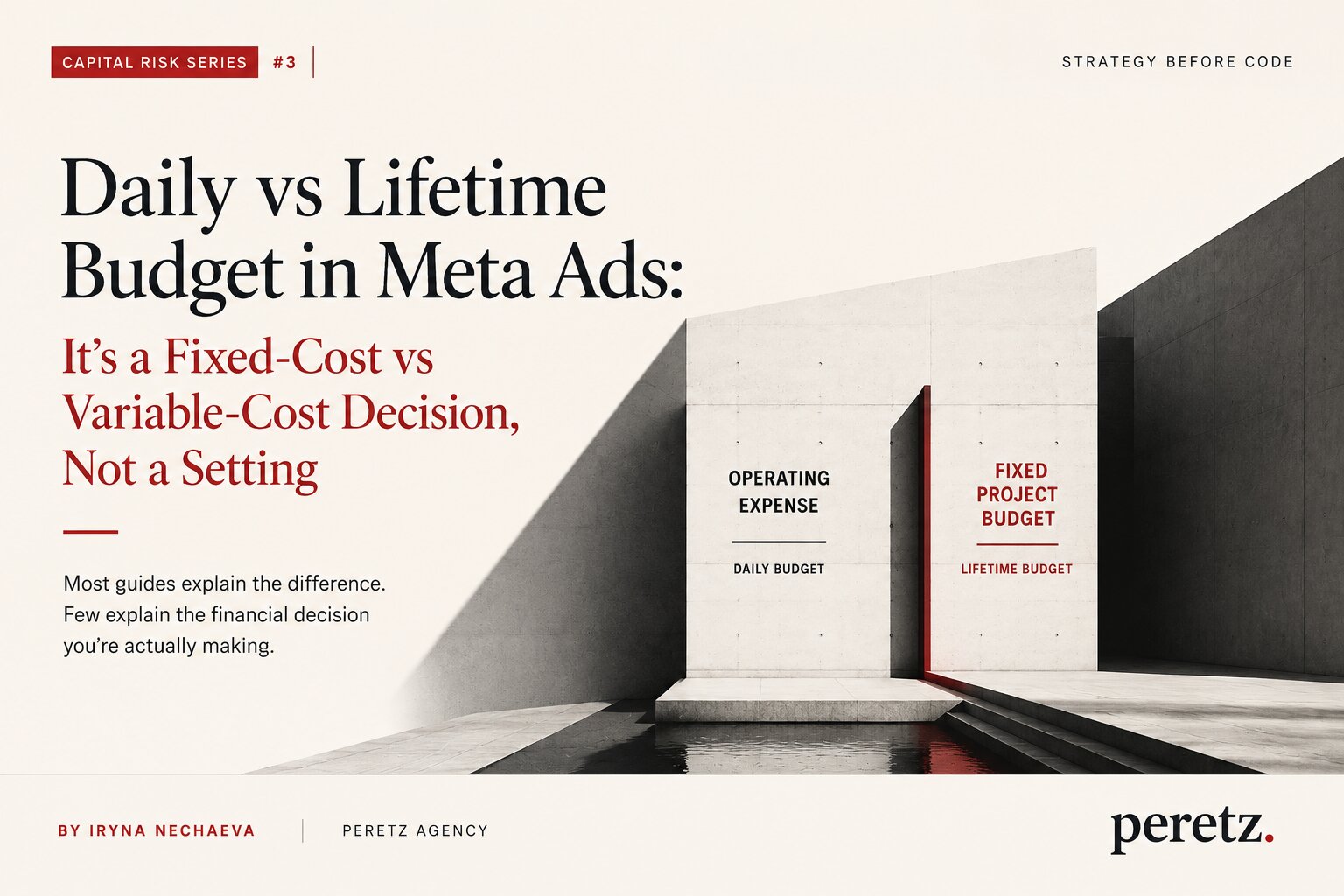
Daily vs Lifetime Budget in Meta Ads Is a Fixed-Cost vs Variable-Cost Decision, Not a Setting
-
10. 08. 2026
Ad Set Budget Optimization: The "Losing" Ad Sets You Fund on Purpose
-
11. 08. 2026
Meta Ads Learning Phase: The Compound Interest Nobody Lets Finish Compounding
-
06. 09. 2026
SEO Gets You Found. AEO Gets You Recommended. Your Commerce Infrastructure Gets You Bought.