

On April 1, 2026, a number of Meta ad accounts stopped delivering. Not because of a policy violation. Not because of a creative rejection. Because their businesses missed a billing deadline most of them didn't know existed, a March 31 cutoff to switch from credit card payments to monthly invoicing or direct debit. Accounts that missed it had their ads paused until they complied.
If that's the first you're hearing of it, you're not alone, and that's exactly the problem this article is about. Most business owners think of "billing threshold" as a minor account setting. It's actually the mechanism that decides when your money leaves your account, how much warning you get, and, as of 2026, whether your campaigns keep running at all.
HOW IT WORKS
How the Threshold Actually Works
Meta uses postpay threshold billing by default. New accounts start with a $25 threshold; the standard ceiling most accounts reach is $2,500, with higher limits available on request for larger spenders. Every time your cumulative ad spend hits that threshold, Meta automatically charges your primary payment method. If you don't hit the threshold before your monthly billing date, you get charged for whatever balance remains, whichever comes first.
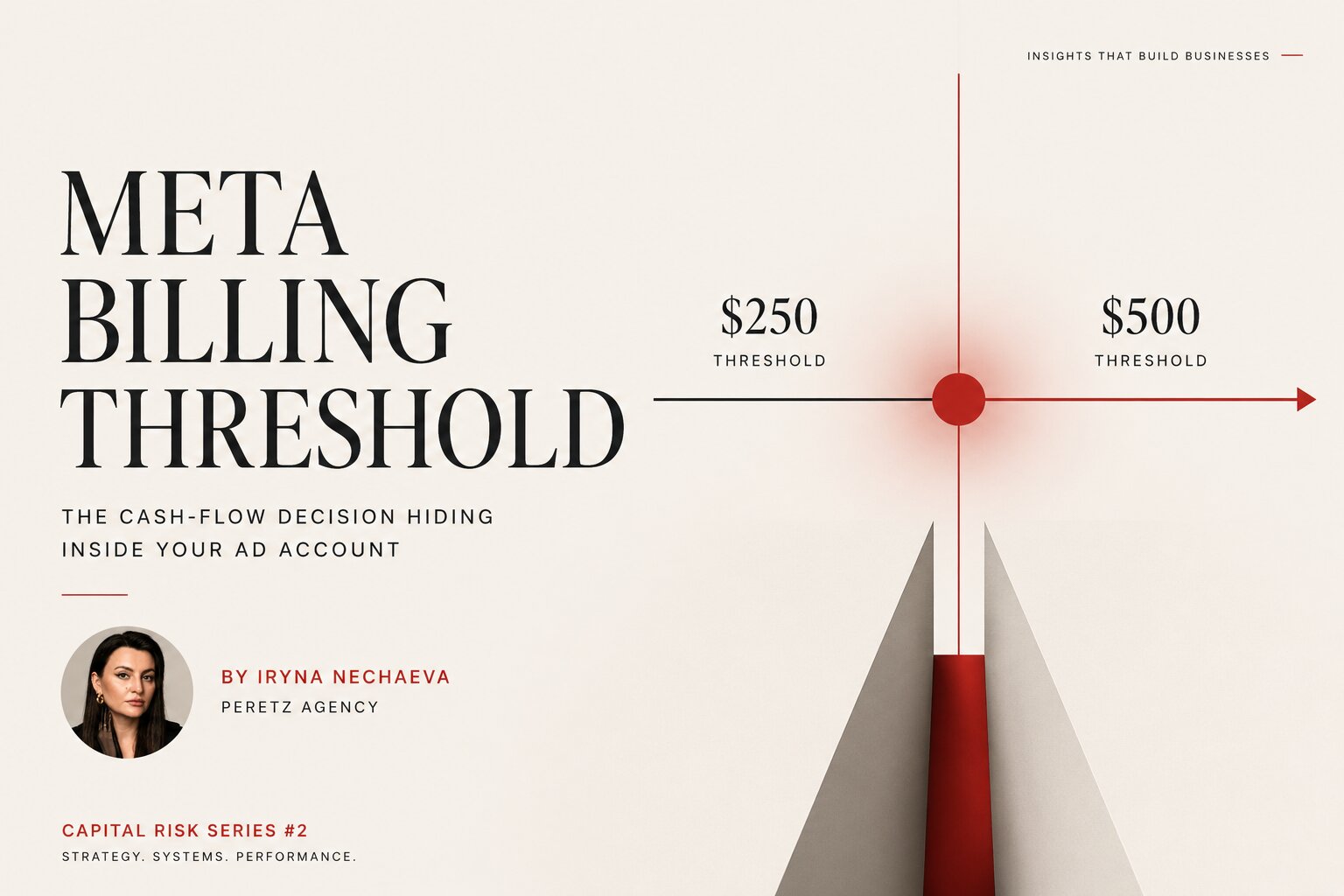
The detail almost nobody tracks: Meta automatically raises your threshold as your spend grows, without necessarily flagging it clearly. A jump from a $250 to a $500 threshold changes how often, and how much, money leaves your account in a single charge. If your cash flow planning was built around the old number, the new one arrives as a surprise, not a notification you registered.
THE 2026 CHANGE
The 2026 Change: Why This Suddenly Matters More
Starting April 1, 2026, Meta began requiring higher-spending ad accounts, particularly those connected to a Business Portfolio, to move away from threshold-based credit card charges entirely, onto monthly invoicing or direct debit. Meta started notifying affected accounts on February 26, 2026, giving a roughly four-week window before the March 31 deadline. Accounts that missed it had campaigns paused on April 1 until they completed the switch.
The exact spend threshold that triggers this requirement isn't publicly documented, Meta's own guidance confirms some accounts "may be required" to switch, without specifying the number. The only reliable way to know if you're affected is checking Billing and Payments in Meta Business Suite for a banner requiring action.
This is the part worth sitting with: an account can be running well, generating leads, hitting targets, and still get paused entirely because of a billing mechanism switch nobody on the marketing side was tracking. The interruption has nothing to do with ad performance and everything to do with whether someone was monitoring a notification that arrived by email, weeks in advance, to whichever inbox happened to be listed as the account contact.
A CASH FLOW DECISION
Monthly Invoicing vs. Threshold Billing: A Cash Flow Decision, Not a Payment Preference
Monthly invoicing consolidates spend into one bill per billing cycle with Net 30 payment terms, meaning spend accumulates through the month, the invoice arrives after close, and you have 30 days to pay. In practice, that gives businesses spending at meaningful scale up to 45 to 60 days of cash flow float: the month of spend plus the payment window. Direct debit works differently, a single payment processed on a set due date, offering predictable timing without the float.
This is where I stop clients from treating a billing method as a checkbox. Threshold billing charges your card constantly, in small unpredictable amounts, the moment cumulative spend crosses a line, which is fine for a business with simple, steady cash flow, and genuinely disruptive for one managing tight working capital or seasonal swings. Monthly invoicing turns that into one predictable number on one predictable date, with real float you can actually plan around. Which one is right isn't a preference. It's a question about how your business actually manages cash, and most businesses have never been asked it, because the platform frames this as billing admin instead of financial strategy.
The trade-off worth knowing before switching: both monthly invoicing and direct debit eliminate the 2 to 3% cash-back rewards many advertisers previously earned by running ad spend through a business credit card. For an account spending $50,000 a month, that's real money, sometimes $1,000 to $1,500 a month in forfeited rewards, weighed against the value of 45 to 60 days of float. Which side of that trade wins depends entirely on what your business does with cash it doesn't have to spend immediately.
WHAT ADVICE GETS WRONG
What Most Advice Gets Backwards
Most guidance treats the billing threshold as something to configure once and forget, set it, maybe request a higher ceiling if you're scaling, move on. That's backwards. The threshold, and now the choice between threshold billing and monthly invoicing, is one of the few places where a marketing platform setting directly touches your company's cash position. Configuring it without asking who actually owns cash flow decisions in the business is the same mistake as letting anyone in marketing set an accounting policy.
Check whether your account received a monthly invoicing notice, the banner sits in Billing and Payments in Meta Business Suite, and it's easy to miss if notifications default to a single inbox nobody actively monitors.
If you're eligible for monthly invoicing, run the actual math: value of 45 to 60 days of float versus the lost credit card rewards, specific to your spend level and your cost of capital, not a general rule of thumb.
Fix notification routing before it becomes a crisis. Default billing alerts often go only to the account creator's email. If that person changed roles, left the company, or the notification landed in spam, a real deadline can pass with nobody aware it existed.
Treat a threshold increase as a cash flow event, not a footnote. When Meta raises your threshold because your spend grew, that's the moment to revisit how much cash sits earmarked for a single charge, not something to notice after the fact on a bank statement.
The question I ask every client managing meaningful ad spend: who in this business would actually notice if Meta changed how and when it takes your money? If the honest answer is "nobody specific," that's the gap, not the billing mechanism itself.
A STRATEGY CONVERSATION
Why This Belongs in a Strategy Conversation
A billing threshold sounds like the least strategic line item in an ad account. It's actually one of the clearest examples of something I keep coming back to: almost every setting inside a Meta Ads account is a financial or operational decision wearing a technical label. Spending limits are risk management. We cover that side of the equation in Your Meta Spending Limit Is a Circuit Breaker, Not a Setting. Billing thresholds are cash flow management. Neither one has anything to do with whether your creative is any good, and both can shut your campaigns down regardless of how good it is.
When I audit a new account, I check who actually receives Meta's billing notifications before I look at a single ad. It sounds unrelated to marketing performance, and it isn't, an account that gets unexpectedly paused over a missed billing deadline loses more momentum than most creative underperformance ever costs. The businesses that treat this as boring admin are the ones most likely to be surprised by it. If your click-through rate looks strong but the account still underperforms, the cause is rarely the budget mechanics, it's usually the creative itself, something we cover in High CTR But Low Conversion Rate? Here's Why Your Ad Copy Is the Problem.
HOW WE APPROACH THIS
How Peretz Agency Approaches This
Every account we manage gets billing and notification routing checked as part of the initial audit, the same category of foundational check as tracking and spending limits, not something we return to after a problem surfaces. If a client is approaching a spend level where monthly invoicing becomes relevant, we flag it before Meta does.
Every platform has defaults. Mature companies decide whether those defaults deserve to stay.
The counterpart to that choice, why a protected per-ad-set budget is sometimes worth funding even while it loses, is in Ad Set Budget Optimization: The "Losing" Ad Sets You Fund on Purpose.
The series closes with the setting that reveals it was never really about Meta at all, in Meta Ads Learning Phase: The Compound Interest Nobody Lets Finish Compounding.
Author: Iryna Nechaeva, Marketing Strategist | Analyst | Targetologist at Peretz Agency.
Not sure whether your account is exposed to a billing threshold or invoicing change you haven't noticed yet? We check billing and cash flow exposure as part of every account audit.
- Share
-

-

-

-

Related Reading
-
07. 08. 2026

Your Meta Spending Limit Is a Circuit Breaker, Not a Setting

-
07. 08. 2026
Campaign Budget Optimization Is a Governance Decision, Not a Toggle
-
29. 06. 2026

Meta Ads in 2026: What Budget Do You Really Need to See Results?
-
28. 07. 2026

Why Your Cost Per Lead Keeps Going Up in 2026 (10 Fixes)
-
18. 06. 2026

Why Your Instagram Ads Aren't Working in 2026 — And How to Fix Them
-
19. 07. 2026

High CTR But Low Conversion Rate? Here's Why Your Ad Copy Is the Problem
-
10. 08. 2026
Daily vs Lifetime Budget in Meta Ads Is a Fixed-Cost vs Variable-Cost Decision, Not a Setting
-
10. 08. 2026
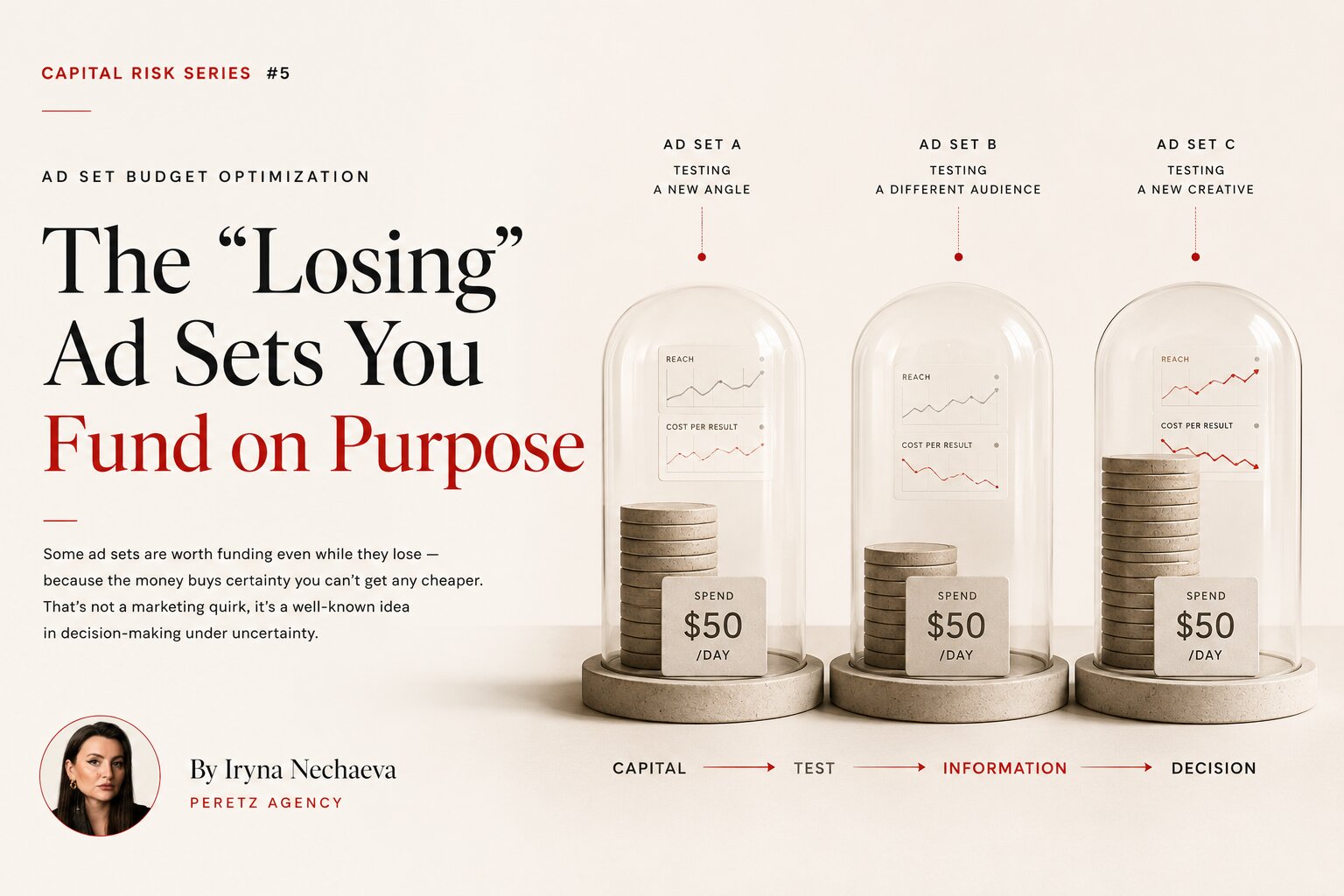
Ad Set Budget Optimization: The "Losing" Ad Sets You Fund on Purpose
-
11. 08. 2026
Meta Ads Learning Phase: The Compound Interest Nobody Lets Finish Compounding