


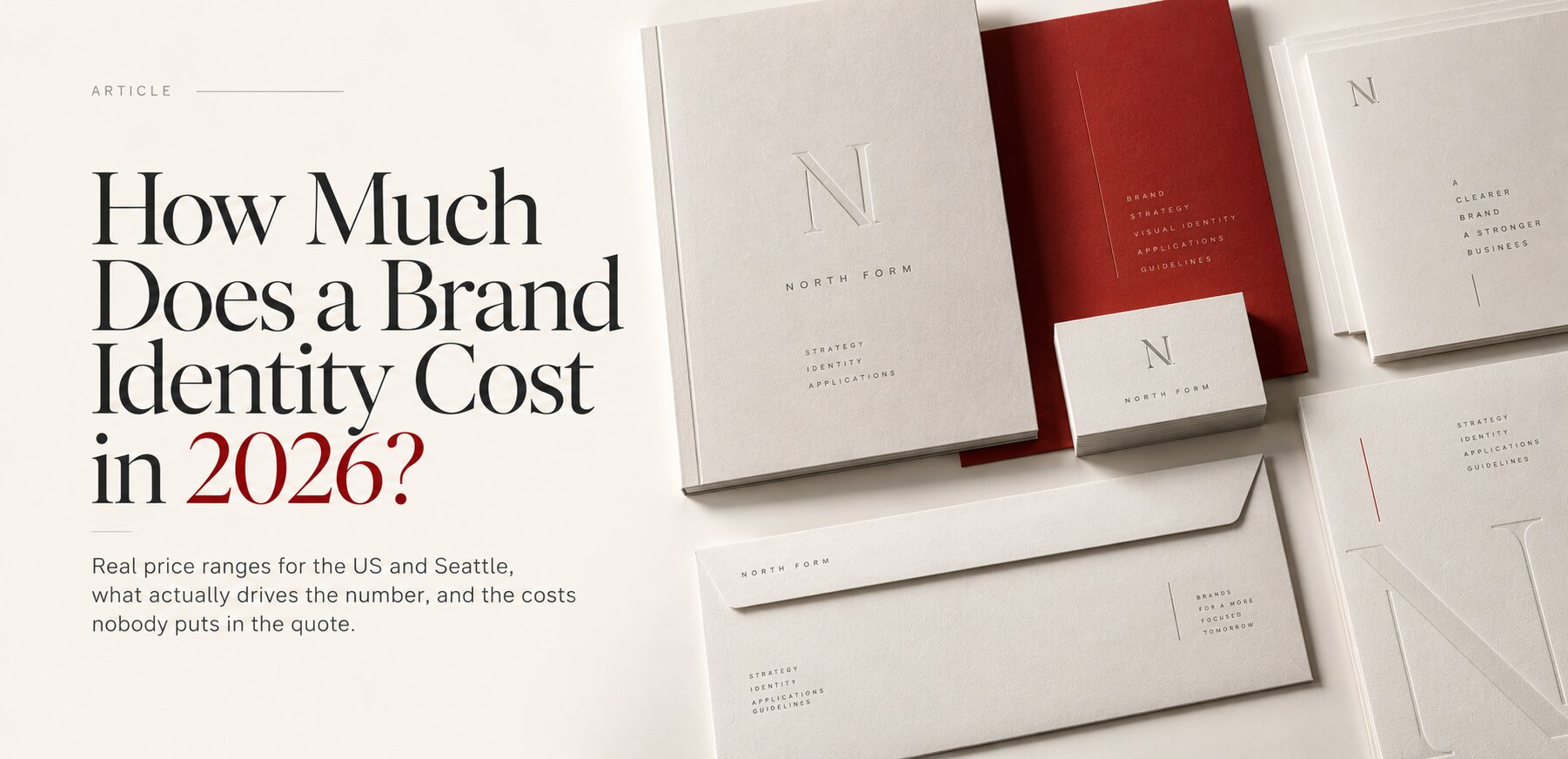
Real price ranges for the US and Seattle, what actually drives the number, and the costs nobody puts in the quote
THE ANSWER
The Short Answer
In short
- As a practical 2026 benchmark, a brand identity in the US costs roughly $500 to $5,000 with a freelancer, $5,000 to $30,000 with a boutique studio, and $20,000 to $100,000 or more with a full-service agency. These are market ranges, not a price list: the market is too uneven for one.
- According to Clutch, most branding projects reviewed by verified clients cost between $10,000 and $49,999, and the average agency rate is $100 to $149 per hour.
- Seattle is more expensive than the national average: most branding agencies in the city list $150 to $199 per hour on Clutch.
- A logo, a visual identity, a brand identity, a brand strategy and a rebrand are five different things, and most confusion about price comes from mixing them up.
- The price is driven less by the logo and more by everything around it: strategy, the number of places the brand has to work, what is at stake, and the rollout.
- You are not paying for a logo. You are paying for the amount of business the brand has to carry.
The question "how much does a brand identity cost" has a wide answer because the words mean different things to different providers. A logo with two colors is called a brand identity. So is a full system with strategy, naming, typography, a brand book and a rollout across a website, packaging and signage.
So before talking about price, it helps to separate five things that are constantly confused:
- Logo. A recognizable mark.
- Visual identity. The logo plus typography, color and a visual language.
- Brand identity. The visual identity plus a verbal identity, rules and applications: how the brand looks, sounds and behaves everywhere it appears.
- Brand strategy. Positioning, audience, differentiation and messaging: what the brand stands for and why anyone should choose it.
- Rebrand. Changing some or all of the above, often including the migration from an existing brand that customers already know.
A great many owners believe that a logo is the brand. Most of this article is about why it isn't, and why that difference is where the price comes from.
Here is what the market looks like in 2026, by type of provider:
| Provider | Typical range | What you usually get |
|---|---|---|
| AI tools and marketplaces | $0 to $500 | A logo file, sometimes colors |
| Freelance designer | $500 to $5,000 | A logo with a basic identity: colors, typefaces, a short guide |
| Boutique studio | $5,000 to $30,000 | An identity system: mark, typography, color, usage rules, key applications, often with positioning work |
| Studio with strategy and a website | $15,000 to $80,000 | Strategy, identity and a website built as one system |
| Full-service agency | $20,000 to $100,000+ | Research, strategy, naming, identity, brand book and rollout |
| National agency | $80,000 to $300,000+ | A full rebrand with research phases, for large organizations |
Treat this as a useful 2026 benchmark, not an official price list. It is assembled from Clutch's branding pricing data and from pricing guides published across the industry, and those sources do not always agree. Individual quotes depend on scope, and the same word, "identity", can hide a twentyfold difference in work.
SEATTLE
Seattle and the Pacific Northwest
Seattle sits above the national average. On Clutch, almost every branding agency in the city lists a rate of $150 to $199 per hour, against a national average of $100 to $149. Minimum project sizes tell the rest of the story: small studios start from about $1,000 to $5,000, established mid-size agencies from $10,000 to $25,000, and the large agencies with Seattle offices from $100,000.
Hours are a useful way to read those numbers. In our experience, a serious identity system, with research, two or three concept directions, refinement, typography, a color system and guidelines, takes a senior team well over a hundred hours, and often closer to two hundred. At Seattle rates that already puts the work in the tens of thousands of dollars, before rollout. A quick logo package takes a fraction of that time, which is why it can cost a fraction of the price.
The Pacific Northwest premium is not only about cost of living. The region's buyers include technology companies, architecture and design firms and premium consumer brands, and agencies price for that market. For a local business, the practical consequence is simple: the same scope can cost noticeably more in Seattle than with an equally strong team elsewhere, including studios that work remotely.
THE RANGE
Why the Range Is Wide
Two quotes for "a brand identity" can differ by a factor of twenty and both be honest. The difference usually comes from five things.
1. Where the work starts. A freelancer typically starts with the logo. A studio or agency starts with the business: who it serves, what it competes on, what it wants to become. The visual work that follows is designed to express that. The thinking is invisible in the final files, and it is often the most valuable part. Why that invisible thinking matters more than the visible result is the subject of our essay Design You Don't Notice: Why the Best Design Disappears.
2. How many places the brand has to work. A logo on a website is one thing. A brand that has to work on packaging, a storefront, a trade show booth, a mobile app, uniforms, vehicles and social media is a system, and every new place adds design, testing and rules.
3. How much is at stake. A new company with no customers yet can experiment cheaply. A company with decades of recognition has something to lose, and changing it carefully takes more research and more care. In our own work this is the difference between designing something new and deciding what to keep, evolve, replace or test.
4. Who actually does the work. Senior designers and strategists cost more per hour and need fewer hours. Junior teams cost less per hour and often need more rounds. The hourly rate alone says little about the final bill.
5. The rollout. The identity itself is only part of the cost. Applying it everywhere it needs to live can cost as much again.
LEVELS
What Each Level Includes
| Level | Typical contents | Typical range |
|---|---|---|
| Logo | A mark and a wordmark, a few color and file variations | $300 to $5,000 |
| Visual identity | Logo system, color palette, typography, basic usage rules | $2,500 to $15,000 |
| Identity system with brand book | All of the above plus imagery and graphic style, templates, detailed guidelines, key applications | $10,000 to $40,000 |
| Strategy and identity | Research, positioning, messaging, then the full identity system | $20,000 to $75,000 |
| Rebrand with rollout | Strategy, identity, website, packaging, signage and the transition from the old brand | $50,000 and up |
If a quote seems too low for its label, it is usually a lower level wearing a higher level's name.
A complete brand identity for $800 is almost always a logo with colors.
HIDDEN COSTS
Costs Nobody Puts in Quotes
The design fee is the visible part. These are the parts that surprise owners later.
The rollout. New signage, printed materials, packaging, vehicle graphics, uniforms. For a physical business this can match or exceed the identity budget.
The website. A new identity on an old website rarely works. The site usually needs at least a visual update, and often more.
The digital footprint. Business profiles, directories, social accounts, the descriptions search engines and AI assistants read, and redirects from old pages. We wrote about this hidden cost in detail in our article on when not to rebrand: years of recognition are attached to the old name, and a rebrand does not move any of it automatically.
Legal protection. A trademark search before the new name or mark is final, and registration afterwards. Skipping the search is how companies end up redoing a brand a year later.
Photography and content. A new visual language often makes old photos and texts look wrong. Budget for at least the most visible ones.
Adoption. Templates, training and someone responsible for keeping the brand consistent. Without this, a carefully built identity drifts back to improvisation within a year.
HOW TO CHOOSE
How to Choose, Honestly
The right level depends less on your budget than on what the brand has to carry.
A freelancer is enough when you are starting out, the brand lives mainly online, and there is little to protect yet. A good senior freelancer can produce a clean, usable identity, and spending $40,000 at this stage is usually money better spent on the product.
A studio makes sense when the business is established and growing, the brand has to work in many places, and you need someone to think about positioning, not only design. This is where most small and mid-size companies land.
A full-service agency is worth it when the stakes are high: a merger, a sale, a new market, a national rollout, or a brand with decades of recognition that must change without losing what customers already trust.
And sometimes the honest answer is that you don't need a new identity at all. A clearer website, better photography or a tighter message may solve the actual problem for a fraction of the price.
OUR PRICES
What It Costs With Us
Brand identity, from $5,000. For businesses that need a coherent visual system: logo, typography, color and the rules that hold them together.
Identity system, $10,000 to $20,000. For businesses where the brand has to work across many applications: a website, packaging, a showroom, documents, social media.
Strategy and identity, from $15,000. For businesses where the problem is not visual but strategic: a new market, a new audience, a business that has outgrown its own story.
That places us in the middle of the boutique studio range: the level of a senior studio, without the Seattle premium.
And sometimes we recommend doing less.
Whatever the budget, we start the same way: before designing anything new, we make an inventory of the brand you already have and decide what to keep, what to evolve, what to replace and what to test. Sometimes that inventory shows that most of the brand should stay, and the project becomes smaller and cheaper. We would rather tell you that before you pay for a redesign you don't need.
Three examples of how different the work can be:
- SHTAYER went through two generations of identity: first a minimalist brand that helped a hotel supplier enter the consumer market, then a personal, botanical language that kept a visible connection to the original logo. The 2026 brand book is here.
- Nico Juliany needed a different story for a different customer: the mark of a jewelry house and the signature of its maker. The full case is here.
- The Institute of Trichology needed more clarity, not less meaning. In the first month after the new identity and website launched, conversion rose by 5%, and over the following year by 34%, with comparable advertising budgets. Not all of that growth belongs to the identity, but it shows that a brand that is easier to understand can have measurable results.
WHAT YOU PAY
What You Are Paying For
This article has a companion: When Not to Rebrand. Together they describe the order in which these decisions should be made.
First decide whether you need the work. Then decide what level of work the business actually needs. Only then talk about price.
A new brand identity is worth the money when something underneath the brand has changed: the business, the audience, the market or the ownership, or when the brand is actively limiting growth. It is rarely worth it when the only reason is that the logo feels old. And when it is worth it, the right budget is not set by what a logo should cost, but by how much the brand has to do: how many places it has to work, how much history it has to carry, and how much is at stake if it gets it wrong.
You are paying for the amount of business the brand has to carry.
FAQ
Frequently Asked Questions
How much does a logo cost in 2026?
From almost nothing with AI tools and marketplaces, to $300 to $2,500 with a professional freelancer, to $5,000 and much more with a studio or agency. A logo alone is not a brand identity: it is one element of it.
How much does a brand identity cost for a small business?
Most small businesses spend between $5,000 and $30,000 for a complete identity with a studio. Freelancers charge $500 to $5,000 for lighter scopes, and full-service agencies start around $20,000.
How much do branding agencies charge in Seattle?
Most Seattle branding agencies listed on Clutch charge $150 to $199 per hour, above the national average of $100 to $149. Minimum project sizes range from about $1,000 at small studios to $25,000 and more at mid-size agencies.
What is included in a brand book?
Typically the logo system and its rules, color palette, typography, imagery and graphic style, tone of voice, examples of correct and incorrect use, and templates for the most common applications.
How long does a brand identity project take?
A logo package can take one to three weeks. An identity system usually takes six to twelve weeks, and a full rebrand with strategy and rollout several months.
Is a new brand identity worth the money?
It is when something underneath the brand has changed: the business, the audience, the market or the ownership, or when the brand is actively limiting growth. It rarely is when the only reason is that the logo feels old.
Sources
- Branding Pricing Guide 2026, Clutch
- Top Branding Agencies in Seattle, Clutch
- Top Branding Agencies in Seattle, DesignRush
- Brand identity design services: what's included and what it costs, ManyPixels
- Branding Costs Breakdown: How Much Should You Spend, DesignRush
Not sure what level of brand work your business actually needs?
- Share
-

-

-

-

Related Reading
-
04. 10. 2026
When Not to Rebrand: What to Change and What to Leave Alone

-
23. 08. 2026
How Much Does a Custom Website Cost in 2026?
-
27. 08. 2026
Why Some Websites Look Cheap Even When They Are Well Designed
-
05. 07. 2026

SHTAYER: Building a Brand for a New Generation
-
11. 07. 2026

The Story Behind Hair
-
27. 09. 2026
Design You Don't Notice: Why the Best Design Disappears