Brand Identity Cost by Industry: Hotels, Restaurants, Clinics and Fashion



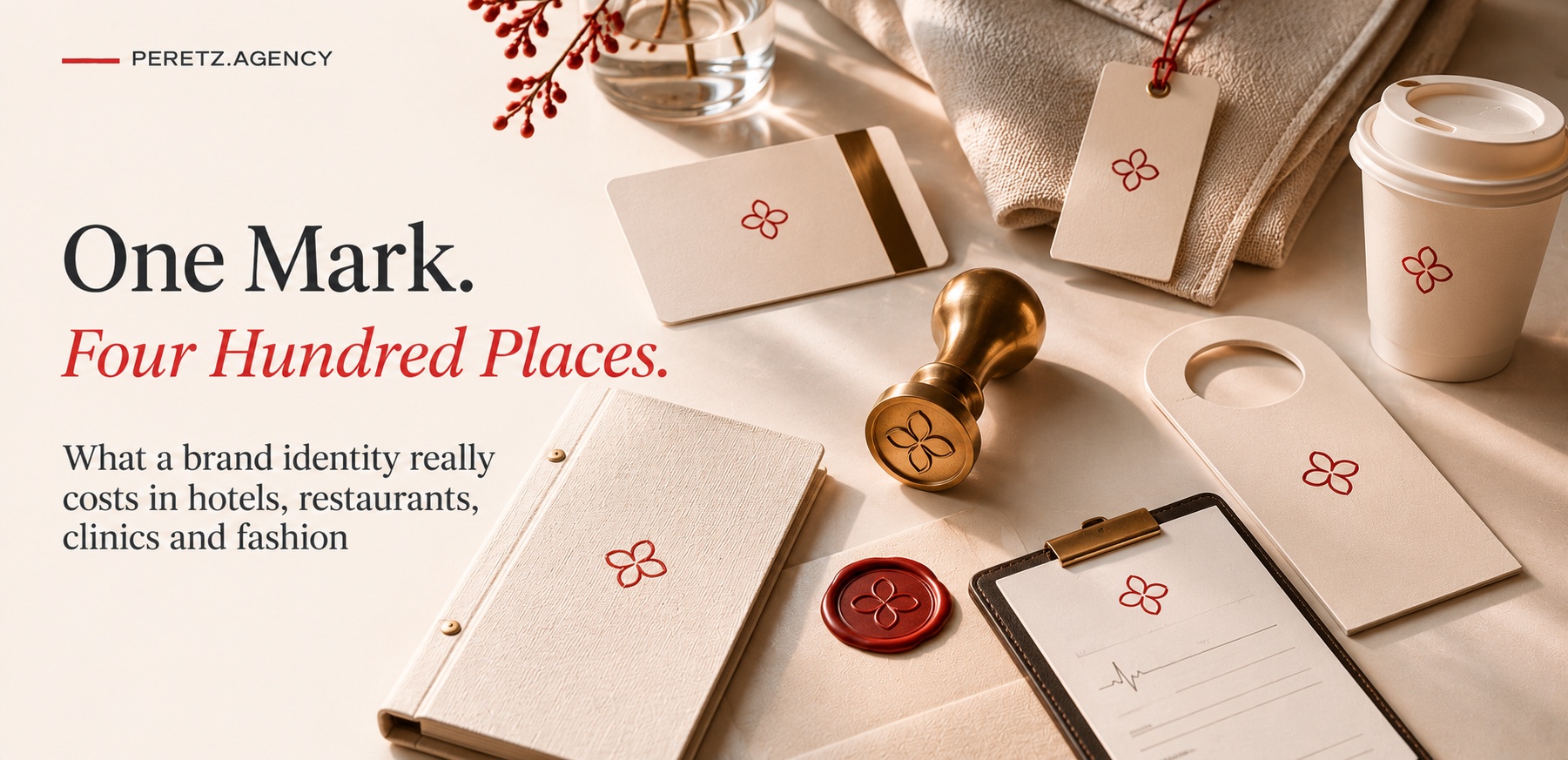
The same word, "identity", covers a café that needs a sign and a menu, and a hotel that needs hundreds of items, from key cards to the pool. Here is what each industry really has to design, why a hotel is always an identity system, and what that means for the price.
SHORT ANSWER
The short answer
The price of a brand identity depends less on the logo and more on how many places the brand has to live in. A shop or a café can start from $5,000. A clinic, a restaurant group or a fashion brand with wholesale and retail usually needs an identity system at $10,000 to $20,000. A hotel is always a system, and often needs strategy on top, from $15,000.
These are our 2026 prices. Sessions with the owner, as many as it takes, are included in every level, and the final price is agreed after the first session, before the work starts. What the market charges in general, from freelancers to national agencies, is in our article on how much a brand identity costs. This article goes one step further and looks at the industry, because in our practice the industry decides the scope more often than the budget does.
The mark itself takes roughly the same thinking for a café and for a hotel. What changes is everything the mark has to carry afterwards: the number of items, the number of people who will apply the rules, the rules that come from the law, and the number of situations in which a guest or a patient meets the brand.
| Industry | What usually has to be designed | Level that fits |
|---|---|---|
| One shop or a service | Sign, cards, packaging or labels, social media, website | Identity, from $5,000 |
| Café | The above plus menu, cups and takeaway, uniform, interior signs | Identity, sometimes a system |
| Restaurant or group | Menus for each format, delivery, interior, staff, events, website concept | Identity system, $10,000 to $20,000 |
| Clinic | Navigation, forms and documents, staff, patient materials | Identity system, $10,000 to $20,000 |
| Fashion and textile | Tags and labels of many types, packaging, B2B and B2C materials | Identity system, often strategy |
| Hotel | Key cards, room and zone signs, pool and spa, documents, offers, colour variants | Always a system, often strategy, from $15,000 |
WHY INDUSTRY
Why the industry changes the price
When an owner asks what an identity costs, we first ask where the brand will appear. The answer can be ten items or four hundred, and that difference decides the price far more than the style.
Three things grow the scope in every industry. The first is the number of carriers: every key card, menu, tag or form is a separate design with its own size, material and production file. The second is the number of people who will apply the brand without us: front desk staff, a print shop, a sign maker, a contractor who builds a spa. The more people, the more detailed the rules must be. The third is the law. Room signs, textile labels and medical forms have parts that are not a matter of taste, and the identity has to fit them.
An identity for a café can live in the owner's head and a short guide. An identity for a hotel has to survive a new manager, a new supplier of key cards and a renovation of the third floor, years after we finished. That is why hotels sit at the top of the table.
The mark costs the same thinking. The system around it does not.
HOTELS
A hotel is always an identity system
In our experience a hotel is never "just a logo". There is simply too much of everything. Here is what a typical hotel identity has to cover, even before the website:
- key cards and their sleeves;
- room numbers, floor plans and navigation between functional zones;
- halls, conference rooms, the pool, the spa, the gym and the activities programme;
- "Do not disturb" and "Please clean the room" signs, menus for room service and the minibar;
- documents, forms and invoices, and the design of the hotel's commercial offers for groups, weddings and corporate clients.
Then come the extra colour solutions. A restaurant inside the hotel, a spa or a kids' club often gets its own accent colour or a sub-mark, so each zone is recognisable while the whole stays one brand. Every one of those variants needs its own rules, or within a year each department invents its own.
What "too much of everything" looks like in numbers. Below is a typical list we draw up for a boutique hotel of about 80 rooms. It is an example of scope, not a quote; your numbers will differ.
| Zone | What has to be designed | Designs, roughly |
|---|---|---|
| Arrival | Facade sign, entrance plaque, registration forms, key cards and sleeves, welcome letter, bill folder | 10 to 15 |
| Rooms | Room numbers, door hangers, room service and minibar menus, TV welcome screen, stationery, amenity labels, laundry list | 20 to 30 |
| Navigation | Floor directories, lift and corridor signs, evacuation plans, toilets, staff-only doors | 20 to 40 |
| Restaurant and bar | Sub-mark, menus for each meal and the bar, table tents, napkins, coasters, takeaway | 20 to 40 |
| Pool, spa, gym | Rules, towel cards, spa menu, treatment forms, gift certificates | 15 to 25 |
| Sales and events | Offers for groups, weddings and companies, presentation, banquet menus, badges | 10 to 20 |
| Staff | Uniforms by department, name badges, internal forms | 10 to 20 |
| Digital | Website, booking pages, email and messenger templates, social media templates, photo rules | 15 to 25 |
That is 120 to 215 separate designs. Multiply them by two or three languages, by sizes and by the colour solution of each zone, and a hotel easily reaches 300 to 400 production files. That is where the "four hundred places" come from.
We have designed an identity for a hotel, and we cannot show it: hotels often belong to groups and investors, and the work stays under agreement. We can share how it went. The whole project took seven weeks and came to about 120 designs. The hotel approved the mark quickly; we did not. For about a week and a half we kept redrawing it, and in the end there were around twenty logo prototypes, not two, not five and not even ten. The rest of the work started only when we were sure, and that is why it then moved fast.
In the US the law adds a layer. Under the 2010 ADA Standards, signs that identify permanent rooms and spaces, such as room numbers, need raised characters and braille, mounted at 48 to 60 inches above the floor, while directional signs need only meet visual rules. So the room sign is not only a design decision: the typeface, contrast and layout have to work in tactile form too. A designer who has never done this will draw a beautiful room number that the sign maker cannot produce as compliant, and the cost appears later, on site.
In a hotel, the guest meets the brand a hundred times a day.
What this means for the price. A hotel starts at the identity system level, $10,000 to $20,000. If the hotel has several outlets, a group behind it or a repositioning to do, it moves to strategy and identity, from $15,000. The rollout itself, the production of signs, cards and textiles, is a separate budget and often a larger one.
RESTAURANTS
Restaurants and cafés
A café is the most honest example of where the base level is enough. A sign, a menu, cups and takeaway packaging, a uniform, social media and a simple website: a clear mark, two colours, one or two typefaces and a short guide can carry all of that. If the owner runs one place and plans no second one, a full system would be money better spent on the kitchen.
A restaurant with ambition is a different story. We developed the concept and the website concept for a well-known restaurant in Kharkiv, and we worked with Kurk's Meat, an American restaurant. In both cases the identity had to work far beyond the logo: menus for different formats and seasons, the interior, staff, delivery and events, and a website that sells the atmosphere before the guest arrives.
Where a restaurant budget grows. The menu is the most used item in the whole identity, and it changes all the time. A good restaurant identity includes a menu system that the team can update without a designer: a grid, rules for photos and prices, and templates. Delivery adds packaging, stickers and screens in delivery apps, where the brand is a small square among hundreds of others. A second location or a second concept turns the identity into a family of brands.
The restaurant is also where an identity meets taste most directly. We wrote about who should hold the pen in such decisions in our article on who decides a brand identity.
CLINICS
Clinics and medical centres
A clinic sells trust before it sells a procedure. The identity has to look calm and competent on a facade, in a waiting room, on a consent form and in a WhatsApp message with an appointment reminder.
For MDC LUX, a diagnostic centre, the mark is a ring that comes from the shape of a CT scanner, and the identity went on to the clinic's interior and architecture. For the Trichology Institute we designed the logo of a medical brand that works with doctors, patients and training at once. In both cases the logo was the smallest part of the job.
What makes a clinic expensive is navigation and paperwork. Patients arrive anxious, often for the first time, and they need to find a cabinet, a lab or a toilet without asking. Wayfinding problems cost real money: one estimate by Craig Zimring, still cited in research, put the cost of wayfinding problems at Emory University Hospital at $220,000 a year, mostly in staff time spent giving directions. A small clinic loses less, but the logic is the same, and good signage is part of the identity, not an afterthought.
Then come forms, consent documents, lab results, prescriptions and staff badges. Each must be readable, consistent and legally correct, and in a clinic people often print and fill them by hand. In the US, room signs fall under the same ADA rules as in hotels. A clinic identity usually sits at the system level, $10,000 to $20,000, and the cost of the rollout depends on the size of the building.
FASHION
Fashion and textile
Fashion looks like the industry of the logo, and it is the industry of tags. SHTAYER, a bed linen brand that sells to hotels and to retail, is our clearest example: a huge number of elements, many types of tags and labels, and two directions at once, B2B and B2C, each with its own materials and tone.
Why tags make the system large. A fashion or textile brand needs a main label, a size label, a care label, a hang tag, a price tag, packaging, stickers, a lookbook and wholesale catalogues, and often a different set for each product line. In the US most textile products must carry a label with the fibre content, the country of origin and the identity of the manufacturer, and care labels for clothing are required by a separate FTC rule. That information is not optional, so the label system has to make room for it without looking like a legal notice.
B2B and B2C need different voices. A hotel buyer wants specifications, certificates and delivery terms, written clearly. A retail customer wants a feeling, a story and a gift box. The identity has to hold both without becoming two brands. The SHTAYER identity grew out of the owners' own vision, which we describe in the SHTAYER brand book case.
A first store is a much smaller job. For Nico Juliany the first identity was made for the brand's first store, and it carried the brand for years before it needed a system. A young fashion brand can start at the identity level and grow into a system with its first wholesale contract.
SMALL BUSINESS
When $5,000 is enough
Not every business needs a system, and we say so openly. The base level, from $5,000, covers sessions with the owner, the idea, the mark and its versions, colour, typefaces and short rules for the business card, the letterhead and social media. For one shop, a studio, a consultant or a small service company, that is usually enough for the first years.
What can wait. A brand book of sixty pages, a pattern language, photo rules and templates for every document can be added later, when the business grows into them. What should not wait is the thinking about the mark and the trademark search: changing a mark after the first sign and the first thousand cups costs more than doing it properly once.
If you are unsure whether you need an identity at all or only a clear position, our article on brand positioning for a small business helps to decide before you spend.
TIMING
How long it takes
A base identity that is really "it" usually takes one to two months. Most of that time goes into the idea, not the files: the sessions with the owner, the sketches, the concepts that die and the one that survives. Rushing that part is the most expensive saving in branding.
A system takes longer, because every carrier has to be designed and checked. Our hotel project, with about 120 designs, took seven weeks, and it was fast only because the mark was settled before the rollout began.
When the date cannot move, the work can be compressed. We have prepared identities for congresses of scientific communities in a few weeks. An event has a fixed date and a narrower set of carriers: badges, a programme, stage screens, signage at the venue and a website. A hotel, a clinic or a fashion brand lives for years, and its identity should not be built to a deadline like that.
WHERE IT GROWS
Where identity budgets grow unnoticed
Owners rarely underestimate the logo. They underestimate what comes after it. In our projects the budget most often grows in five places.
A personal brand we worked on is a good example. It was needed for yesterday, and at first it seemed to have few carriers. Once we began to work with a real understanding of the business, there turned out to be much more: materials for events, a sign for the office, the website and social media. Then came custom favicons, social media styling with its banners and backgrounds for Zoom calls. We could not leave that unattended. One scope was agreed and paid for, but we finished the work as a complete package, so the brand was serious and not a set of mockups.
Extra colour solutions and sub-brands come first: the spa, the restaurant inside the hotel, a kids' line, a premium line. Every variant needs its own rules. Languages come next. A bilingual or trilingual brand needs typefaces that work in every script and layouts that survive a longer text; we wrote about this in our article on multilingual website design.
Production files are the third. A sign maker, an embroidery shop and a key card printer each need files in their own format, with their own limits on colour and detail. Contractors are the fourth: interior designers, architects and agencies that will build on the identity need rules written for them. The fifth is the website, which almost always has to change with the identity.
None of this is a reason to avoid a system. It is a reason to count the carriers before asking for a quote.
OUR APPROACH
How we work: from a conversation to a system
Whatever the industry, every identity we make starts the same way: with a conversation with the owner. Each brand gets its own idea, drawn from scratch, and under every idea there is a system. It can be strict like a technical drawing or so airy you barely notice it, but each line has a reason and nothing is stuck on afterwards.
The ideas come from what owners tell us, not from a questionnaire. MEDPRESSO's mark grew out of the founder's morning with fresh coffee and her favourite medical journal. SHTAYER's little monkey was the owners' own feeling about the brand, and in that project their idea went deeper than our first one. This is why sessions with the owner, as many as it takes, are included in every level and never sold as an extra.
We start on paper, then move to the iPad Pro or the Wacom, even in the age of AI. Paper works like film: you think a line through before you draw it. We work a concept until everyone around the table says "that's it", and we accept that an idea which looked brilliant in the evening can die the next morning. The industry changes how many places the idea has to reach; it does not change how carefully the idea itself is found. More about the approach is on the brand identity service page.
HOW TO ESTIMATE
How to estimate before you ask for a quote
You can get close to the right level on your own in an evening. List every place where a customer meets your brand, from the sign to the invoice. Count the items, then count the people who will make them without a designer. Mark the items where the law sets part of the content: room signs, labels, medical forms.
Then compare. Ten to twenty items and one team usually mean the identity level. Forty items and more, several departments or a production chain mean a system. Several brands under one owner, a repositioning or a sale ahead mean strategy and identity.
Bring that list to the first session. It turns a vague question about price into a concrete scope, and the final price is agreed after that session, before any work starts. What we include at each level is on the brand identity service page, and all our prices are on the pricing page.
FAQ
Frequently asked questions
How much does a hotel brand identity cost?
A hotel is always an identity system, because it has to cover key cards, room and zone signs, the pool and spa, documents, offers and colour variants for its outlets. With us that starts at $10,000 to $20,000, and from $15,000 with strategy. Producing the signs, cards and textiles is a separate budget.
How much does a restaurant or café identity cost?
A single café can usually start at the identity level, from $5,000: mark, colours, typefaces, menu, cups and short rules. A restaurant with several formats, delivery and plans for a second location needs a system, from $10,000 to $20,000.
Why does a clinic identity cost more than a logo?
Because a clinic lives on navigation and paperwork. Patients must find their way without asking, and forms, consent documents and badges must be readable and correct. The logo is the smallest part of that work.
Why does a fashion brand need so many tags?
A textile product needs a main label, size and care labels, hang tags, packaging and wholesale materials, and in the US the label must show fibre content, country of origin and the manufacturer. A brand that sells both wholesale and retail needs two sets of materials in one style.
Can I start with a small identity and grow it later?
Yes, and for one shop or a young brand it is often the right way. Think the mark through properly and run a trademark search first, then add the brand book, patterns and templates when the business grows into them.
How long does a brand identity take?
A base identity usually takes one to two months, most of it spent on finding the idea. A system takes longer: our hotel project with about 120 designs took seven weeks. For events with a fixed date, such as scientific congresses, we have prepared identities in a few weeks.
Are owner sessions included in the price?
Yes. Sessions with the owner, as many as it takes, are part of every level. The final price is agreed after the first session, before the work starts.
Sources
- U.S. Access Board: Guide to the ADA Accessibility Standards, Chapter 7: Signs
- Federal Trade Commission: Threading Your Way Through the Labeling Requirements Under the Textile and Wool Acts
- Devlin A. S. Wayfinding in Healthcare Facilities: Contributions from Environmental Psychology. Behavioral Sciences, 2014
Not sure how big your identity really has to be? Let's count the places your brand lives in.
- Share
-

-

-

-

One notification a week with the new PERETZ articles. Nothing else.
Related Reading
-
05. 10. 2026
How Much Does a Brand Identity Cost in 2026?

-
04. 11. 2026
Who Decides a Brand Identity? Two Projects, Two Opposite Answers
-
16. 10. 2026
Brand Positioning for Small Business: How to Write One That Customers Can Repeat
-
15. 10. 2026
Multilingual Website Design: What Changes Beyond Translation