Brand Positioning for Small Business: How to Write One That Customers Can Repeat


Seven questions, a formula, a real case and three tests for a position your customers can repeat without notes.
ONE-WEEK TEST
What Your Customer Repeats
Ask a customer, a week after they bought from you, what your business does. What comes back is your positioning. If the answer is "they do marketing, I think, they were nice," you don't have a position yet. You have a service, a logo and good intentions.
This article is about fixing that on your own: what positioning is, seven questions that produce it, a formula to check the result, a real case from a premium event agency, and three tests to run before the sentence goes on your website. At the end there is a free worksheet with all seven questions to fill in.
Short version: positioning is one sentence about who you are for and what is structurally different about how you serve them, specific enough that a competitor couldn't sign it without becoming a different business.
NOT POSITIONING
What Positioning Is Not
Three things get called positioning, and each of them can waste months.
- A slogan: it is what you say, while positioning is what is true about you that makes the slogan believable. Start from what is true, and the slogan either writes itself or turns out to be unnecessary.
- A niche: "we work with dentists" is a market choice, and other firms work with dentists too. In my audits, a sharp niche with no position is a very common setup.
- A list of advantages: quality, service, experience, attention to detail: nearly every competitor claims them, so customers have stopped hearing them.
A position is one thing, held consistently.
Positioning is also different from strategy. A social media strategy decides where and why you show up (we cover that in What Is a Social Media Strategy and Why Does a Business Actually Need One?). Positioning decides what you say once you are there, and strategy without a position produces tidy, forgettable content.
None of this is new in spirit. Al Ries and Jack Trout described positioning as a place in the customer's mind in the early 1980s, Geoffrey Moore's positioning-statement template is still the most common format, and April Dunford's idea of "competitive alternatives" is what Question 2 below rests on. The order of the seven questions is my working adaptation of those ideas for small businesses.
SEVEN QUESTIONS
The Seven Questions
Answer in this order. Each question narrows the next, and skipping ahead produces answers that sound right and mean nothing.
| # | Question | A weak answer | A strong answer |
|---|---|---|---|
| 1 | Who is the customer, specifically? | "Small businesses", "women 25 to 45" | A person in a situation: "the owner who just lost their first key employee" |
| 2 | What are they doing about the problem today? | "Nothing" | The real behaviour: a spreadsheet, a cousin, a cheaper tool, ignoring it |
| 3 | What does that cost them? | "Time and money" | A named consequence: a missed deadline, a lost client, a Sunday night |
| 4 | What do you do differently, not better? | "We care more" | A structural difference: method, scope, refusal, origin |
| 5 | Why should they believe it? | "Trust us" | Evidence a sceptic accepts: track record, mechanism, guarantee |
| 6 | What do you refuse to do? | "We do it all" | A clear boundary: whom you won't serve, what you won't do |
| 7 | What is the one sentence? | A paragraph | One sentence a customer repeats to a friend without notes |
Questions 1 to 3 are about the customer and are usually answered lazily. Questions 4 to 6 are about you and are usually answered defensively. Question 7 is easy when the rest are honest and impossible when they aren't. Note that "nothing" is never a full answer to Question 2: even doing nothing is an alternative the customer has chosen.
QUESTION 4
Where a Real Difference Can Live
"Different, not better" is where most positioning dies, because being better is comfortable and being different means giving something up.
Better is comfortable. Different means giving something up.
A real difference tends to sit in one of six places:
- Method: you do the work in a way others don't.
- Scope: you do less, on purpose, and are better at the narrower thing.
- Origin: where you come from gives you knowledge others can't acquire.
- Refusal: you won't do something the category routinely does.
- Relationship: the structure of how you work with a customer is unlike the norm.
- Point of view: you believe something competitors don't, and act on it.
A quick check: could a competitor copy your answer by next quarter without changing who they are? If yes, it is a feature. If copying it would require becoming a different business, it is a position.
FORMULA
From Answers to One Sentence
Once questions 1 to 6 are honest, this template, a simplified version of Geoffrey Moore's, turns them into question 7:
For [customer in a situation], [your business] is the [category] that [the difference from Question 4], unlike [the alternative from Question 2].
The formula forces three things at once: a named customer, a named alternative and a stated difference. If you cannot fill one gap, the problem is in the earlier question, not in the wording.
SINETA
A Real Case: Sineta Event Team
Sineta Event Team is a premium wedding and event agency in Ukraine whose Instagram I have run for about a year and a half. Here is how the seven questions look when answered with its real facts. Where a fact is not known, I say so instead of filling the gap.
Customer (Q1): Couples with premium, effectively unlimited budgets, for whom a wedding is a statement of status, taste and personal philosophy. They want a conceptual performance, not just a celebration; one of the agency's projects was built around a ticket model ("Wedding by Tickets").
Alternatives (Q2): A handful of top players in a narrow market of conceptual events. Mass-market organisers cannot carry this level of technical and creative production, so for this customer they are not a real alternative.
Cost (Q3): These couples treat the wedding as a statement of status and taste, so the cost of getting it wrong is public: everyone who attends sees it.
Difference, method plus relationship (Q4): Every couple gets an individual concept and strategy, written after a questionnaire and conversations with them, never a ready programme. The agency then directs the event like a production: space architecture, scenography, casting, light. And it shows the machinery: ten hours of continuous assembly, coordinators working to the minute, the building of the location.
Why believe it (Q5): Every project post carries the full project-team block: the venue, performers, musicians, decorators and technicians, credited by role and handle. For this customer it reads as proof that the agency can run a large group of professionals as a single mechanism.
Refusal (Q6): Visible in the communication: no "wedding fairy" tone, no lyrical descriptions of love, no cheap emojis, no template hashtag stories, no lifestyle-blogger questions. The tone is restrained, expensive and professional. Refusals at the business level, which orders the agency declines, are not covered here.
Sentence (Q7): Our working formulation: "For couples who treat a wedding as a statement of taste and philosophy, Sineta writes an individual concept for each pair and directs it as a full-scale production, with the whole team credited in the open."
The agency's own shorthand, "we don't copy trends, we create formats that become benchmarks," is a fair statement of ambition. Run the substitution test on it (explained below): swap in another premium agency's name and it still sounds true, so on its own it doesn't tell a couple why Sineta. That is why the concrete half, who it is for and what the work looks like, sits beside it.
What changed on the feed: it moved from visual noise to something closer to an editorial publication, with a fixed grid of up to twelve posts per project that alternates portraits, the architecture of the location, wide shots and macro details, without repeating angles. Inquiries arrive almost every day, thanks to the agency's name and paid advertising; by the middle of 2026, nine dates for 2027 were already booked, and the agency takes bookings for the following year all the time. The position is what both the feed and the ads now say.
THREE TESTS
Three Tests Before You Publish
- Substitution: replace your own name in the sentence with a competitor's. Is it still true? If it is, the sentence separates you from no one, and you haven't positioned anything. (In the Sineta sentence, put in a mass-market organiser's name: the part about an individual concept and a full-scale production stops being true.)
- Enemy: does the sentence stand against a practice or belief in your category? No enemy, no edge. (Here: against the idea that a wedding is assembled from a ready programme; every Sineta couple gets an individual concept.)
- Repeat: tell a customer once. A week later, ask what you do. What comes back is your real position, whatever your website says. This one cannot be run on a page: it needs a real customer and a week.
If a competitor could sign your sentence, it is not a position.
The most common ways it goes wrong:
- Writing question 7 first and reverse-engineering the rest. You get a sentence nobody can back up.
- Answering questions 4 to 6 without anyone outside the business reading them. It is hard to see your own difference from the inside.
- Stating a position on the homepage and abandoning it on social media. If the feed looks like everyone else's, the sentence is decoration; see Why Your Social Media Content Isn't Working for how that shows up.
NEXT STEP
What to Do Next
Once you have the sentence, it should shape what you post, which is a different job from planning a calendar (Social Media Strategy Is Not a Content Calendar covers that). Put it at the top of your brief and test every piece against it. It should shape how the brand looks, too: in The Same Car in Another Colour Is Another Car, Yevhen Borovoi shows how a single colour decision can move a product into another category. When the position is clear and the identity no longer expresses it, that is the job of brand identity work.
Want to work through all seven questions on paper? The free worksheet has the seven questions with space for your answers, the six places where a difference can live, and the three tests for your sentence.
FAQ
Frequently Asked Questions
What is the difference between positioning and branding?
Branding is how you look and sound. Positioning is the decision about whom you serve and why you are different. Branding expresses the position; it cannot replace it.
Does a business with no direct competitors need positioning?
Yes. Customers always have alternatives, even if the alternative is a spreadsheet, a relative or doing nothing. That is exactly what Question 2 asks.
How often should positioning change?
When the customer, their alternatives or what you actually offer changes, not when a trend does. A yearly re-read of the seven answers is a reasonable habit.
Stuck on what makes you different (Question 4) or what you refuse to do (Question 6)? Those are the two questions most people can't answer alone, and a Strategic Session is built for exactly that.
- Share
-

-

-

-

One notification a week with the new PERETZ articles. Nothing else.
Related Reading
-
24. 09. 2026
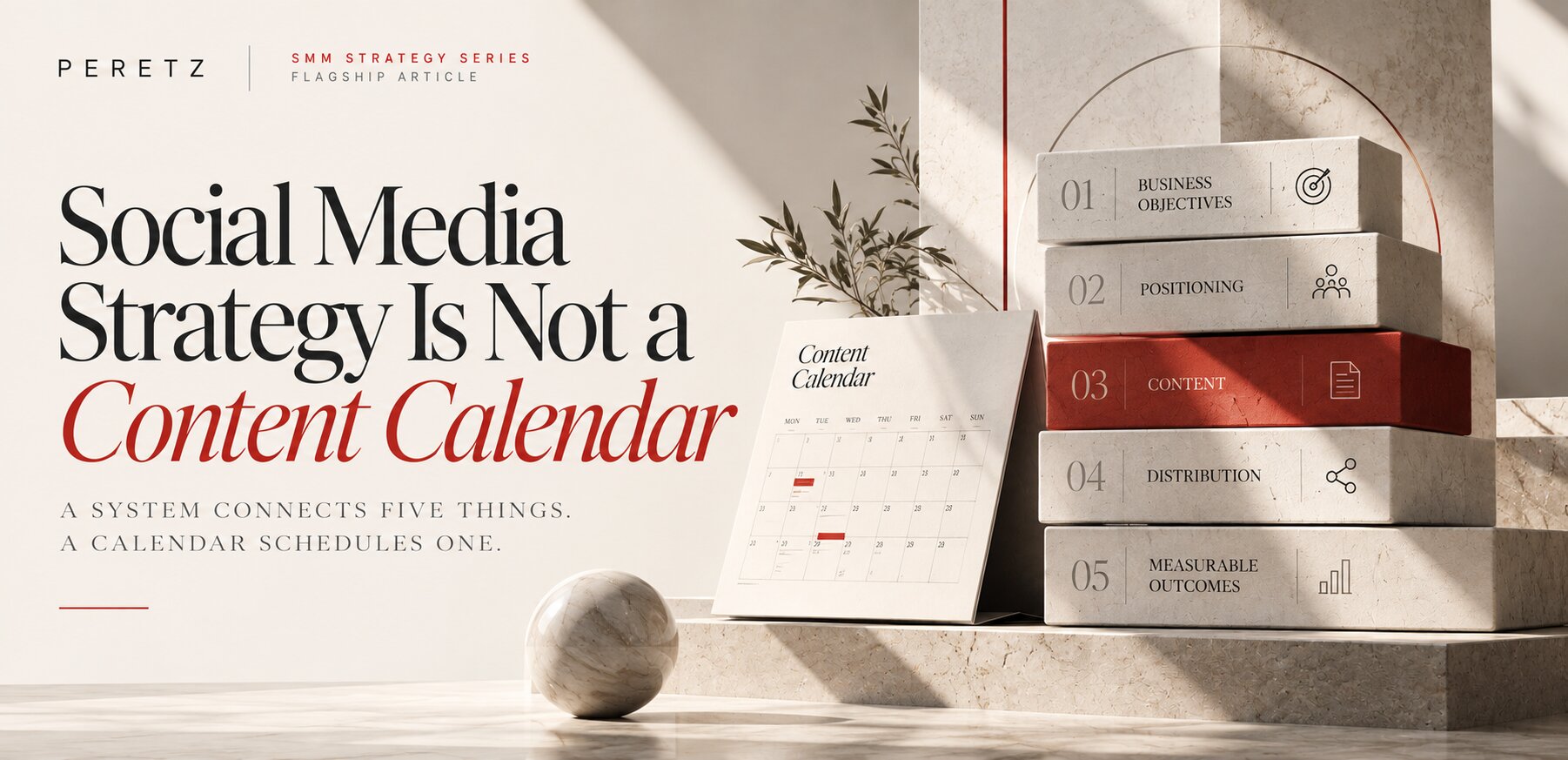
Social Media Strategy Is Not a Content Calendar

-
07. 09. 2026
What Is a Social Media Strategy and Why Does a Business Actually Need One?
-
08. 09. 2026

Why Your Social Media Content Isn't Working (7 Real Reasons, Not Algorithm Excuses)
-
12. 10. 2026

The Same Car in Another Colour Is Another Car