Pitch Deck for Investors: What It Is, What Goes on Each Slide and What Keeps Them Reading




An investor gives your deck a few minutes before deciding whether you get an hour. Here is what a pitch deck is, what each slide has to make that person believe, what stands behind it when they check, and why we make it last.
IN SHORT
The short answer
A pitch deck for investors is a short set of slides, usually between 10 and 20, whose one job is to earn a meeting: it tells a single reader what the company does, why it can become large, what has been proven so far, how much money is needed and what that money will buy. The rest of the round happens after it, in conversations and checks the deck can open but cannot finish.
So let us say the uncomfortable part first. The deck is rarely why a round closes or fails. Rounds turn on the company, the people, the market and the timing. Sequoia says as much about the Airbnb deck it made famous: "it wasn't really the slides we liked", it was the ideas and the clarity of thinking. A good deck gets a strong company read properly, and a weak one can get it skipped. Nothing here will make a deck raise money, and we would distrust anyone who promises that.
What keeps an investor reading is simple to state. They understand the first slide at once, each slide answers the question the previous one raised, and the numbers carry definitions, so nothing has to be decoded. Selling a company is a different exercise with a different reader, covered in How to Present Your Company to a Buyer. Our own view comes from real work, set out a little further down: we packaged our own company as an experiment and watched an outside price, and we are working on the pitch deck for MEDPRESSO as it expands. Other examples below are brand, product or technical work, and we say which.
WHAT IT IS
What a pitch deck is, and its two versions
A pitch deck is an argument for one reader with one decision to make: is this worth an hour of my time? DocSend, which tracks how decks are opened, says in its 2021 pre-seed guide that the deck exists to get the meeting and leaves the investment to later. Carta's Series A guide says the same about later rounds.
It is also a small part of a larger set of documents, and founders often ask it to do the work of all of them.
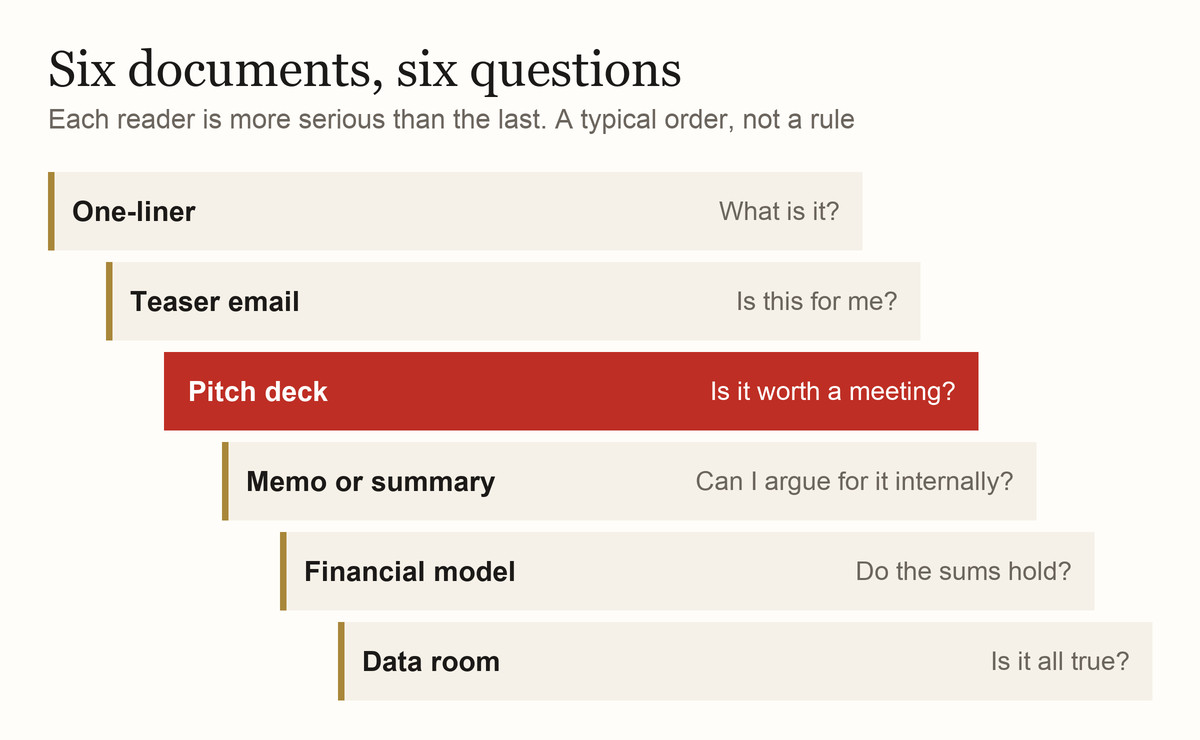
| Document | Its job | Size | When it is used |
|---|---|---|---|
| One-liner | Let someone repeat what you do | One sentence | Everywhere, and first in the deck |
| Teaser email | Get the deck opened by the right person | A few lines | With an introduction or cold |
| Pitch deck | Earn the first meeting | Ten topics at Sequoia; 16 to 20 slides in DocSend's samples | Sent ahead, then presented |
| Executive summary or memo | Let a partner carry your case to colleagues | One or two pages in the YC guide; longer if asked | With the deck or just after it |
| Financial model | Show the sums behind the plan | A spreadsheet with open assumptions | Once interest is real; thin at seed |
| Data room | Hold the evidence itself | As much as the round needs | Series A and later; little at seed |
Geoff Ralston's guide to seed fundraising on Y Combinator's site warns against overbuilding this set at seed, and advises caution with a seed investor who demands a great deal of diligence. By Series A the balance changes, and the capital raise comes with real checks. None of these sizes is a standard.
The deck you send and the deck you present. Most of the confusion about length comes from mixing up two documents. Kevin Hale's post on the YC blog (November 2015) was written for Demo Day: about two and a half minutes on stage, more than 500 people, over 100 companies in one event. There, he suggests about five to seven slides. Aaron Harris's seed deck template, from the Winter 2018 batch, is for the slightly longer deck used in follow-up conversations. And Ralston asks for a coherent leave-behind that a partner can show to colleagues when you are not there.
That second reader is the more common one, since DocSend wrote in 2019 that most investors want to see a deck before agreeing to meet. So you need two files built from one set of facts.
- The one you send has to make sense with nobody explaining it. Headings state conclusions as sentences, and definitions sit in small type under each number.
- The one you present has fewer words and more pictures, because you are there to say the rest.
- Both show the same numbers. A figure that differs between the versions, or between the deck and the model, costs more than the figure itself.
For the sent version, DocSend's samples give a rough range: an average of 19 pages in its 2019 seed analysis, and 16 slides in successful pre-seed decks against 19 in unsuccessful ones in its 2023 report on more than 200 startups. DocSend also noted in 2019 that venture investors almost never sign NDAs for decks.
HOW IT IS READ
How investors actually read a deck
The most useful public data comes from DocSend, with two warnings. It sells deck tracking, so its samples are its own users. And the most recent report we could find and open is from December 2024, so read every figure with its date.
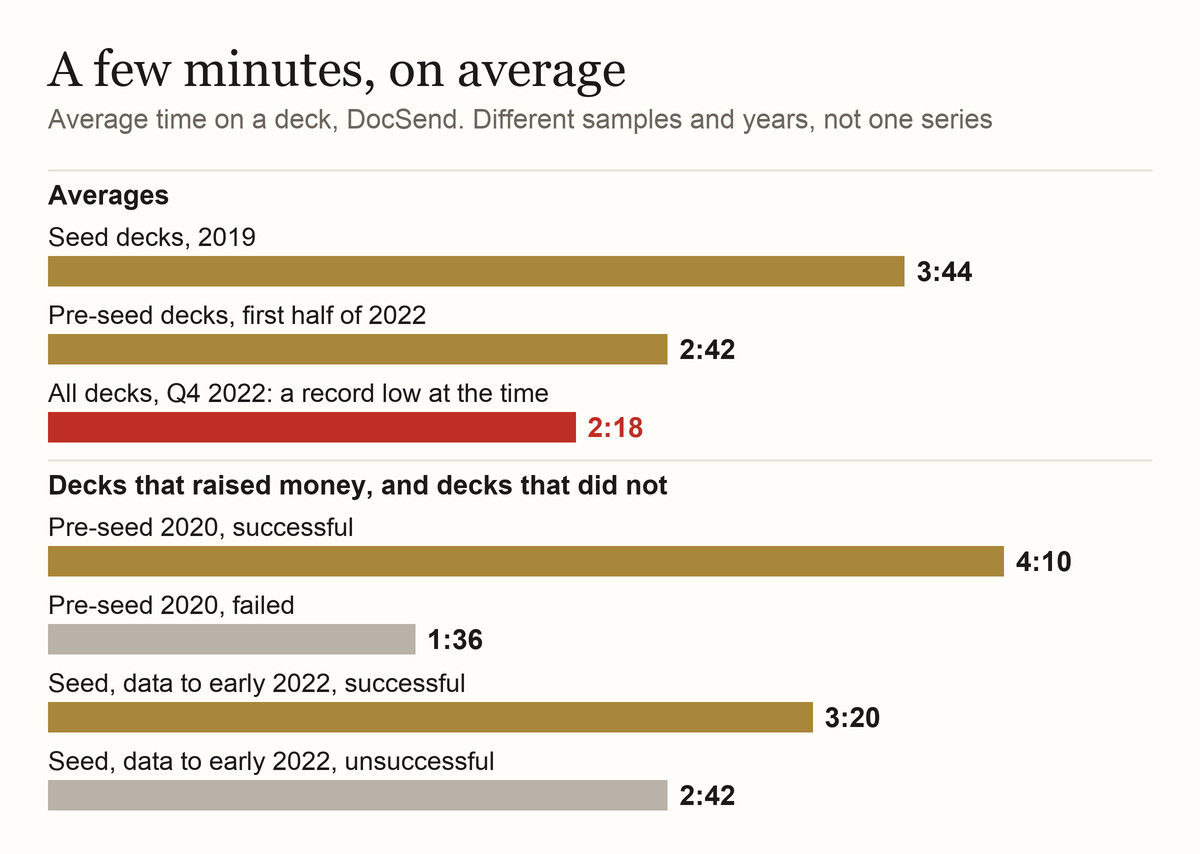
The first lesson is scale. The averages stay under four minutes, and the 2:18 of late 2022 was an all-time low at the time. In its data on 2020, many decks got views of 20 or 30 seconds, meaning the reader left after a slide or two. That makes the first two slides far more important than their share of the file.
The second lesson is harder: time on a deck is no score. In 2019 DocSend found that decks that went on to succeed got about two minutes, less than average, because a clear story reads fast. Later it reported the opposite: 4:10 against 1:36 for pre-seed decks in 2020, and 3:20 against 2:42 for seed decks in data to early 2022. A long view can mean interest or confusion. In the 2019 data, the Team slide got under ten seconds in successful decks and over a minute in unsuccessful ones, because the reader was trying to work out why these people were doing this. If you track your deck, use the numbers to form a question, then get the answer from a person.
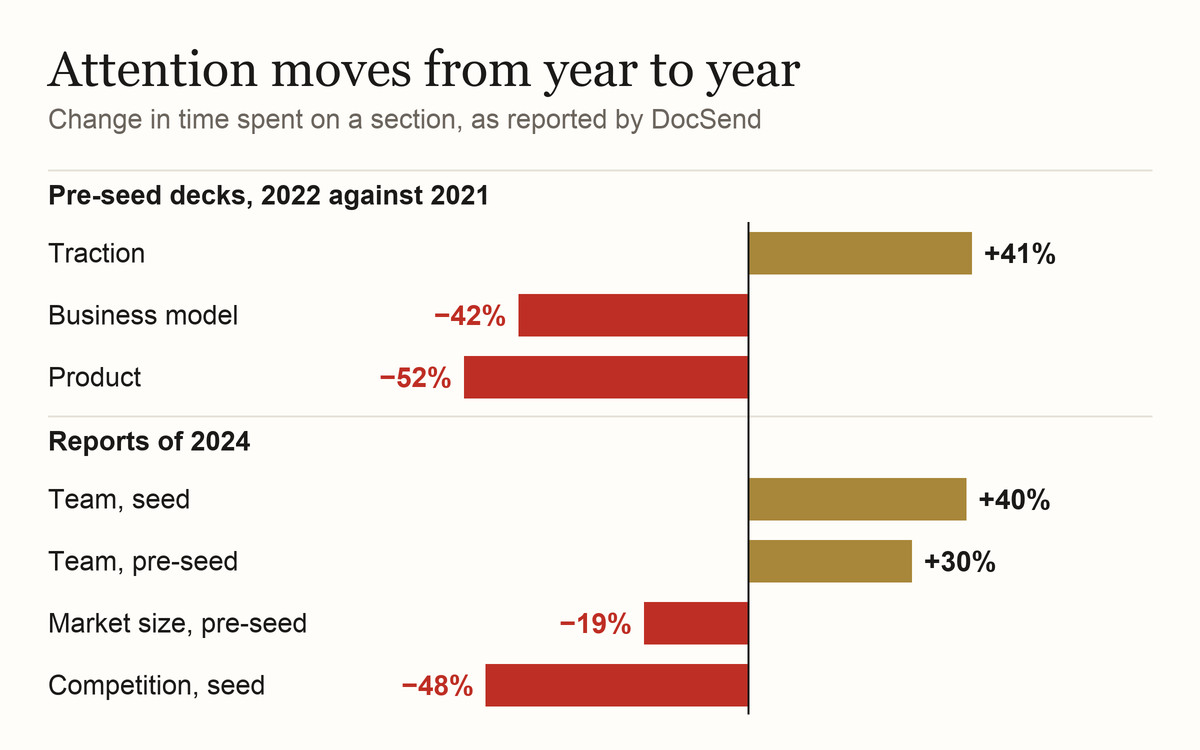
The third lesson is that attention moves with the market. In the 2022 pre-seed report the company purpose climbed from thirteenth to third most scrutinized section, though it is often a sentence or two. In 2024, DocSend's release has investors moving toward people and proof and away from market context. A deck built around last year's favourite slide is a poor bet.
The deck earns a meeting. The company earns the money.
OUR CHAIR
From the founder's chair: where our view comes from
We have come at this from more than one side, and we start with our own company.
Peretz, packaged. Peretz has been receiving offers constantly. As an experiment we packaged our own business: the upgrade to Laravel 13 and PHP 8.4 (live since October 1, 2026), the design put in order, the service lines and team competencies, all the necessary documentation and the pitch. Through intermediaries who wanted to resell us to their clients, we watched how the price changed. Over three months it rose 18%. Not a huge rise, but to be fair the business was already quite well prepared. It was an experiment, and the final deal could have wiped out the result; had we not been ready, it would have wiped out even more.
The most important item was the least visible: documents with all our developers confirming that the code is ours. This is the legal side, and the term to know is IP assignment. No slide shows it, a buyer's lawyer asks for it, and it stands behind whatever a deck says about technology and ownership. Many companies own less than they think, and it is among the things a technical review turns up. A lawyer drafts such papers; our point is only how much weight they carry.
Read the number for what it is: a price seen through intermediaries, for one company, in an experiment and not a sale, and nothing here offers the company to anyone. It proves nothing general, it is no measure of what packaging or a deck yields, and we would not promise it to you. It came with the whole package, of which the pitch was one part. And those were conversations about selling, with a different reader from an investor. What carries over is the material and the discipline, with the pitch at the end of the list.
A founder's deck: MEDPRESSO. MEDPRESSO, an international continuing medical education platform, is expanding and needs investment, which is why we are working on this with them, the pitch deck included. The deck is the company's to show, so here we describe what stands behind it. The case study records the company behind it: a partnership that began in 2017 with a website for a diagnostic center and grew through five major projects, strategy sessions where developers and architects heard the founders before anyone touched a pixel, and today a platform in four languages with about ten thousand pages of content, where doctors learn. That is the kind of material a deck can stand on, and it takes years to exist. Three habits from this kind of work are worth taking for any deck: when a platform has two sides, state the pain of both before the solution; tie each line of the ask to what gets done with it; and where a regulator decides who may operate, give its requirements their own place instead of a footnote.
Our other company: DeZZign. DeZZign, our architecture and interior design company and one of our own products, periodically receives offers to buy it. So we did to it what we describe here: we put its code, all its documentation and the company's assets in order, replaced all its SaaS with custom systems, and tested the pitch and everything around it on ourselves. We have sat on the founder's side of this conversation with our own company.
A stake in the outcome: Schoeffel. With Schoeffel, a pearl house founded in 1921, we work as a business partner across commerce, technology, marketing and processes. When you build a business the grown-up way, you calculate the scenarios of how it may develop, and this one is built in too: we build its processes with the aim that the company is worth not tens of millions but hundreds of millions, so that when the owner needs to exit, everything is ready, and we hold a percentage of the company ourselves. That is an aim, not a value today. It explains how we look at a business, as someone with a stake would: a deck is honest only when the company behind it has been built to stand up.
SLIDE BY SLIDE
The slides, and what each must make an investor believe
We offer no structure of our own here, because the public ones are good. Sequoia's guide (March 2019) lists ten topics. YC's template by Harris adds traction and the ask, and Ralston's guide offers a similar list. All say the order is yours to change, and DocSend advises leading with your real strength. Merging them gives twelve topics, and a topic may take more than one slide.
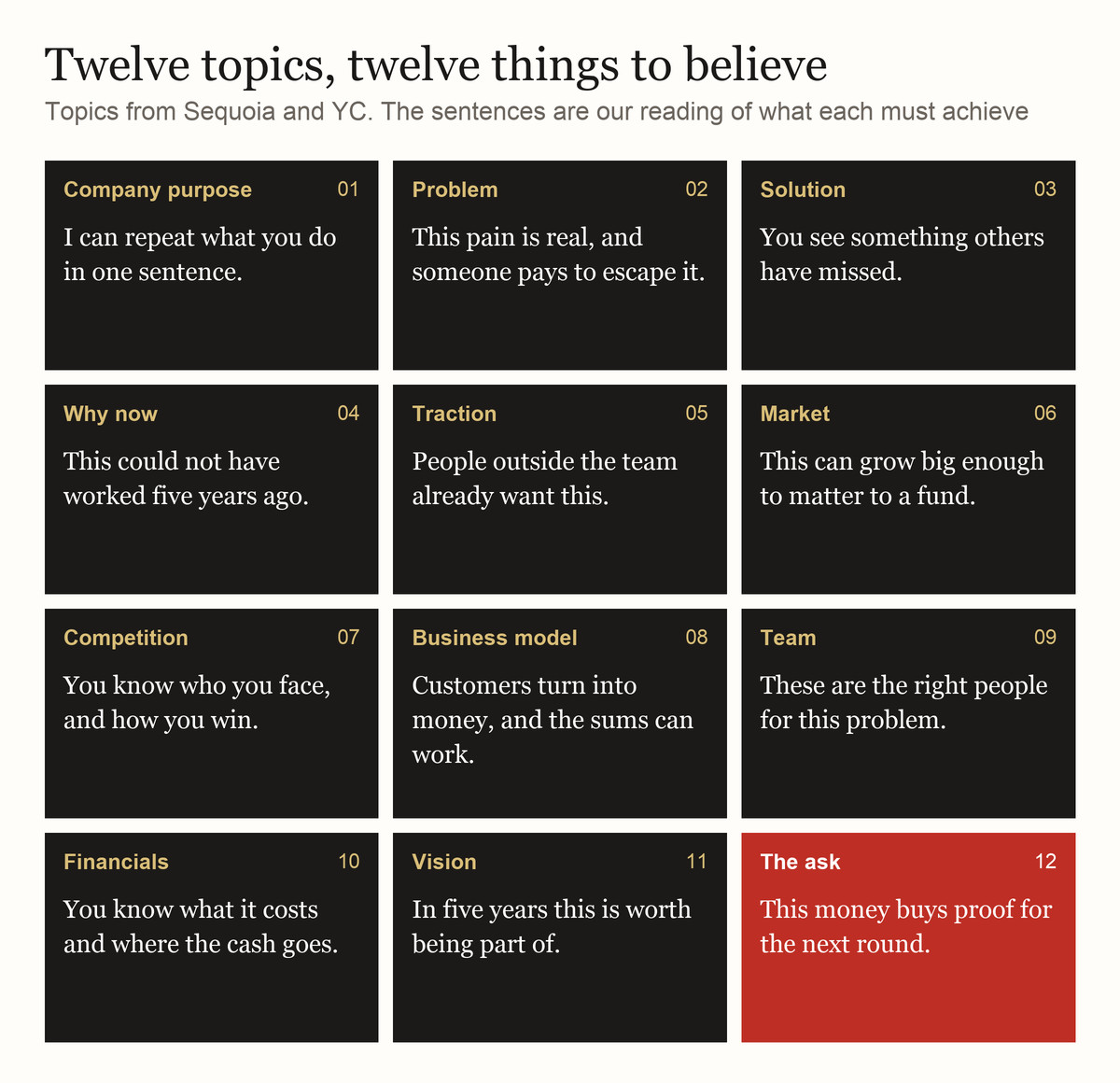
| Topic | Where it comes from | What goes on it |
|---|---|---|
| 1. Company purpose | Sequoia; YC title slide | One declarative sentence: what you do and for whom |
| 2. Problem | Sequoia, YC | Whose pain, how they cope today, why that falls short |
| 3. Solution | Sequoia, YC | What you do, in few words; the concrete benefit; your insight |
| 4. Why now | Sequoia | What changed (a technology, a rule, a price, a habit), and why nobody built this before |
| 5. Traction | YC | Your clearest measure of progress, shown honestly |
| 6. Market | Sequoia, YC | Who buys, how many there are, what they pay, how it can grow |
| 7. Competition | Sequoia; landscape in the YC guide | Direct and indirect alternatives, and your plan to win |
| 8. Business model | Sequoia, YC | How users become revenue: actuals first, then plans |
| 9. Team | Sequoia, YC | The founders, and why they suit this problem |
| 10. Financials | Sequoia, where you have them | Revenue, costs, cash burn, the main assumptions |
| 11. Vision | Sequoia | What you will have built in five years if all goes well |
| 12. The ask | YC | How much, what it buys, where it takes you |
Traction, market and the ask get their own chapters below. A few notes on the rest.
Company purpose. Sequoia warns against listing features instead of stating a mission. A good test is whether someone can repeat the sentence after one reading, because that person will be repeating it to a colleague.
Problem and solution. DocSend calls the problem the crux of the deck, and Harris wants particulars of how it hurts real people or businesses. Then say what you do in few words, and name the benefit concretely.
Competition. Saying you have none tells the reader you have not looked, because the alternative is often a spreadsheet, a phone call or doing nothing. Name those too.
Team. In DocSend's 2019 seed sample it was the only slide every successful deck had, and in 2024 readers gave it 40% more time at seed and 30% more at pre-seed than a year before. Harris's advice stands: write about the founders and why they fit this problem, and leave the advisors out. An investor buys a future with the founder in it, a reversal of the sale case in Founder Dependency. Even so, by Series A someone will ask who else can ship this.
Financials and vision. A seed investor reads your numbers for how you think: which costs you know, which assumptions you noticed. The vision slide is the one place where ambition has room, provided the earlier slides have earned it.
TRACTION
Traction, with its definitions
Traction is evidence that people outside the team want this, and the honest version comes in many sizes. DocSend's 2021 guide counts customer quotes and letters of intent at pre-seed, and Harris adds that your curve will probably not be as smooth as the template's. The trouble lies in the words. Almost every traction number can be defended in one definition and fall apart in another.
| On the slide | What it can hide | What to write instead |
|---|---|---|
| Users | Registered accounts, most of them gone | People active in a stated period, with "active" defined |
| Customers | Everyone who ever paid, or free pilots | Paying now; pilots counted separately |
| Revenue | Bookings, one-off projects, money passed through | Recognized revenue by month, recurring split out |
| ARR | One good month times twelve, services included | Contracted recurring revenue, with its date |
| Growth | A cumulative chart, or the best month chosen | Values per period on one axis, bad months included |
| Pipeline | Friendly conversations | Signed or not, stage, amount |
| Retention | The best cohort | All cohorts, by customers and by revenue |
A number without a definition is a question you have not answered yet.
We hold our own case pages to something like this table, although they report client work and no investor traction. On the Trichology Institute identity, inquiries from the website rose 5% in the first month and 34% over the following year, with comparable advertising budgets, and the page says that not all of it belongs to the identity. On SHTAYER the average Google position moved from 40.8 to about 12, measured before any dedicated SEO campaign, and the page says so. The Mercedes-Benz dealership case marks its 4 to 8 cars a month as the dealer's estimate. Period, base, source and the limits of the claim are what a reader needs from a traction slide as well.
The extreme end of this subject is on public record. The US Attorney's Office in San Francisco described in April 2025 the founder of YouPlus, who pleaded guilty to securities fraud and got 30 months. By the agreed facts, he showed investors a spreadsheet of 90 customers paying $600,000 a month, while the company had earned less than $200,000 in its history. When Series A investors asked for a data room with bank statements and contracts, he altered statements and forged contracts, obtaining about $6.4 million with these false claims.
That is fraud, and an honest founder rounding up is a different thing. The chain is what matters to you: a number on a slide leads to a spreadsheet, which leads to a request for bank statements. So calculate each figure from the source system now, and write its definition down. For why investors separate recurring from one-off revenue so strictly, see Why Tech Companies Get Valued on Different Math.
MARKET
Market size without the fantasy
This slide exists for a reason. Venture funds depend on a few very large outcomes, and the YC guide asks plainly for a total market above $1 billion if possible, with the most persuasive evidence you have. The fantasy begins when the evidence is a line from an analyst report: "the market is $50 billion, and we only need 1%." Nothing in that sentence says who buys, why they would pick you, or how you would reach them.
Build it from the bottom, starting from people you could name. How many customers fit your product today? What do they pay now for the problem? Which group comes next, and what has to be true before you can reach it? As an illustration only: 4,000 independent clinics at $6,000 a year is a $24 million market you can defend line by line, and a neighbouring segment can appear as a separate, labelled step. Then use the top-down figure as a cross-check, with its source and year.
Segments matter more than the total. We saw this building for SHTAYER: a private customer, an interior designer and a hotel look at the same textile differently and buy on different prices and terms, so the store had to start from that. A market slide that counted them as one "buyer" would describe nobody.
A small market today need not be fatal, and Sequoia notes that some of the best companies invent their own. The known argument is Bill Gurley's 2014 reply to an academic valuation of Uber built on a $100 billion taxi market: better service makes the market grow. That works only when you can name the mechanism: which behaviour changes, for whom, and what you have already seen.
DESIGN
Design is a matter of reading speed
If a reader has a few minutes, design decides how much of your thinking they receive. Hale's rules are the best short statement: slides should be legible, simple and obvious. His talk is about the stage. The sent version can carry more words, as long as the heading states the conclusion: "Revenue" is a label, and "Monthly revenue doubled in six months with no paid acquisition" is a claim someone can check (an invented example).
Product slides are where most decks lose time. DocSend found in 2019 that most companies spent five pages on the product, probably too many, and Hale dislikes screenshots for the same reason. Show the two or three moments that solve the problem from your problem slide.
Reading speed also depends on whether the page looks like the company. YC's template is deliberately plain, and it should be read as a list of questions. A real deck follows the logic of the business, and readers can tell when a company has been poured into someone else's mould. This is the part of the craft we know best, here from identity and product work rather than decks. For The TSEKH we built the brand from nothing, identity and brand book included, around what its reader checks: an architect wants to see finished interiors, so projects lead the site and products follow. MEDPRESSO had to make complex medical information clear on desktop and on phones. A deck inherits this work if it exists, which is one more reason to settle the identity before the slides. Good design will not rescue a weak number, and it should not try. Its job is to make a strong one impossible to miss.
THE ASK
The ask, and what the money buys
The last slide says how much you are raising and what you will have when it is spent. Harris asks you to lay out where you will be in a year, ideally ready for the next round. Ralston adds the rule that matters most: the amount has to be tied to a believable plan, and it is often wise to prepare several plans for different amounts.
So work backwards from the next round. Carta's Series A guide (October 2026) says the next investor looks for product-market fit, growing and fairly predictable revenue, unit economics your margins support, and a clear plan for the capital. Its deck guide adds that where investors once backed companies with under $1 million in annual recurring revenue, many may now expect closer to $5 million or even $10 million. Those are the things your money should buy.
- The number. The amount and the months it lasts. Ralston speaks of 12 to 18 months to the next fundable milestone; Carta's seed guide says most founders aim for 18 to 24.
- Use of funds. Three or four lines, each tied to a result. As an illustration: 55% on the product team to ship a named feature, 30% on sales to reach a stated number of paying customers, 15% on infrastructure and buffer.
- The milestones. What will be true when the money runs out, in the same defined terms as your traction slide. A stated figure by a stated month can be argued with, which makes it worth reading.
Leave the valuation off the slide. Ralston advises letting the market set the price, and Peter Walker, formerly of Carta, points out that valuation usually follows from the cash raised and the dilution accepted, so the useful question is how much cash you really need.
BY STAGE
How the deck changes from pre-seed to Series A
The list of topics barely changes between rounds, and Harris says the seed template is not all that different from best practice for a Series A. What changes is the weight of evidence, and who is reading.
| Pre-seed | Seed | Series A | |
|---|---|---|---|
| What the investor bets on | The founders and the idea | The founders and early proof | Evidence and execution |
| The product | Prototype or first version | A product you can demo | Working and adopted |
| The deck leads with | Problem and team | Story and traction | Metrics |
| Usual instrument | SAFE: 93% of US pre-seed rounds on Carta | SAFE, note or priced round | Priced round, preferred stock |
| Money, Q2 2026 | Average instrument $276,000 | Median $4.5M at $23.9M post-money | Median $14.7M at $76.3M post-money |
| Median dilution | Varies with the cap | 19.4% | 18.7% |
| What follows the deck | A conversation | Summary, light questions | Model, data room, technical and financial checks |
The money rows come from Carta's State of Pre-Seed for Q2 2026 (more than 11,500 US instruments) and its Q2 2026 benchmarks, as printed in the guides linked above, without a stated sample. The other rows adapt Carta's comparison, plus our reading of what usually follows.
Read these as reference points, since they describe US companies on one platform and AI pulls them up. In Q1 2026 more than 60% of venture dollars on Carta went to AI companies, and a foundational model startup at Series A might raise at a $300 million median valuation against $55 million for a non-AI startup. If you are outside the favoured category, benchmark against companies like yours. A large product can also move through these stages in parts: we launched MEDPRESSO in stages, testing each one with its audience.
TECHNICAL CHECK
What the technical check will ask
Serious interest brings someone who reads the product. At seed this may be one conversation with a technical partner. At Series A it can be a formal review, of the kind our investors page describes: access to systems, code and accounts, then a written report on what is owned, what is at risk and what it will cost. We covered the mechanics from the buyer's side in What a Buyer's Technical Due Diligence Will Find.
"AI-powered" gets opened first. Using an outside model is no problem in itself, and using AI tools to build is no sin: our own CRM took two developers about a month with Claude in the process, and the page adds that the code was the fast part, since the decisions rested on five years of knowing what we needed. The question is where the capability really lives: in a call to someone else's model behind a prompt, or in your own data, retrieval, orchestration and evaluation around it. We described the levels in The AI Wrapper Problem and in What Building the Systems Teaches You.
A public case shows how far this can go. In April 2025 the US Attorney's Office in New York announced an indictment of the former CEO of the shopping app nate, alleging that pitch materials claimed it could transact online without human intervention, while the real automation rate was effectively zero and hundreds of contractors in a call center completed the purchases. He raised more than $40 million, according to the indictment, and the SEC brought a parallel case. These are allegations, and we have found no reported outcome so far.
Be ready for these, at any honest scale:
- What the AI actually does. What share of the work runs without a person, which model, whose data, how you measure quality.
- What each customer costs. Model and infrastructure costs go straight into the gross margin on your business model slide.
- Who owns it. Are the code, the accounts, the domains and the contractors' work assigned to the company? In our own packaging this mattered most, and a Digital Ownership Audit finds out. The principle we proposed in the Schoeffel partnership is a good test: own what differentiates, rent what is commoditised.
- Who understands it. Can someone other than the founder explain, change and deploy the system? Has anyone reviewed what AI tools generated?
- What users never see. In the MEDPRESSO MVP we put early money into security, user architecture, database design and scalability, and a technical reader looks there first.
- What breaks at the next stage. Your milestones imply a load, a team and a set of integrations. What would it cost if the current system cannot carry them?
The answer to that last one is not always a rewrite. Trichocosmetics, a store we built for the Institute of Trichology, moved from PHP 5.6 to 8.4 and kept its original design, because the foundation was what needed the work. If you built the first version yourself with AI tools, see our decision guide; our MVP Review (from $3,000) is for the moment investors are about to look, and a fractional CTO (from $3,500 a month) can answer their questions over time. Owner self-checks like the list above are only a first look.
AFTER IT OPENS
After the deck is opened, and the usual mistakes
If the deck does its job, the work is just beginning. DocSend's 2019 seed data averaged 58 investors contacted and 40 meetings across 11 to 15 weeks, and its 2022 pre-seed sample 60 investors and 52 meetings over 15 weeks. In 2024 pre-seed rounds averaged 12 weeks. Its 2019 work suggested six months of runway when you start: three to raise and three for a plan B. Expect to rewrite the deck along the way, since the questions you keep hearing are the real feedback.
The usual path runs from the opened file to a first call, then partners, a term sheet and confirmatory checks. A no often says nothing about your deck, since investors have mandates, full portfolios and conflicting bets.
The mistakes that cost most are rarely about the slides themselves:
- Sending the deck before the product can back it up.
- Using one deck for investors and buyers, who read different things.
- A cumulative chart, a cropped axis, or a metric that changes its definition between slides.
- Claims the technical check will overturn, starting with AI, IP and "proprietary".
- Numbers that differ between the deck, the model and the memo.
There is also a legal side: statements to investors in a private round can carry real liability, as both cases above show, and the disclaimer on the last slide offers less shelter than founders tend to assume. Have your lawyer read the deck, and not only the round documents. This is general information rather than legal advice.
WHY LAST
Why the deck comes last
Our view is simple, and it is why we love this work: a pitch deck comes last, because making one means the product is ready. The crown goes on at the end. A deck sums up what exists, so it can only be as strong as the thing it describes.
The deck comes last because it can only say what is true.
Money does get raised earlier, and pre-seed exists for that. But Carta says companies are typically ready for a seed round when they have an actual product to demo, and we would hold any stage to the same test: can you show what the deck describes? You probably need the product first if you cannot demo slide 3 without narrating around what is missing, if your traction has no source system, if you could not say today who owns the code, or if your plan for the money is mainly to find out what to build. Then discovery and a real MVP come first. If the deeper question is whether to raise at all, diagnose the business first.
We have seen what early and late look like. For ANGLE we built the identity, website and marketing materials before the company launched, and the business never launched; the case page says so. LavShash got a finished site, market and native apps, then the client's plans changed, and five years on it would need substantial rework. Neither was a fundraising job, but both show that what is made ahead of a business depends on it.
None of this is quick or free. An independent read that an investor would take seriously needs people who have worked in technology M&A for years, sometimes licensed, and analysts who can understand someone else's code from top to bottom. Our reviews are led by Valeriya Chumachenko, who has more than ten years in technology M&A. The technical due diligence session ($1,500) and the full review (from $7,500) give an assessment and a direction. Assessment and repair are separate things: the repair has no starting price, because the product has to be seen first, and the team doing it is sometimes large. Here we have a real advantage, a large pool of vetted developers of European and Ukrainian origin at reasonable prices, whether you need a dedicated team or a few specialists inside yours; for Neon AI we have provided Python teams for more than six years.
Then comes the part we enjoy most. We build the deck last, as one piece with the product and the numbers behind it, around the logic of your business and in no one's template, with the people who checked the facts behind each slide. What we build for you stays yours. The deck has no price of its own: decks differ, and the deck itself is not the problem. The problem is the preparation, and its cost lies in accompanying the business through it. It will not guarantee a round, and nobody's will. It can make sure the person reading for three minutes sees your company as it really is.
FAQ
Frequently asked questions
What is a pitch deck in simple terms?
A short set of slides that explains what a company does, why it can grow large, what has been proven and how much money it needs, so an investor can decide whether to meet. A financial model shows the sums and a data room holds the documents.
How many slides should an investor pitch deck have?
There is no standard. Sequoia lists ten topics, YC's template about a dozen, and DocSend's samples show about 16 to 20 slides in sent decks. Hale suggests five to seven for a Demo Day stage. Cut anything that does not help the reader decide on a meeting.
How long do investors spend on a pitch deck?
A few minutes. DocSend has reported averages from 2:18 to 3:44 across different samples and years, the latest we could open dating from 2024, and its own data disagrees on whether more time is a good sign. Do not treat time as a score.
Can I use the same deck for investors and for buyers?
No. An investor buys a share of a future with the founder in it, and a buyer buys what stays when the owner leaves, so several slides change while the facts stay the same. Our article on presenting to a buyer covers the other version.
When is it too early for a pitch deck?
When you cannot show what the deck would describe. If the product cannot be demonstrated or the metrics have no source, that work comes first. Pre-seed rounds do get raised on less, but the deck then has to say plainly what does not exist yet.
Does Peretz make pitch decks?
Yes, and it is our favourite work, because getting to make one means the product is ready. We are preparing one for MEDPRESSO. A deck has no price of its own, since decks differ and the deck itself is not the problem. The problem is the preparation, and its cost lies in accompanying the business. We build it last, around the logic of your business, after the facts behind each slide have been checked, and we do not promise it will raise a round.
Sources
- Sequoia Capital: Writing a Business Plan, March 15, 2019
- Y Combinator: How to build your seed round pitch deck, Aaron Harris, 2018
- Y Combinator: How to design a better pitch deck, Kevin Hale, November 15, 2015
- DocSend: 2024 pre-seed and seed reports, release of December 18, 2024
- Carta: Series A funding guide with Q2 2026 benchmarks, October 7, 2026
Raising soon? Let's check whether your product can stand behind what the deck is about to say.
- Share
-

-

-

-

One notification a week with the new PERETZ articles. Nothing else.