How to Present Your Company to a Buyer So Its Story Survives Due Diligence


Everything you tell a buyer comes back later as a document request, and in the end as a line in the contract. Here is how to build the story, and the pitch deck that crowns it, so that nothing has to be taken back.
IN SHORT
The short answer
A company's story survives due diligence when it is written from the evidence, not ahead of it: every claim has a definition, a document and a person who can explain it, and the pitch deck is assembled last, once the facts are in place. The deck is the crown of the preparation. It is also the part most owners want to start with, which is the most expensive mistake in this whole subject.
A strong presentation raises a buyer's interest, and it also raises the buyer's expectations. Auditors then compare the two. Where the deck and the data room agree, confidence grows and the conversation moves to price. Where they disagree, the difference becomes a discount, a holdback or a longer list of questions, and the buyer starts reading everything else with more suspicion.
This article walks through the whole path: what a pitch deck is, how it differs from a teaser, an information memorandum and a management presentation, what goes on each slide and what must stand behind it, how to handle adjusted numbers and forecasts, and why we always make the deck at the very end. For the technical side of the same review, see what a buyer's technical due diligence will find.
THREE LIVES
One story, three lives
The same story lives three lives during a sale. First it is told: in a teaser, a deck, a memorandum, a meeting. Then it is checked: auditors, lawyers and analysts ask for the documents behind it. Finally it is signed: the facts that mattered turn into representations and warranties in the purchase agreement, with money and sometimes personal liability attached.
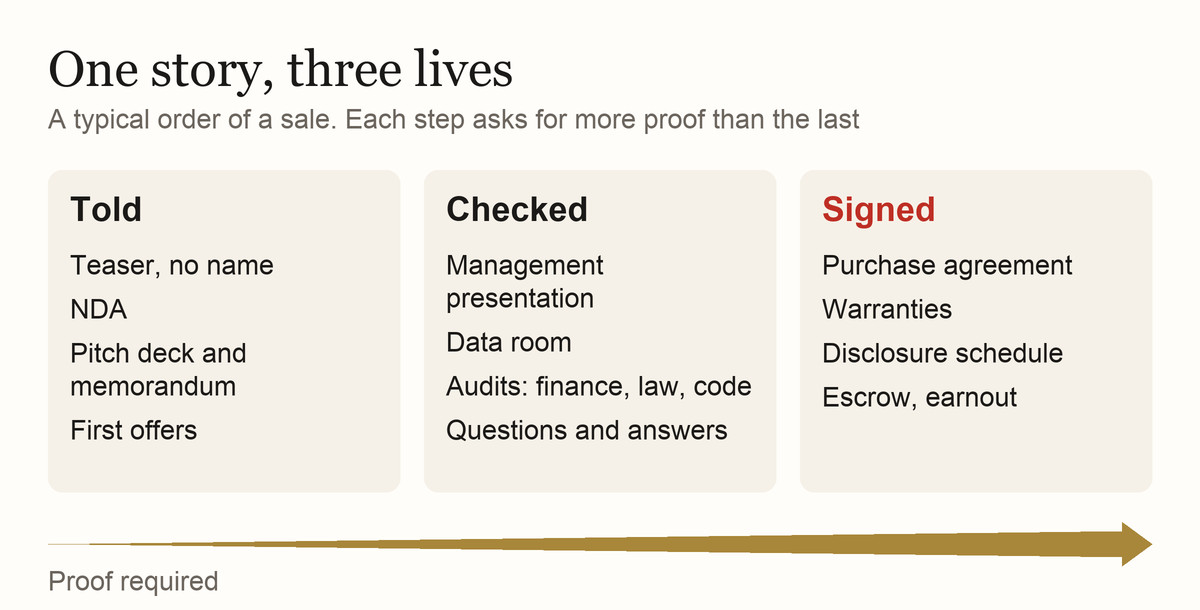
M&A advisory firm IMAP describes the usual order like this: a teaser goes to a broad list of buyers, interested parties sign an NDA and receive the memorandum, they submit indicative offers, and the selected ones move on to management presentations, the data room and confirmatory due diligence. Among the mistakes it lists are inconsistencies between the teaser, the memorandum and the data room.
That is the practical meaning of the title. A story survives when a sentence said in the first meeting can still be said, unchanged, in the contract twelve months of work later.
Every sentence in the deck comes back as a document request.
PITCH DECK
What a pitch deck actually is
A pitch deck is a short visual argument for why a company is worth a particular person's money: usually a dozen or so slides, built so that one reader can follow the logic alone and then decide whether to give you a meeting. Three things separate it from any other company document. It argues rather than describes. It chooses what matters rather than listing everything. And it is written for a specific reader who has a specific decision to make.
The word itself causes confusion, because people use it for different things. Founders mean the slides they send to venture investors. Owners selling a business mean the presentation of the company for buyers. Investment bankers have their own "pitch book", which is the deck a bank uses to win the mandate from the seller, so it presents the bank. And in a formal banker-run sale, the documents have other names altogether: teaser, memorandum, management presentation.
So where does a pitch deck fit in a sale? In a large auction it becomes the core of the management presentation. In a smaller deal or a direct conversation with one buyer, it often does the work of several documents at once, and it may be the only thing the buyer's board ever sees before the data room opens. That is why its quality matters more in a mid-size deal, where the owner has no one else to tell the story, not less.
| Document | Its job | Length | When and who |
|---|---|---|---|
| Teaser | Make the right buyers want to know more, without naming the company | 1 to 2 pages | First step, broad list, no NDA |
| Pitch deck | Argue why this company is worth it and why now | About 12 to 20 slides | After the NDA, to serious buyers; the main document in a direct deal |
| Information memorandum (CIM) | Give enough structured detail for an indicative offer | 30 to 80+ pages | After the NDA, qualified buyers |
| Management presentation | Let buyers meet the people and test them live | 20 to 40 slides plus questions | Buyers selected after first offers |
| Data room | Hold the evidence itself, not the argument | As much as the deal needs | Selected buyers, then final bidder |
The teaser and memorandum figures come from IMAP. The length of a management presentation is a common rule of thumb, and the deck length is our own view. Deals vary, and none of these is a standard.
The memorandum and the deck are the pair most often confused. The memorandum is a reference: a buyer's analyst reads it with a pen and takes numbers from it into a model. The deck is an argument: a partner or a board member reads it and decides whether the analyst's time is worth spending. Pasting memorandum pages into slides gives you a bad version of both.
BUYER OR INVESTOR
An investor deck will not sell a company
Most advice and templates you will find online are written for raising a venture round, and they answer a different question. Y Combinator's well-known guide to pitch decks was written for Demo Day, a room of investors hearing a hundred companies. Its design rules work everywhere. Its logic does not transfer by itself, because an investor and an acquirer are buying different things.
The investor buys your future. The buyer buys what stays after you leave.
| Slide or question | In an investor deck | In a deck for a buyer |
|---|---|---|
| What is for sale | A share in a future, with the founder in it | The business itself, often without the founder |
| The founder | The main asset: why this person will win | A possible risk: what happens when this person steps back |
| Market size | How big it can become | How much of it you hold now and can prove |
| Financials | Growth and the plan | Clean history, quality of revenue, then the plan |
| Technology | What it enables | Who owns it, what it costs to keep, what transfers |
| Why now | Why the market is ready | Why you are selling and why this buyer |
| The closing slide | How much you are raising | The process, the timeline and the next step |
The founder row is the one that catches people out. A slide celebrating a visionary founder who still closes every large account and approves every exception reads as confidence to a venture fund and as a discount to an acquirer, a subject we took apart in Founder Dependency: The Discount Nobody Puts in the Deck. The two audiences also read differently within the same category. DocSend's 2024 report on early-stage decks found that venture investors spent 40% more time on seed-stage Team slides than a year earlier, while the seed-stage Competition slide got 48% less attention. A strategic buyer who competes with you, or who has looked at your market for years, will spend that time very differently.
Do not build one universal deck and send it to everyone. The facts stay the same for every reader, and they have to. What changes is the order and the emphasis, because buyers differ in their reasons, not just their names. A strategic acquirer wants to see what your customers and technology add to what it already owns. A financial buyer starts from the stability of cash flow and who will run the business. The two decks can open with different slides and still contain the same numbers. If they contain different numbers, one of them is a problem.
SLIDE BY SLIDE
Twelve slides, and what stands behind each
Here is the structure we use as a starting point for a deck addressed to a buyer. It is a starting point because a real deck is built around the logic of the particular business: a software company and a retail chain with an online side will not open with the same slide, and a template that treats them alike is visible at once.
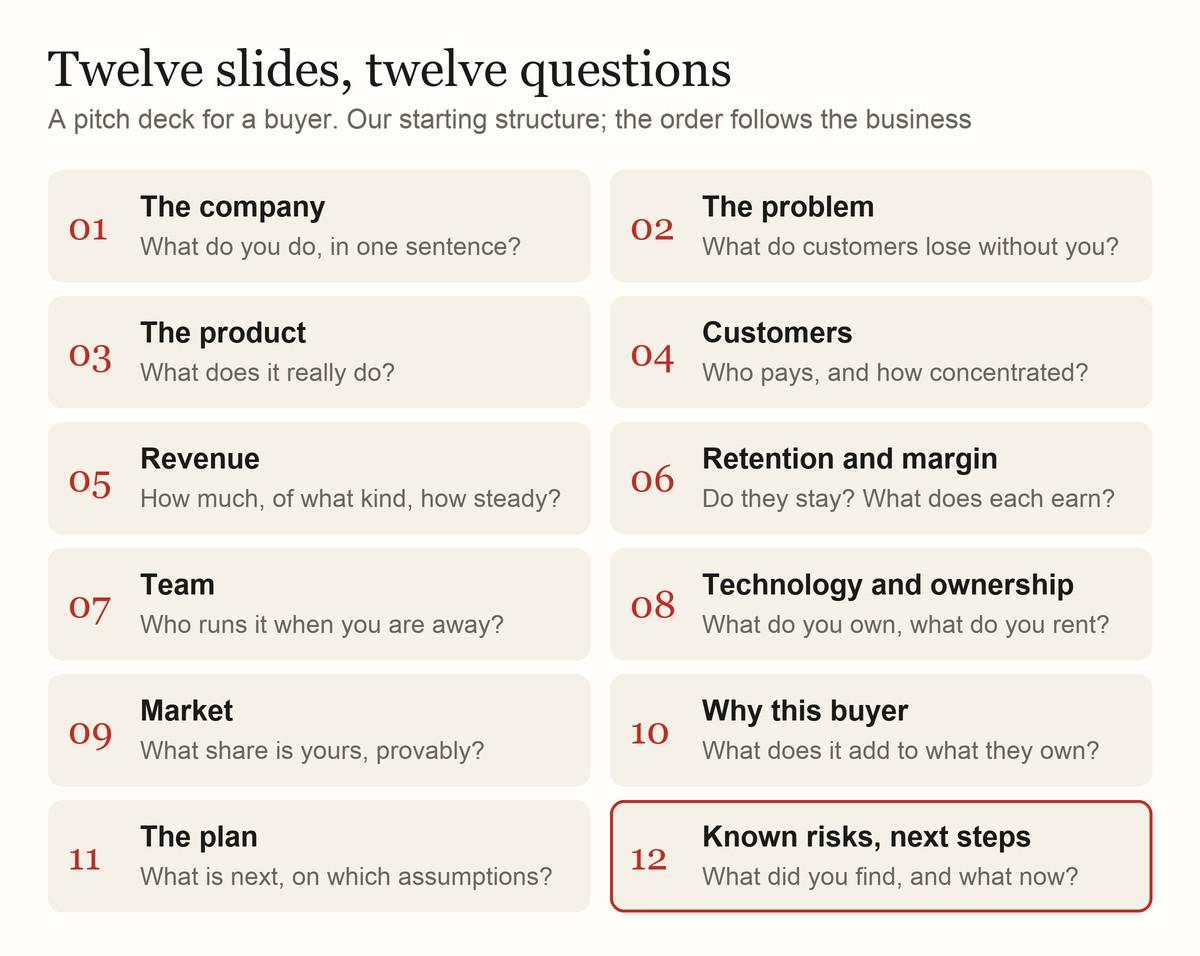
Each slide makes a claim, and each claim has an address in the data room. If you cannot name the folder, the slide is not ready.
| Slide | What it has to say | What the buyer opens to check it |
|---|---|---|
| 1. The company | What you do, for whom, and why it matters, in one sentence | Everything else in the deck |
| 2. The problem | What your customers lose without you, in their terms | Customer interviews, contracts, renewal reasons |
| 3. The product | What it does, shown on real screens or real work | A demo, the product itself, documentation |
| 4. Customers | Who pays, how many, how concentrated | Customer list, top 10 by revenue, contracts |
| 5. Revenue | Three to five years, split by type: recurring and one-off | Accounts, invoices, reconciliation to the bank |
| 6. Retention and margin | Whether customers stay, what each one earns you | Cohort tables, cost of sales, churn log |
| 7. Team | Who runs what, and who runs it when you are away | Org chart, contracts, retention terms |
| 8. Technology and ownership | What you own, what you rent, what it costs to keep | Assignments, repositories, accounts, audit results |
| 9. Market | The share you hold now and the realistic next step | Your own sales data, then outside sources |
| 10. Why this buyer | What this business adds to what the buyer already has | Your overlap analysis, stated as a hypothesis |
| 11. The plan | Next two or three years, with assumptions shown | The model, with assumptions in editable form |
| 12. Known risks and next steps | What you have already found, what was done, and the process | Issue log, remediation records, timeline |
A few of these slides deserve more than a table row.
Revenue (5). A cumulative chart always goes up, which is why it appears so often and why experienced readers skip it. Show revenue by period, and split it by type, because buyers value recurring and one-off revenue on different math. Label what you call recurring. A contract that renews each year because one person calls the client each year is a different thing from a subscription, and the buyer will find out which you have.
Customers (4). Almost every deck wants to show logos. Check first whether your contracts allow it, and whether the customer knows you are in talks. Before the final stage, it is normal to show customers as Customer A, B and C with their share of revenue. That number, the concentration, is the fact a buyer needs in any case. Advisers give different thresholds for when it starts to hurt, and we have found no independent study to quote, so we do not offer a formula. Show it before they calculate it.
Technology and ownership (8). "Proprietary AI platform" is a sentence that a technical reviewer will open within the first hour. Say what the system really is, including the parts that are other people's, as we explained in The AI Wrapper Problem. Say who holds the code and accounts; many companies own less of their website than they think. This slide can be plain, but it has to be accurate, and a buyer's lawyers will read it next to the warranties.
Why this buyer (10). A guess about someone else's strategy can sound presumptuous, so write it as a hypothesis with your reasoning. The value of this slide is that it gives a person inside the buyer's company the first draft of the internal argument they will have to make for the purchase.
Known risks (12). Owners resist this slide more than any other. We defend it because it does more for credibility than the rest of the deck combined: it shows you know your own business and leaves the buyer's team less to "discover". A later chapter explains why this also matters legally.
ONE IDEA
How a slide should read
A deck is usually read before it is ever presented, and quickly. DocSend, which tracks how decks are opened, reported that the time investors spend reviewing a deck kept falling, reaching a record low in 2023. That data covers venture investors, not acquirers, and a buyer who is seriously interested will return to the deck many times. But the first pass, the one that decides whether anyone returns, is short for almost everyone.
Kevin Hale's rule from the Y Combinator guide holds well here: slides should be legible, simple and obvious. He also advises picking the five to seven ideas you want people to remember, since they will keep few of them. For a buyer's deck, we would add some rules of our own.
- One idea per slide, and the heading states it as a sentence. "Revenue" is a label. "Recurring revenue has grown for four years and is now 70% of the total" is a claim someone can check. (The figure is an example.)
- Every number carries its definition, its period and its source in small type on the slide. A number without them will be asked about, and the answer will sound like an excuse.
- Charts start the axis at zero and show the bad year too. Readers trained in this notice a cropped axis at once, and it then costs you more than the bad year would have.
- Two versions, not one. The version you send must make sense without you, so it carries more text. The version you present has less, because you are there to say the rest.
- The same figure appears the same way everywhere. Keep one table of all the numbers used in the teaser, the deck, the memorandum and the model, and change them there first.
- Send a protected file with tracked views, never an editable one, and put the recipient's name on each copy.
Design here is a question of respect for the reader and for the business. Every company's logic is different, and a deck that follows that logic shows that someone has thought it through. A rented template with a stock picture of a handshake tells a buyer something too. Good design will not rescue a weak number, and it should not try. Its job is to make a strong number impossible to miss.
CLAIM REGISTER
Write the claims before the slides
The most useful document in this whole process never goes to the buyer. We call it the claim register: a plain table listing every statement you intend to make, with its evidence and its status. Start it long before there is any deck.
| What you want to say | What the buyer will ask | What has to exist |
|---|---|---|
| "Our revenue is mostly recurring" | Which contracts, what terms, how many renew | Contracts by customer, renewal history, revenue split in accounts |
| "Customers love us" | What are retention by cohort and churn reasons | Cohort table, cancellation log, references you can offer |
| "We own our technology" | Who wrote it, under what agreement | Signed assignments, repository and account control, license scan |
| "It runs without me" | When were you last away, what happened | Delegation in writing, a real absence, a named deputy |
| "Margins will improve" | Which costs, by when, and did that happen before | A cost plan with dates and an earlier example |
| "We have a big opportunity with X" | Is there a signed agreement or just a conversation | Correspondence, a pipeline with stages, a realistic probability |
Then mark each row. Green means the evidence exists and is in order. Yellow means it exists but is scattered or incomplete, so it needs work. Red means the sentence is, for now, a hope. Red rows have only two honest exits: do the work until the evidence exists, or remove the sentence.
There is a simple test an owner can run for a first look. Give your current materials to someone who knows finance and has never seen your company, and ask them to underline each thing they would want to see proof of. Then try to produce it within a day. This shows where to look, and that is all it shows. It does not replace a real review, for the reasons in the last chapter.
DEFINE IT
The number needs a definition
The most famous recent case of a story failing is an extreme one, and it is worth reading closely for what it says about definitions. According to the US Attorney's Office in New York, the founder of the student aid startup Frank told two banks that it had 4.25 million users, and explicitly defined a user as a person with an account and at least four categories of data. In fact there were about 300,000. When JPMorgan asked to verify the number, the founder asked the director of engineering for an artificial data set. The director declined, and the founder hired an outside data scientist to create one. JPMorgan paid $175 million in 2021. A jury convicted the founder in March 2025, and the sentence that September was 85 months. AP reported at the time that the verdict was being appealed, and that the judge also criticized the bank's due diligence.
That is fraud, and it has nothing in common with an honest owner rounding a number up. The ordinary version of the problem is far more common and looks innocent. "Customers" in the deck includes everyone who ever paid, while the buyer expects those active in the last 12 months. "Recurring revenue" includes annual maintenance on one-time projects. "Users" means registered accounts, while the product team counts weekly logins. Each one can be defended. Each one, discovered in month three of a deal, looks like the seller was hoping nobody would check.
The remedy is boring and it works: write the definition down, on the slide, in the same words the data room will use, and calculate the number from the source system rather than from last year's presentation. A precise definition also protects you. Once you state exactly what you counted, a smaller figure that is true becomes an asset you can stand behind.
ADJUSTED NUMBERS
The adjusted number is the first to be cut
Nearly every sale presents an adjusted profit figure: reported EBITDA plus the costs the seller says will not recur. Some of these adjustments are entirely fair. Others are hopes. Buyers know the difference, and they have data on it.
S&P Global Ratings has been measuring this for years on large US leveraged deals. In its seventh annual study, in April 2025, add-backs made up 28% of management-adjusted EBITDA at the start of a deal, as a median across the life of the study, and the agency concluded that projections in marketing materials have proven aggressive. After the first year, actual leverage was a median of 2.3 turns of EBITDA higher than projected. These are big, rated companies raising debt, not your company selling to a strategic buyer, but the mechanism is the same, and the people across the table have read these numbers.
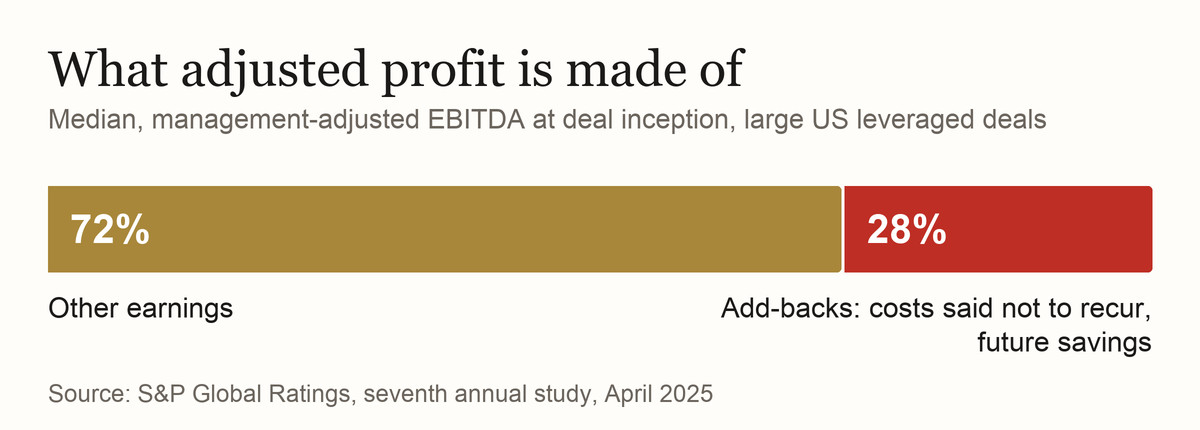
So show the bridge on a slide or an appendix: from reported profit to adjusted profit, line by line, each with its amount and its document. The owner's salary brought to market level, with the benchmark. A one-time legal bill, with the invoice. Expected savings from a planned move are the weak kind, so either keep them out or show them separately. A sell-side quality of earnings report, done by an independent accounting firm before the buyer's team arrives, puts someone else's name behind this bridge. For a sizable deal it is usually worth considering, and your adviser can tell you if yours is one.
A cut add-back costs more than itself, since the price is often a multiple of profit. If a buyer strikes out $200,000 of adjustments and values the business at six times profit, $1.2 million leaves the price (the figures here are an illustration). That is why an aggressive line on a slide is a poor bargain: it gains nothing once it is checked, and it casts doubt on all the lines next to it.
THE FORECAST
A promise is priced as a promise
A forecast is the one part of the story nobody can verify, so buyers verify the person making it instead. They look at whether last year's plan came true, and they look at the assumptions. Show both. A forecast built from named customers, a current conversion rate and a hiring plan can be argued with, and that is how it gains weight. A line that rises because you have drawn it rising gets no credit at all.
When a buyer does not believe the forecast but wants the deal, the disagreement usually moves into the structure of the price. The part they do not believe becomes an earnout: money paid later, if the results arrive. SRS Acquiom's 2026 summary of earnout trends puts earnouts in 24% of 2025 private deals outside life sciences, 22% of technology deals and 30% of deals of $50 million or less. Then look at what comes back.
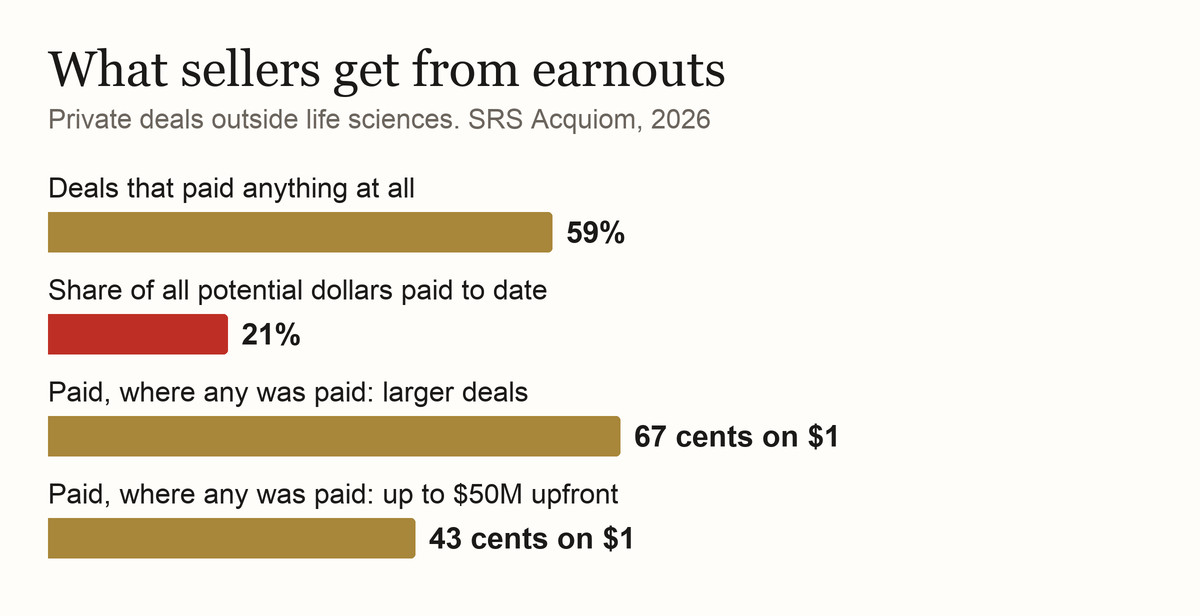
Across all earnout deals in that data, sellers received about one in five of the potential dollars. Most earnouts paid something, but where they paid, it was about half. In smaller deals it was less: a median of 43 cents on the dollar, against 67 cents in deals with more than $50 million upfront.
Read this as an owner: a part of your price you could not prove today has a good chance of never reaching you. Earnouts have their place, and they can bridge a real gap. But the cheapest way to shrink one is to turn forecast into history before you go to market, by selling after the new contracts have been signed and have run for a while, not before. A year of preparation is partly a way of moving numbers from the plan slide to the revenue slide.
SAY IT FIRST
Say the bad news before they find it
The buyer's team will find most of what there is to find. What you control is who says it first. A problem you raise, with its size and what has already been done about it, is a management decision. The same problem found by an auditor in week six is a question about what else has been kept from them.
There is a contractual reason too. Purchase agreements typically contain a warranty that there are no undisclosed liabilities; SRS Acquiom's 2025 claims update shows it in 97% to 99% of the deals it studied, depending on the year. Claims for breaching it rose from 11% of warranty claims in its 2022 report to 24% in its 2024 report, and they took a median of 14 months to resolve, against 2.8 months for warranty claims overall. What you disclose properly, on the schedule to the agreement, generally stops being a surprise you can be sued over. Your lawyer decides how that works in your deal.
The words in the deck matter as well. A 2017 overview of post-closing fraud claims by the law firm Winston & Strawn explains how this works in several US states. Delaware generally respects a clear clause in which the buyer confirms it did not rely on anything outside the contract, including projections and diligence materials, but such a clause cannot protect deliberate lies in the contract's own representations. California courts, the same overview says, generally will not enforce these clauses at all. In other words, the disclaimer on your last slide is less protection than it looks, and it depends on the law of your deal and how the contract is drafted. Have a lawyer read the deck before it goes out, not just the agreement. This is general information, not legal advice.
IN THE ROOM
The management presentation
At some point the slides stop being the story, and the people become it. In a management presentation, buyers are checking whether the team knows its own business, whether its members agree with each other, and who really runs the place.
A few things go right when they are prepared and go badly when they are improvised.
- More than one voice. If the owner answers every question, including those on finance and technology, the buyer's team has just watched a live demonstration of founder dependency. The finance lead should present the numbers and the technical lead should answer about the system, as the people who will remain.
- Rehearsal with a hostile audience. Someone who has sat on the buyer's side should ask the unpleasant questions: why did you lose that customer, why did margin fall that year, why are you selling now. "Why now" gets asked in every meeting, and it needs one honest answer that everyone gives in the same words.
- "I will get back to you" is a good answer. It is far better than an improvised figure, provided the promise is logged and kept. One person keeps a log of every question and answer, so that the third buyer does not hear something different from the first.
- Sensitive things open in stages. Customer names, source code and exact pricing go to fewer people and later, particularly when a bidder is a competitor. Plan this before the first meeting.
Remember why this works at all. Everything said in the room will be compared with the data room within weeks. People who have prepared from the evidence can answer calmly because there is nothing they have to remember to keep consistent.
WHY LAST
Why the deck comes last
A pitch deck made too early is a list of promises.
The pitch deck is the crown of the preparation, and we mean that literally: it goes on last. It sums up work that has been done, so it can only be as strong as that work. When an owner comes to us for "just the deck", the right first step is usually to find out what it would have to claim and whether that is true yet. For us, making a pitch deck is the favourite part of the job, because getting to make it means the product is ready.
The work under it takes real time. A year of preparation before a sale is ideal: time to clean up the numbers, settle ownership, repair the product, let a full year of clean results accumulate, and present the company properly. Four to six months is the minimum, and that holds for a fairly small product and a deal of a few million. A rushed version of this work is visible to the people reading it.
It also takes the right people, and that part is neither free nor easy. A review a buyer will take seriously needs people who have worked in M&A for years, sometimes licensed, and an analytical department that understands someone else's code from top to bottom. The team doing the repairs is sometimes not small. Here we have a real advantage: Peretz works with a large pool of vetted developers of European and Ukrainian origin at reasonable prices, so when a product needs a bigger dedicated team for those months, we can assemble one.
Keep assessment and repair apart, because owners often confuse them. Our Exit and Succession Readiness Session ($1,500) and the preparation program that can follow it (from $5,000) give an assessment and a direction. So do the technical due diligence session ($1,500) and the full review (from $7,500); usually 5 to 10 working days are enough to see the surface and understand what needs work and what needs very deep work. The real work after that has no starting price, because the product has to be seen first. These reviews are led by Valeriya Chumachenko, who has more than ten years in technology M&A. The deck comes after that, as one piece built around your business, with the same people who checked the facts behind each slide.
If you are at an earlier point, still weighing the decision itself, start with Before You Hire Bankers, Diagnose the Business and What Building the Systems Teaches You About Buying Them.
FAQ
Frequently asked questions
What is a pitch deck in simple terms?
A short set of slides, usually about a dozen, that argues why a company deserves someone's money and gives one reader enough to decide on a meeting. It argues and selects, while a memorandum describes in detail and a data room holds the documents themselves.
How many slides should a pitch deck for a buyer have?
We start from twelve and usually end up between 12 and 20, with the supporting detail in an appendix. There is no standard. A management presentation for selected buyers is longer, commonly 20 to 40 slides. If a slide does not carry a claim the buyer needs, remove it.
What is the difference between a pitch deck and a CIM?
A CIM, or confidential information memorandum, is a reference document, often 30 to 80 pages or more, that gives analysts enough to make an indicative offer. A pitch deck is an argument for the people deciding whether the deal deserves attention. They must contain the same facts. In a smaller deal, the deck may be the only presentation document.
Can I use the deck I made for investors to sell the company?
Not as it stands. An investor buys a share of a future with the founder in it, while a buyer buys what stays after the owner leaves. The founder, market, technology and closing slides all change, and most need new evidence behind them.
When should I start on the pitch deck?
Start the list of claims at the very beginning of preparation, and build the deck itself last. The ideal preparation takes about a year, and four to six months is the minimum, for a small product and a deal of a few million. A deck made before the work is done has to be redone anyway, and it may commit you to claims you cannot support.
Should a pitch deck mention risks and problems?
Yes, the ones a competent reviewer will find anyway, along with what you have done about them. It is the slide that does the most for your credibility. Your lawyer should check the wording and how it lines up with the disclosure schedule in the agreement.
Does Peretz make pitch decks?
Yes, and it is our favourite part of the work, because it means the product is ready. We build the deck last, around the logic of your business, after the facts behind each slide have been checked. If the facts are not yet in place, we start there.
Sources
- US Attorney's Office, Southern District of New York: sentencing of the founder of Frank, September 29, 2025
- SRS Acquiom: M&A Earnout and Milestone Trends, 2026
- S&P Global Ratings: EBITDA Addback Levels Remain High Despite Some Easing, April 17, 2025
- IMAP: CIM vs. Teaser, What Goes In Each and Why It Matters, 2026
- Winston & Strawn via the Harvard Law School Forum: post-closing fraud claims in private company M&A, July 19, 2017
Planning to show your company to buyers? Let's check which claims in your story will hold up, before they do.
- Share
-

-

-

-

One notification a week with the new PERETZ articles. Nothing else.