Online Store Marketing Budget: How Much to Spend in the First Year (2026)



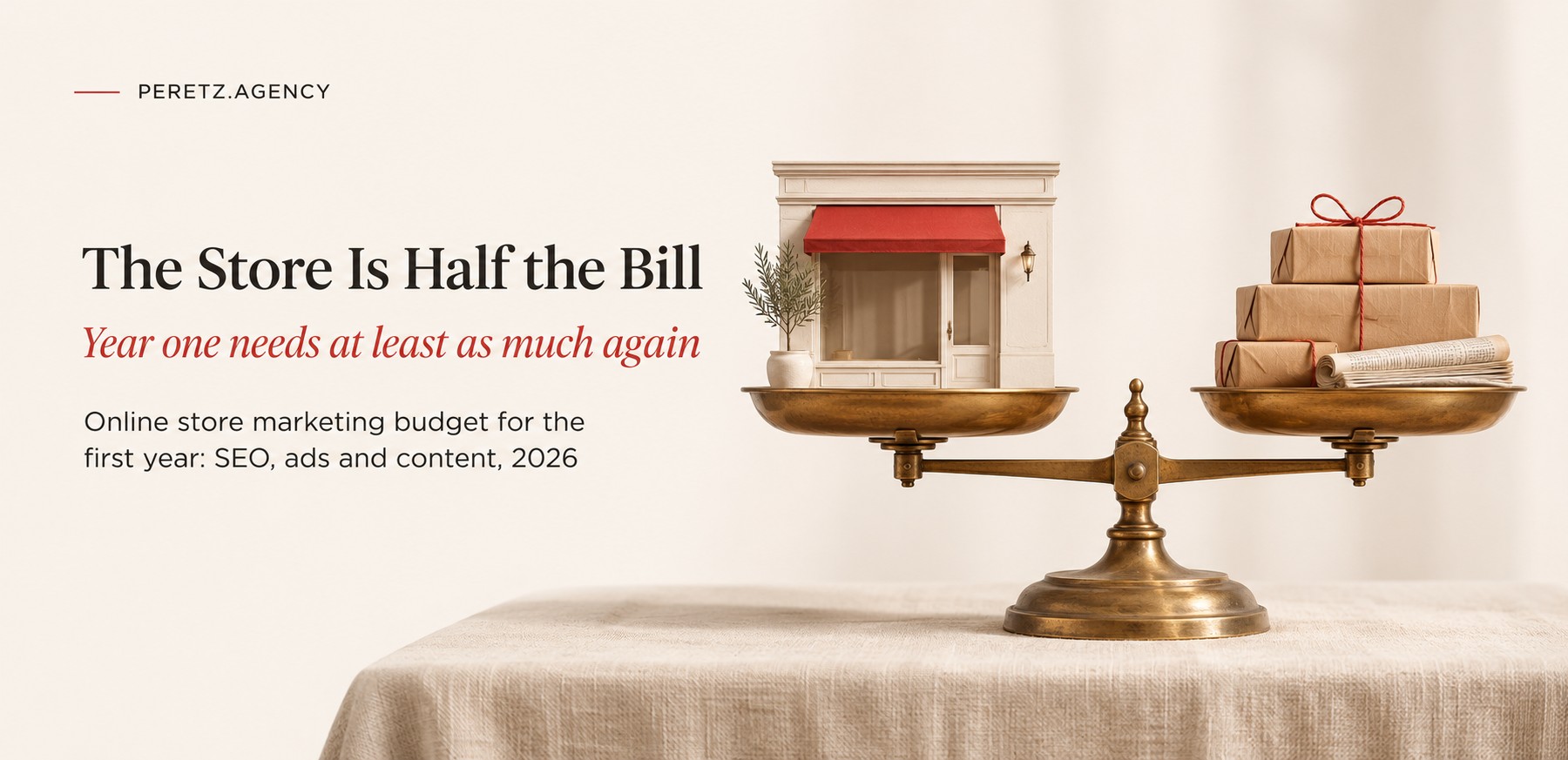
The first question serious clients ask us about a new online store is not about design. They ask whether their budget is enough to build it, and how much the marketing will cost in their niche. Our answer comes from many launches: in the first year, plan at least as much for marketing as the store itself is worth, and in the US usually two to five times more. Below we explain where the rule comes from, check it against 2026 click prices and SEO studies, and show what the money buys.
SHORT ANSWER
The short answer
Plan a first-year marketing budget (SEO, paid search, social ads and content) of at least the market cost of building your store, 1:1. A healthy range is two to three times that, and in the US it is often two to five times. For a serious custom store worth about $50,000, that means $100,000 to $150,000 for the first year; $50,000 will be far too little. The ratio is counted from what such a store costs on the market, not from what you paid: a store written with AI or put together from a template pays the same price for every click.
This is our own rule of thumb from launching online stores, not an industry standard. Before writing this article we looked for a published ratio between the marketing budget and the build cost in agency guides, Shopify and BigCommerce materials and market reports, and found none. The figures below are the check: what a click costs in 2026, how many clicks turn into orders, and how long SEO takes before it brings sales.
OUR EXPERIENCE
Where the rule comes from
We have launched many online stores from scratch, and only part of them is in our portfolio. Among those we can show are Sport-Discount, one of our first stores, the jewellery and watch house Nicole, which grew from a catalogue into an online store, Riccardo, BAGS etc, SHTAYER, HEMST and Skin Health. Right now we are relaunching the Trichocosmetics store.
The same story repeated for years. A first-time owner, often encouraged by friends who had launched their own store, ordered the development and said SEO would come later, after the launch. The store went live beautiful, everyone liked it when they got the link, and it did not sell. Sometimes the reason was as simple as a robots file still closing the site to search engines. More often there was nothing for search engines and buyers to find: product cards copied from suppliers, no articles, no reviews, no mentions anywhere else.
We wrote the same rule for apps in our article on mobile app marketing budgets: at least 1:1, counted from the market price of the product. A store differs from an app in one way that matters for the budget: part of the traffic can come from search for free, but only after months of work, so the first year still runs on paid traffic.
PERCENT OF REVENUE
Why percent of revenue does not work
The usual advice is to spend a share of revenue on marketing. Gartner's CMO Spend Survey put budgets at 7.7% of company revenue in 2025 and 7.8% in 2026, The CMO Survey (Duke, Deloitte and the American Marketing Association) at 9.4% in spring 2025, and Shopify's own guide for small businesses at 2% to 8%. These numbers describe mature companies, most of them large, with years of sales behind them.
A new store has close to zero revenue, so any percentage of it gives a budget close to zero. BigCommerce says it directly: a new business will have a difficult time using the percent-of-revenue formula and should set a fixed amount for the first year. The question then is how to choose that amount, and the cost of the store is a better anchor than a guess: it tells you the scale of the catalogue, the competition you are entering and the order value you are counting on.
Click prices do not care what your store cost to build.
CLICK PRICES
What a click costs in the US
According to the 2026 search advertising benchmarks of WordStream by LocaliQ, the average cost per click across industries rose to $5.42, from $4.66 a year earlier, with prices up in 87% of industries. Retail rows are lower: shopping, collectibles and gifts $4.14, apparel and jewellery $4.44, beauty $4.62, sports $2.77. Shopping and Performance Max clicks are cheaper than search: a panel of 28 US direct-to-consumer brands (Top Growth Marketing, 2025 to 2026) shows a median Shopping click at $1.02 and a cost per purchase of about $26 to $32.
Conversion is where the arithmetic gets serious. Shopify's 2026 overview of benchmarks gives 1.4% of global e-commerce visits converting (Statista) and a global average of 2.66% (Dynamic Yield), with fashion at 2.77% and home and furniture at 1.29%. A new store, without reviews, brand searches or a list of past visitors to bring back, usually sits below those averages.
| First-year paid budget | Clicks at about $2 each | Orders at 1.5% | Orders at 2.5% |
|---|---|---|---|
| $50,000 | 25,000 | 375 | 625 |
| $100,000 | 50,000 | 750 | 1,250 |
| $150,000 | 75,000 | 1,125 | 1,875 |
The table mixes cheaper Shopping clicks with dearer search clicks at an average of about $2, which is a planning assumption, not a benchmark. Even so, $50,000 buys roughly 30 to 50 orders a month for a store that cost $50,000 to build. At an average order of $90, that is $3,000 to $5,000 of monthly revenue, before returns, product costs and shipping. That is why we say $50,000 is far too little for a store of that scale, and why the US end of the rule goes up to five times the build.
SOCIAL ADS
Social ads and the learning phase
Meta is cheaper per click and weaker per sale. LocaliQ's 2026 Facebook benchmarks give an average traffic click at $0.60 across industries and $0.59 for shopping and gifts. The DTC panel of Top Growth Marketing shows a median CPM of $13.40, 1.79% of clicks ending in a purchase and a cost per purchase of $33.80, with a lower return on ad spend than Google.
Algorithms also need volume to learn. Meta considers an ad set out of the learning phase after about 50 results in a week. At a few dollars a day the campaign never gets there, which is one more reason a small budget spread across many channels gives no answer at all. For a new store we start with Google Shopping or Performance Max on the products with the best margin and real demand, add search on category terms, and bring in social ads with a budget that lets at least one ad set learn.
SEO TIMING
SEO takes about a year
SEO is the part of the budget that pays back longest and slowest. In its 2025 study Ahrefs followed a million new pages: only 1.74% reached Google's top 10 within a year, and 6.11% under a fairer filter of English pages with content. The average page in first position was five years old. Google's own advice on hiring an SEO, given in a 2017 video, was that in most cases it takes four months to a year to make improvements and see the benefit.
SEO started on launch day brings its first meaningful sales in the second year. That does not make it optional. It means the work has to start before the launch, so that the year in which the store pays for every click is as short as possible. We explained why marketing results take time, and why promises of quick results deserve suspicion, in a separate piece on how long marketing results take.
BEFORE LAUNCH
SEO starts before launch
Google says the same in its own documentation. Its page on whether you need an SEO calls the best time to hire one the moment you plan a new site or a redesign, "the earlier, the better". Its guide on launching an online store warns that a store hidden behind a password until a "grand reveal" can take longer to get visibility in Google Search and the Shopping tab, and suggests opening a placeholder home page early so that others can start linking to it.
In practice, SEO before launch means the category structure is built from real search demand, product pages have their own texts and structured data, the product feed for Merchant Center is ready, the old domain or old pages keep their addresses or get redirects, and nothing closes the site from search on the day it opens. On Nicole we built the SEO structure into the new store and warmed up the existing domain before launch, and we described what that gave in the Nicole case. How SEO is built into the store itself, from categories to filters, is in our article on e-commerce SEO built into the store.
Moves done carelessly are expensive. A Search Engine Journal study of 892 domain migrations (2025) found that it took 523 days on average for the new domain to match the old one's organic traffic, and 17% had not recovered after 1,000 days.
A beautiful store that nobody can find is a very expensive catalogue.
EDITORIAL OFFICE
A store is a small editorial office
From the first launches we have told owners the same thing: an online store has to become a small editorial office. It writes unique product cards instead of supplier copy, publishes articles and guides and links them to the products, places information about the brand on other platforms and in the press, and works with reviews and its reputation in search. Social media helps a young store too, as a second channel and as proof that the brand is alive.
On SHTAYER we rebuilt the information architecture, the product pages and the content strategy before touching the visual layer. As the case shows, the average position in Google search moved from 40.8 to about 12, and the organic click-through rate from 0.58% to above 2%. These are the results of exactly this editorial work, and none of it appears in a quote for development.
A full walk through marketing does not have to be expensive. When a client has the will to do it, as Sport-Discount once did, we find a way to start with what the business can afford. And when an online store will not help a business, we say so before the first invoice.
BUDGET SPLIT
What the money buys
Here is how we would split a first-year budget for a custom store worth about $50,000 in the US. It is a planning example, not a quote, and the split changes with the niche, the margin and how well known the brand already is.
| Item | First year | What it covers |
|---|---|---|
| SEO and content | $30,000 to $45,000 | category structure, product texts, articles, structured data, links; agencies average about $2,900 a month by the Ahrefs pricing survey |
| Google Shopping and search | $50,000 to $75,000 | the main source of orders in year one, starting with products that have margin and demand |
| Social ads | $15,000 to $25,000 | prospecting and bringing back visitors, enough budget for ad sets to learn |
| Photos, video and reviews | $5,000 to $10,000 | product photography, short videos, a review collection system |
| Total | $100,000 to $155,000 | two to three times the build |
Our own services fit into these lines: E-commerce SEO starts from $2,500 a month after a structure audit, and Google Shopping ads management from $1,000 a month, by our price list as of November 2026. The ad budget itself goes to Google and Meta, not to us.
BUILD COST
Count from the market price
Owners who built cheaply often expect a small marketing budget to match. In the US, a store can now be assembled from a template in a week or written with AI in a few days, and the price of development keeps falling. The price of a click and the cost of a buyer's trust do not fall with it. A template store selling baby clothing competes in the same auction, against the same brands, as a custom store worth ten times more.
That is why we count the ratio from the market cost of a store with the same catalogue, integrations and ambitions. For a cheap build the honest result can look strange, five or ten times what was paid, and that is correct: the marketing cost was always there, the build simply stopped hiding it. Where development costs come from, and what you get for them, we covered in what makes e-commerce development expensive.
FAILURE MYTH
The 90% myth
Articles about launching a store often say that 80% or 90% of online stores fail. The best-known version, "90% of e-commerce startups fail within 120 days", comes from a 2019 survey of 1,253 owners of failed British e-commerce startups by the agency Marketingsignals, and the article does not explain how the 90% was calculated. A survey of people whose business failed cannot measure a failure rate.
Better data comes from the US Bureau of Labor Statistics. Of retail businesses with employees born in March 2019, 60.7% were still operating five years later, and of those born in March 2020, 59.7%. Roughly four in ten new retailers close within five years: a serious risk, but nowhere near nine in ten. The same British survey is still useful for its reasons: owners named competing and running online marketing (37%) and weak online visibility (35%) among the main causes, ahead of running out of cash (32%).
THREE MARKETS
USA, Ukraine and the Gulf
The rule works in every market we sell in, but the multiplier is different, because clicks cost different money.
| Question | USA | Ukraine | UAE and Saudi Arabia |
|---|---|---|---|
| Typical click | Shopping about $1, retail search $3 to $4.50 | Shopping about $0.16 (UAH 6.80) | retail search about $0.50 to $2, $4 to $7 in peak seasons |
| First-year marketing | 2 to 5 times the build | from 1:1 to a normal market build price, a working minimum of $15,000 to $20,000 | 1:1 at the floor, 2 to 3 times for a brand store |
| SEO | average agency about $2,900 a month | agencies UAH 10,000 to 25,000 a month | e-commerce SEO in Dubai AED 3,000 to 10,000 a month |
| What adds cost | high click prices, competition with large brands | rising clicks, organic search losing share to AI answers | two languages, refused cash on delivery orders, marketplaces |
The Ukrainian version of this article covers Ukraine in detail, and the Russian version the UAE, Saudi Arabia and Bahrain. The documents and pages a store needs before its first sale in each of these markets are in our online store launch checklist.
FIRST YEAR PLAN
How we plan the first year
- Before development: demand for the categories, competitors' prices and order values, the margin on the products you plan to advertise, and the marketing budget agreed together with the build.
- During development: the category structure from search demand, product texts, structured data, the feed for Merchant Center, analytics and conversion tracking, redirects from any old site.
- Launch: a check that nothing closes the site from search, Shopping or Performance Max on the best products, search campaigns on category terms, the first reviews collected from the first orders.
- Months two to six: articles and guides linked to products, mentions on other platforms, social ads once there is enough data, a monthly review of cost per order by channel.
- Months seven to twelve: more budget to what pays back, SEO starting to carry part of the orders, a plan for the second year based on real numbers rather than benchmarks.
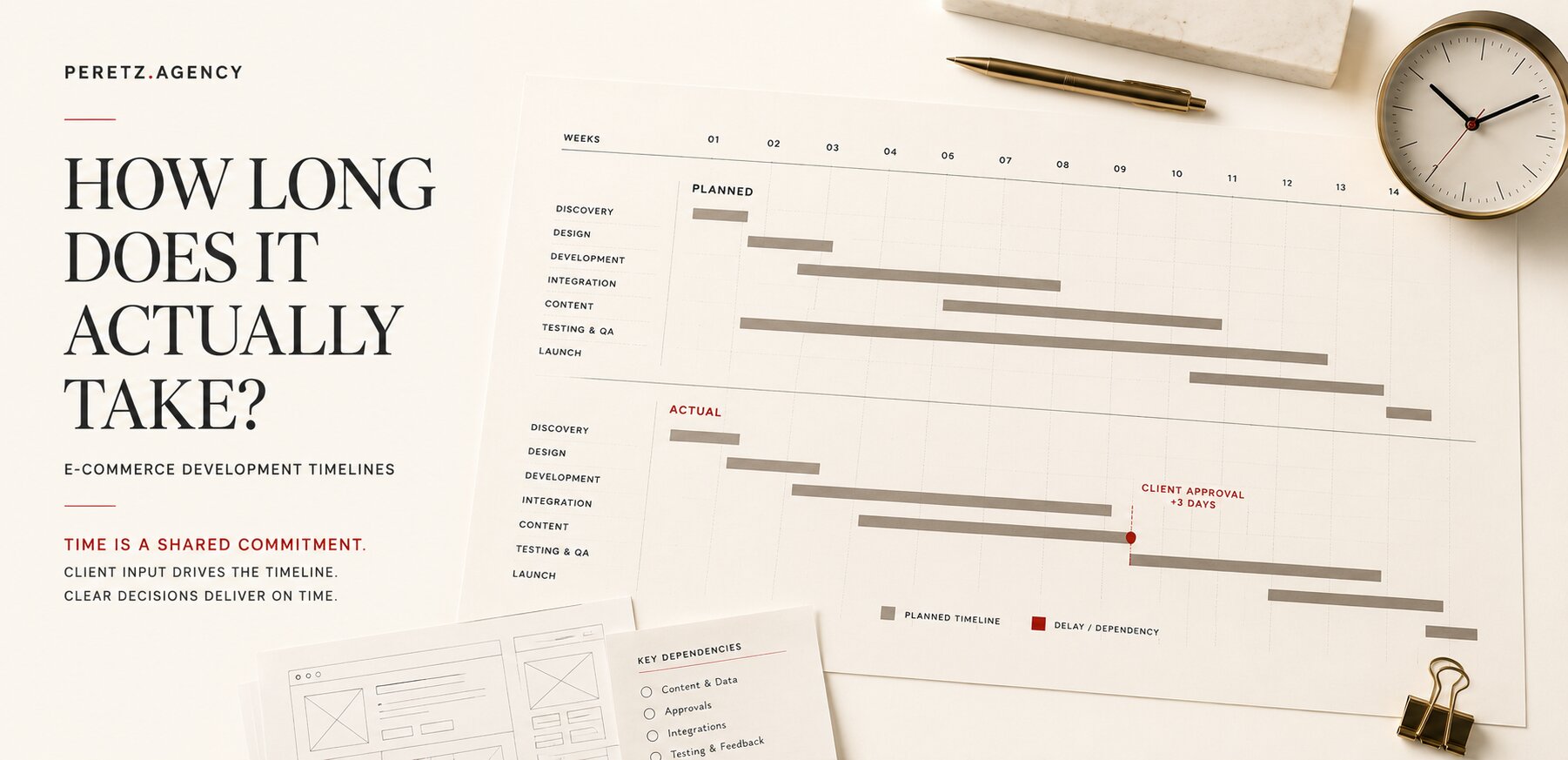
If you are about to build the store itself, our e-commerce development starts from $25,000 for a full project by our price list as of November 2026, and the marketing budget is the first thing we discuss with it. How long the build takes and what the client does during it is in how long an e-commerce build takes.
Part of that budget may go to a marketplace instead of your own site; how Amazon and your own store compare on fees, search and customer data is in Amazon or your own online store.
A budget only works on a store that can take the traffic; how we built Baby Rabby for that is in Baby Rabby, stage two.
FAQ
Frequently asked questions
How much should a new online store spend on marketing in the first year?
By our rule, at least as much as the market cost of building such a store, and in the US usually two to five times that. For a custom store worth about $50,000 we plan $100,000 to $150,000 for SEO, ads and content in the first year.
Why not budget a percentage of revenue?
Because a new store has almost no revenue. The 7% to 10% of revenue that surveys report describes mature companies; BigCommerce itself advises a fixed first-year amount for a new business.
How long does SEO take for a new online store?
Usually a year or more before it brings meaningful sales. Ahrefs found that under 2% of new pages reached Google's top 10 within a year in its 2025 study, which is why SEO work has to start before launch.
What does a click cost for an online store in the US?
In 2026 the average search click across industries is $5.42, and retail categories run about $2.80 to $4.60. Google Shopping clicks are cheaper, around $1 for established brands.
Is it true that 90% of online stores fail?
There is no reliable data behind that figure. US Bureau of Labor Statistics data shows about 60% of new retail businesses with employees still operating after five years.
My store was cheap to build. Can I spend less on marketing?
No. Click prices and buyers' trust cost the same for a template store and a custom one, so we count the budget from the market cost of a store with the same catalogue and goals.
Sources
- WordStream by LocaliQ: Search advertising benchmarks 2026
- Ahrefs: How long does it take to rank in Google?
- Google Search Central: How to launch a new ecommerce website
- BigCommerce: How to determine your marketing budget
- US Bureau of Labor Statistics: establishment survival, retail trade
Launching a store and not sure how much marketing it needs? Let's work out the first-year budget for your niche.
- Share
-

-

-

-

One notification a week with the new PERETZ articles. Nothing else.
Related Reading
-
21. 11. 2026
How to Launch an Online Store in the USA: Company, Sales Tax, Product Safety and Required Pages (2026)

-
15. 11. 2026
Mobile App Marketing: What It Costs to Get People to Use Your App
-
28. 08. 2026
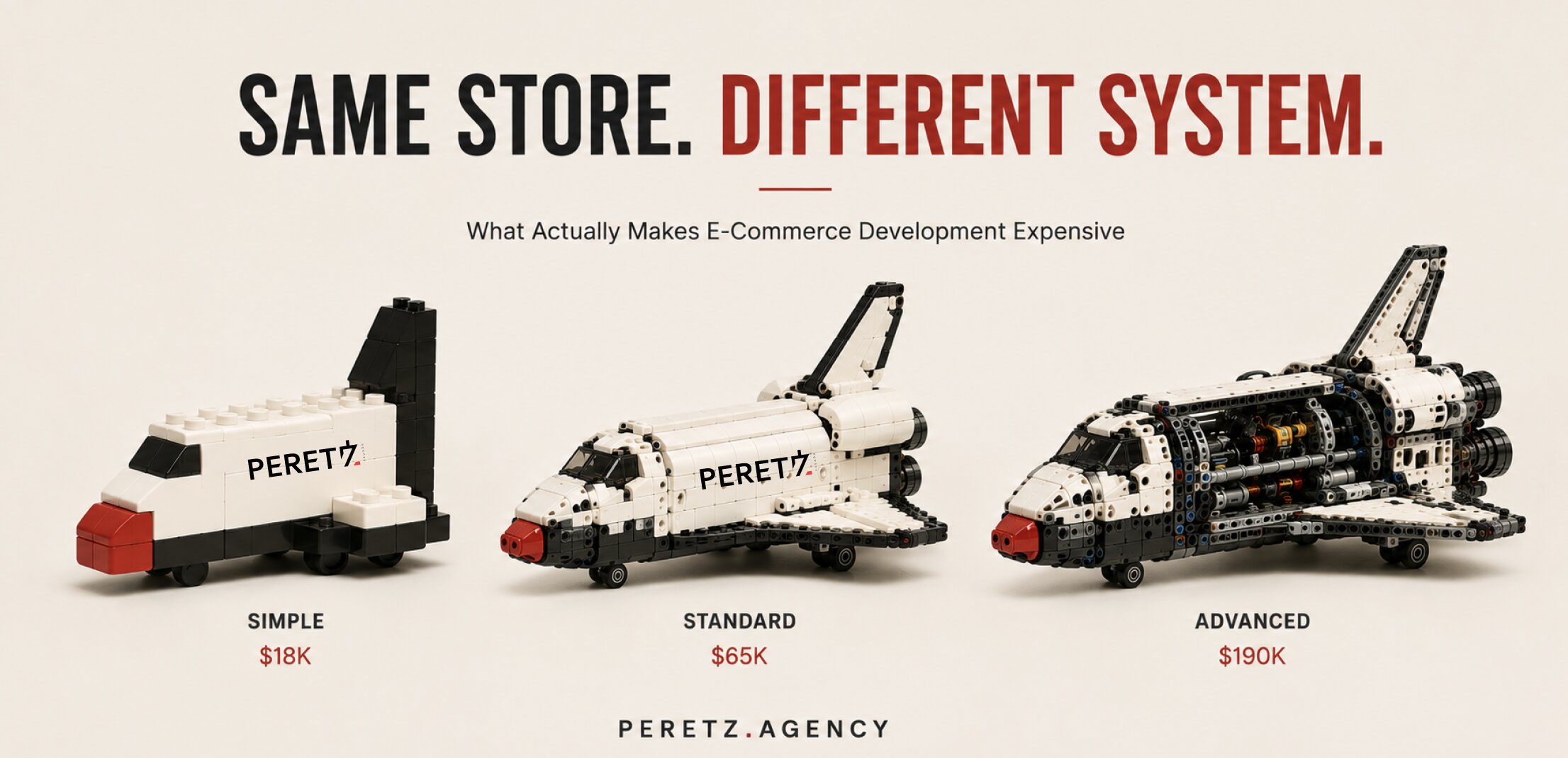
What Actually Makes E-Commerce Development Expensive
-
01. 09. 2026
How Long Does an E-Commerce Build Actually Take, and What the Client Has to Do
-
21. 11. 2026

Amazon or Your Own Online Store: Which to Start With in the US (2026)
-
22. 11. 2026
Baby Rabby, Stage Two: From a Prototype to an Online Store Built to Grow