Amazon or Your Own Online Store: Which to Start With in the US (2026)



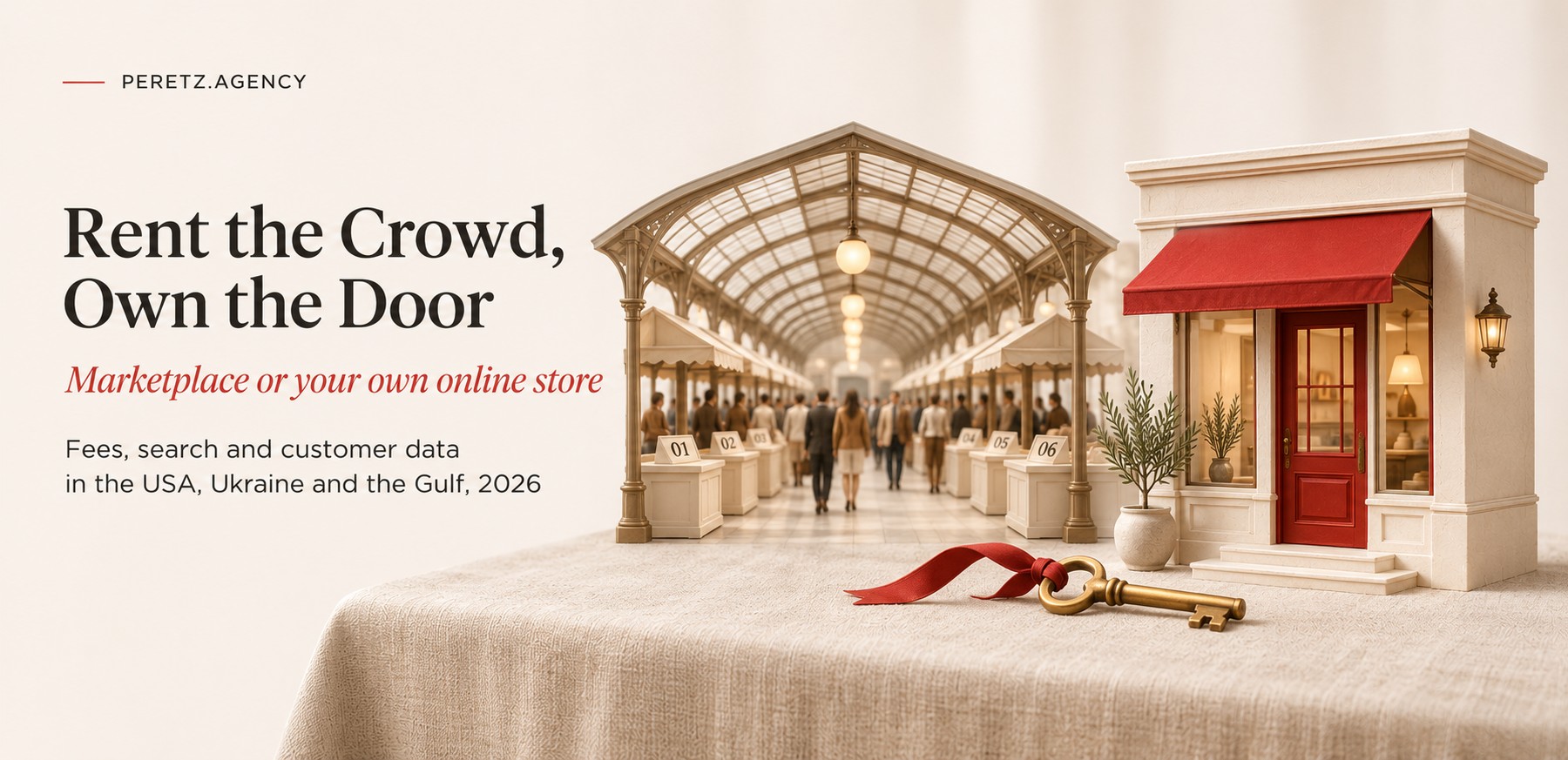
Many of the stores we launched also sold on marketplaces, and we saw both sides of it: extra orders and trust on one side, commissions and a slowly shrinking own site on the other. In the US the choice is sharper than anywhere else we work. Amazon takes a large share of every sale, but for a founder without the budget for a proper store and its marketing, it is often the only realistic way to start. Below we compare the real costs in 2026, explain what happens to your own site when you sell in both places, and show when each path makes sense.
SHORT ANSWER
The short answer
If you have the budget for a proper store and its first year of marketing, start with your own site and add Amazon for a few best-selling products later. If you do not, start on Amazon: you will pay a large share of every sale, but you get buyers, reviews and cash flow without building traffic from zero. Most brands end up in both places, and the real decision is which comes first and how to keep the marketplace from taking over your own search results.
This is not a call to leave marketplaces. Our point is simpler: whatever the marketplace brings, keep promoting your own channel alongside it and never let it slide, because that is the part of the business that stays yours.
The US is the hardest of the markets we work in for a young independent store. Amazon holds about 36% of US online sales by Marketplace Pulse's estimate and about 40% by eMarketer's, and click prices for an own store are the highest we see. Building your own store there is harder than in Ukraine or Europe, but not hopeless, and since 2025 there is more room for brand sites in Google than there has been for years.
OUR EXPERIENCE
What we saw in our own launches
We have launched many online stores, and many of them, especially those selling simple, searched-for goods, sold on marketplaces in parallel with their own site. In Ukraine that meant Prom, Rozetka and Kasta; the mechanics are the same on Amazon.
On one side, the marketplace helped: it brought orders from the first weeks and gave the product an extra source of trust. A buyer who sees the product on a large platform with reviews is calmer about buying it on the brand's own site too.
On the other side, there was the commission, and something owners rarely expect. The marketplace's product pages were stronger in search than the store's own pages, and over time the store's own product pages slipped further down. To bring them back, owners had to put more and more money into promoting their own pages. In the end, the parallel sale that looked free cost them their own search presence. We now plan for this from the start: if a store sells on a marketplace, its own site needs its own content, not a copy of the listing. None of these stores had to leave the marketplace. What hurt them was that their own site stopped getting money and attention while the marketplace was selling.
WHAT AMAZON TAKES
What Amazon takes from a sale
Amazon's official US pricing page lists a Professional plan at $39.99 a month and a referral fee on every sale: 17% for clothing above $20, 15% for beauty and baby products above $10, and 15% for home and kitchen. On top come fulfilment fees if Amazon ships the order: from 15 January 2026 they rose by an average of $0.08 a unit, and from April 2026 a 3.5% fuel and logistics surcharge was added. There are also fees for inbound placement, low inventory and returns.
The bigger cost for a new seller is advertising. A new listing without reviews rarely sells without Sponsored Products, and Amazon's own ad business earned $68.6 billion in 2025. Marketplace Pulse estimated that fees and advertising together passed 50% of a seller's revenue on Amazon in 2022, and 50% to 60% for a typical private-label seller in 2023.
| Channel | Fee on a $60 dress | Monthly fee | Who owns the customer |
|---|---|---|---|
| Amazon | 17% referral, plus fulfilment and ads | $39.99 | Amazon |
| Walmart Marketplace | 15% referral, by application only | none | Walmart |
| Etsy | 6.5% transaction plus 3% and $0.25 payment, offsite ads 12 to 15% | none | mostly Etsy |
| Own store on Shopify | 2.9% + $0.30 payment | $39 on the Basic plan | you |
The table shows commissions only. On your own store the main cost is not in it: every visitor has to be bought or earned.
OWN STORE
What your own store costs
The platform itself is cheap. Shopify Basic costs $39 a month, or $29 billed yearly, and card payments cost 2.9% plus 30 cents, the same as Stripe. A $50 order pays about $1.75 in payment fees. On Amazon the same beauty product pays $7.50 in referral fees before fulfilment and ads.
But an own store pays for every visitor. The average Shopify store converts about 1.4% of visits into orders (Littledata, about 2,800 stores), so a hundred orders need around seven thousand visits, and in the US a search click for retail goods costs $3 to $4.50. We counted what a new store needs for its first year in our article on the online store marketing budget: in the US usually two to five times what the store cost to build. That is the money a founder without a budget does not have, and that is why Amazon is often the honest first step in the US.
On a marketplace you rent the buyers. On your own site you build them.
SEARCH
Who gets the search results
When the same product sells on Amazon and on your site, Google often shows the Amazon page first. Amazon's pages have years of trust, thousands of links and reviews, and your new product page has none of that. This is the effect we saw in our own launches, and it grows over time: the more the marketplace sells, the stronger its page becomes.
There is one change in the brand sites' favour. Amazon stopped buying Google Shopping ads in the US on 23 July 2025, and a year later it was still absent from US Shopping results, according to Tinuiti's data reported by Search Engine Journal. In other markets it returned within about a month. In the US its slots went to Temu, Shein and Walmart, and to brands with a good product feed.
Where shoppers start their search has also changed. The often-quoted line that half of product searches start on Amazon comes from Jungle Scout surveys of 2022 to 2024. In 2026 surveys Google leads again as the starting point, at about 49%, with Amazon second at about 34% (Envision Horizons, reported by eMarketer). A brand site with a clean feed in Merchant Center and its own texts can now win Google traffic that Amazon used to take. How SEO is built into the store itself is in our piece on e-commerce SEO built into the store.
CUSTOMER DATA
Who owns the buyer
On a marketplace the buyer belongs to the marketplace. You get an order and a shipping address, not a customer: Amazon does not let sellers market to its buyers, and the next purchase goes through Amazon and its fees again. On your own site the email, the order history and the repeat sale are yours, and for products people buy again, this is where most of the profit sits.
Prices are not fully yours either. Amazon's fair pricing policy treats a price much higher than recent prices on or off Amazon as harmful, and an offer can lose the Buy Box for it. In practice your own site cannot sell much cheaper than Amazon without making the Amazon offer look overpriced. The usual way out is to give the site what Amazon does not have: bundles, exclusive products, subscriptions and the full range.
INVESTING IN A MARKETPLACE
What happens when the money goes into the marketplace
When a store puts its budget into marketplace ads and promotion instead of its own site, that money builds the marketplace's asset, not the store's. The US is where this is measured best, and the numbers match what we saw in our own launches.
The platform's share keeps growing. Marketplace Pulse estimated that Amazon took about 40% of a seller's revenue around 2018, more than 50% in 2022, and 50% to 60% for a typical private-label seller in 2023. Amazon's own results show the scale: in 2025 it earned $172.2 billion from third-party seller services and $68.6 billion from advertising. The price of a click on Amazon stayed near $1 for seven years by Skai's data, so sellers pay more not because clicks got dearer, but because they need more of them to stay visible.
Sellers complain and still lean in. In the Marketplace Pulse Seller Index 2026, 47% of sellers saw their margins fall. Among the sellers most frustrated with fees, 42% were still growing Amazon's share of their revenue and only 24% were cutting it. Marketplace Pulse calls this paradoxical dependence: the channel that squeezes the margin is also the one the business cannot leave.
Even your own brand name is for sale. In PMG's study of the top 10,000 branded searches on Amazon (October 2024), an organic result came first in only 18.7% of them; in the rest the first place was paid. On Google, branded searches make up 45.7% of all search volume (Ahrefs, 2025), and on your own site that brand demand costs nothing once the site ranks for it.
The buyer and the business stay with the platform. A marketplace buyer cannot be reached again outside the marketplace, while on an own site automated emails alone bring about 41% of email revenue from 5.3% of sends (Klaviyo benchmarks 2026). Buyers of online businesses notice the difference: the broker Empire Flippers wrote in its 2026 report that Amazon FBA brands no longer fetch the prices they did and that buyers now prefer businesses the owner controls. Amazon aggregators paid around seven times profit at the 2021 peak, and Thrasio, which raised $3.4 billion, filed for bankruptcy in February 2024, mainly because it overpaid and borrowed too much.
The reverse is also true. Nike left Amazon in 2019, its digital sales fell 20% in fiscal 2025, and it returned to Amazon that May. A marketplace is a strong paid channel; the mistake is to make it the place where all the money and all the customers end up.
RISKS
What can go wrong on a marketplace
The Marketplace Pulse Seller Index 2026, a survey of 181 sellers with more than $2 billion in combined revenue, found 23% of sellers thriving, 31% grinding and 38% distressed. Almost half named marketplace fees as their main margin concern, and 46% named advertising costs.
The number of new sellers is falling as well. In 2025 only 165,000 new sellers launched on Amazon.com, the lowest since tracking began in 2015, and only 16% of them were American. The other risks are well known: an account can be suspended, a listing can be hijacked by another seller, rules and fees change for everyone at once, and a store built only on Amazon has no customer list to fall back on. The marketplace is a strong channel, but it is a channel, not a business you own.
TRUST
A marketplace as a source of trust
There is a side of marketplaces that owners underestimate. A product with reviews on a large platform is easier to trust, including on the brand's own site. In a Radial survey of 1,000 US adults (March 2026), 44% said they first buy from a new brand on a marketplace such as Amazon or Walmart.
Even the strongest brands end up in both places, as the Nike story above shows. For a young brand, a few products on Amazon with real reviews can make the own site more convincing, as long as the site has something the marketplace does not.
AMAZON FIRST
When to start on Amazon
- The product is searched by category, not by brand: people type what it is, not who makes it, and compare on price and reviews.
- The margin carries about half the price going to fees, fulfilment and ads. A rough rule we use: the landed cost of the product is at most a quarter or a third of the retail price.
- You do not have the budget for a proper store and a year of marketing. In the US this is the most common reason, and it is a good one.
- You need proof of demand fast: the first reviews, the first sales and the first cash flow, to decide whether the product deserves its own store.
OWN STORE FIRST
When to start with your own store
- The brand, design or story is the product. On a marketplace a premium product turns into a line in a price comparison.
- People buy again: cosmetics, care products, food, consumables. Your own email list turns one paid acquisition into many orders, and a marketplace charges you for every one of them.
- Your demand comes from outside search: social media, creators, PR, wholesale, a community. Sending that traffic to an Amazon page means sending it to a page with your competitors' ads under your product.
- You need price freedom, bundles, made-to-order products or subscriptions that a marketplace does not support well.
- You have the budget for the store and for its first year of marketing. Without it, an own store in the US becomes a beautiful catalogue nobody visits.
BOTH
How to sell in both places without losing your site
When a store sells on a marketplace and on its own site, we keep a few rules so the marketplace does not take over.
A copied product description is a gift to the marketplace.
The rules are simple:
- Own texts on the site. Product descriptions, photos and guides on your site are written for it and differ from the marketplace listing. A copied description helps the marketplace page outrank yours.
- The full range and the best offers on the site: bundles, sets, new products first, exclusives. On the marketplace, the best-selling products that bring new buyers.
- Aligned prices. No undercutting that breaks the marketplace's pricing rules; the site wins with range and service.
- A product feed in Merchant Center from day one, and protection of your brand name in Google and on Amazon, with the trademark registered for Amazon Brand Registry.
- Count the net margin per channel, after commission, marketplace ads, fulfilment and returns, not the revenue.
- A fixed part of the budget goes to your own site every month, even when the marketplace sells well: texts, SEO, the product feed, email to existing buyers.
OUR CASE
Our own store: Baby Rabby
We are relaunching Baby Rabby, our own store of baby clothing, and we face the same question. For now our plan is the own site and our own social media, without marketplaces. The next step is to talk to the manufacturers and suppliers we worked with before, check today's prices, and decide on the channels from those numbers. The documents and pages a store needs before the first sale are in our online store launch checklist.
THREE MARKETS
USA, Ukraine and the Gulf
The answer depends on the market, because marketplaces take different shares and clicks for an own store cost different money.
| Question | USA | Ukraine | UAE and Saudi Arabia |
|---|---|---|---|
| Main marketplaces | Amazon, Walmart, Etsy, TikTok Shop | Rozetka, Prom, Epicentr, Kasta | Amazon.ae and .sa, noon, Namshi |
| Fee on clothing | Amazon 17% above $20 | Prom about 18 to 19% for dresses | noon 27%, Amazon.ae 15% |
| Own store | hardest: expensive clicks, Amazon's habit | realistic: clicks are cheap | possible: social media brings buyers to the site |
| Where we would start without a budget | Amazon | a marketplace plus a simple own site | Amazon.ae for a few products |
The Ukrainian version of this article covers Ukraine in detail, and the Russian version the UAE, Saudi Arabia and Bahrain.
Whatever the channel, your own store needs a cabinet, an admin and a warehouse that hold up; we show ours in Baby Rabby, stage two.
FAQ
Frequently asked questions
Is it better to sell on Amazon or on your own website?
It depends on your budget and product. Without the budget for a proper store and a year of marketing, Amazon is usually the realistic start. With it, your own site keeps the customer and the margin, and Amazon can be added later for best-selling products.
How much does Amazon take from a sale?
The referral fee is 15% to 17% in clothing, beauty, baby and home categories, plus $39.99 a month, fulfilment fees and advertising. Marketplace Pulse estimated fees and ads together at more than half of a seller's revenue.
Will selling on Amazon hurt my own site's SEO?
It can: Amazon's product pages are usually stronger in Google than a new store's pages, especially if the description is the same. Write separate texts for your site and keep the full range and best offers there.
Can I sell cheaper on my own site than on Amazon?
Only carefully, because Amazon's fair pricing policy can take the Buy Box from an offer priced much higher than elsewhere, so most brands keep prices aligned and give the site bundles, exclusives and subscriptions instead.
Do shoppers still start their product search on Amazon?
Many do, but in 2026 surveys Google leads again as the starting point at about 49%, with Amazon second at about 34%. Since Amazon left US Google Shopping ads in July 2025, brand sites have more room there.
Should a new brand be in both places?
Most brands end up in both places, so decide which comes first, keep your own content on your site, and count the net margin per channel after fees, ads and returns.
Sources
- Amazon: selling plans and referral fees in the US
- Marketplace Pulse: Amazon takes a 50% cut of sellers' revenue
- Marketplace Pulse: Seller Index results 2026
- Search Engine Journal: Amazon left US Google Shopping a year ago and never came back
- Walmart Marketplace: pricing
Not sure whether to start on Amazon or with your own store? Let's work it out for your product and budget.
- Share
-

-

-

-

One notification a week with the new PERETZ articles. Nothing else.
Related Reading
-
21. 11. 2026
Online Store Marketing Budget: How Much to Spend in the First Year (2026)

-
21. 11. 2026
How to Launch an Online Store in the USA: Company, Sales Tax, Product Safety and Required Pages (2026)
-
22. 10. 2026
E-Commerce SEO in 2026: What Has to Be Built Into the Store, Not Added Later
-
28. 08. 2026
What Actually Makes E-Commerce Development Expensive
-
22. 11. 2026
Baby Rabby, Stage Two: From a Prototype to an Online Store Built to Grow