Type at least 3 letters to search

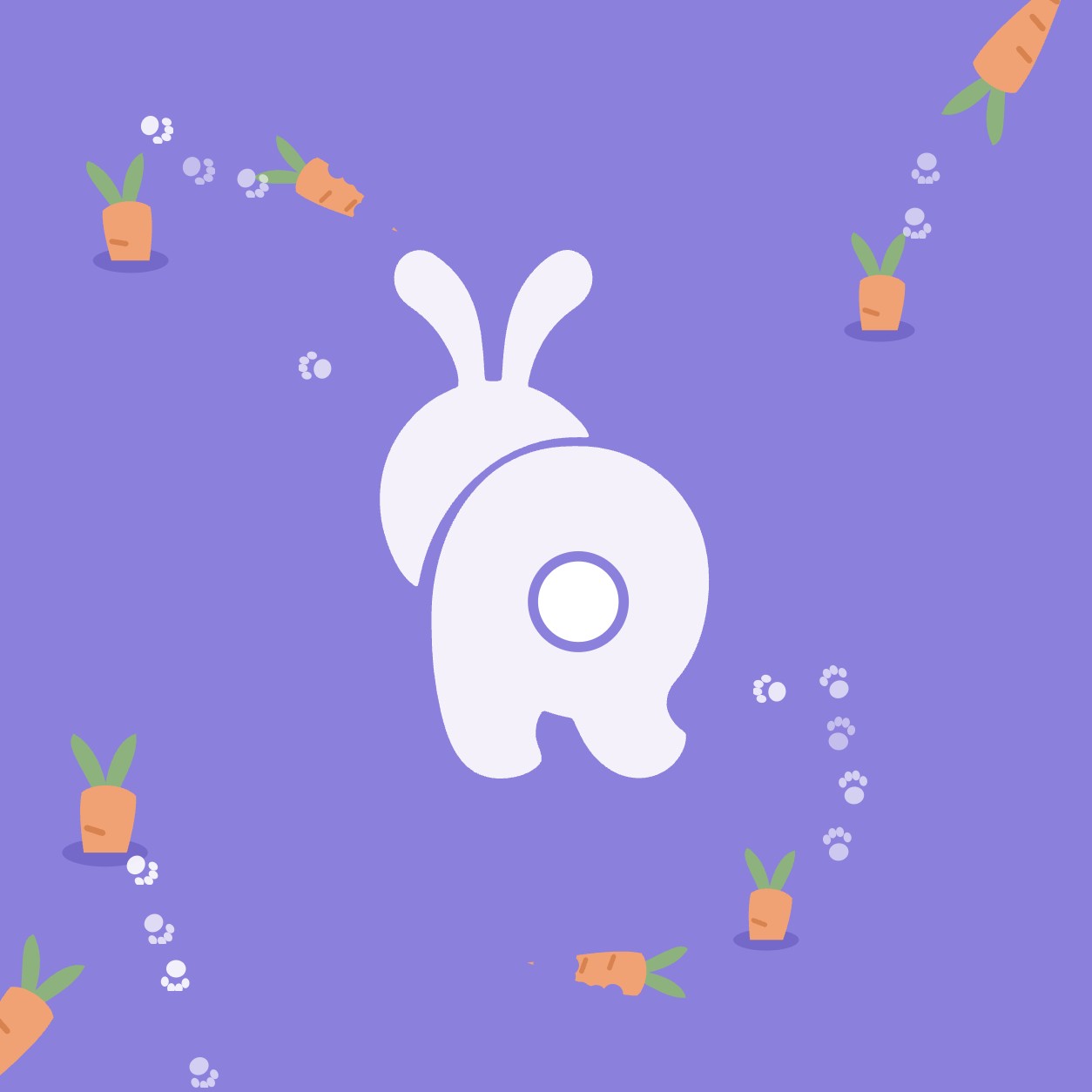
Baby Rabby: the bunny from behind in a carrot field full of paw prints

Baby Rabby

Baby Rabby is our own brand: clothes, textiles, sleep goods and toys for babies from birth to two, for Ukraine. By early 2022 everything was in place: the company registered, the sign and the shop designed, the coding started, suppliers chosen, the first stock in the warehouse, the first posts out. But the shop never opened.

In 2026 we went back to it. We kept the sign, looked at it again and found a bunny from behind in the R. Around it we drew a new soft look and built the whole shop again as a working prototype on babyrabby.shop. The brand is getting ready to relaunch.

A shop for little bunnies, with a bunny hidden in its own name.

A parent buys baby things at night, with one hand, with a baby on the other arm. So the brief was simple: nothing to read twice, the size chosen by the baby’s height, the delivery date before the button, and a shop that is pleasant to open even when you are tired.

There are no product photos yet, and we did not want stock babies or generated pictures. So every item is drawn: 24 goods as vector pictures that recolour for every colour in the catalogue. In its second stage the prototype became a working shop on Laravel with a parent’s cabinet, an admin and a warehouse (chapters 09 to 15). Until real photos arrive it stays closed to search engines, apart from the blog and the glossary.

Client: Baby Rabby, our own brand
Industry: baby clothes and goods
Services: brand identity, online shop, UI/UX design, e-commerce SEO, AEO
Languages: Ukrainian, Russian, English
Market: Ukraine
Status: working shop on Laravel, preparing to open

01. The sign

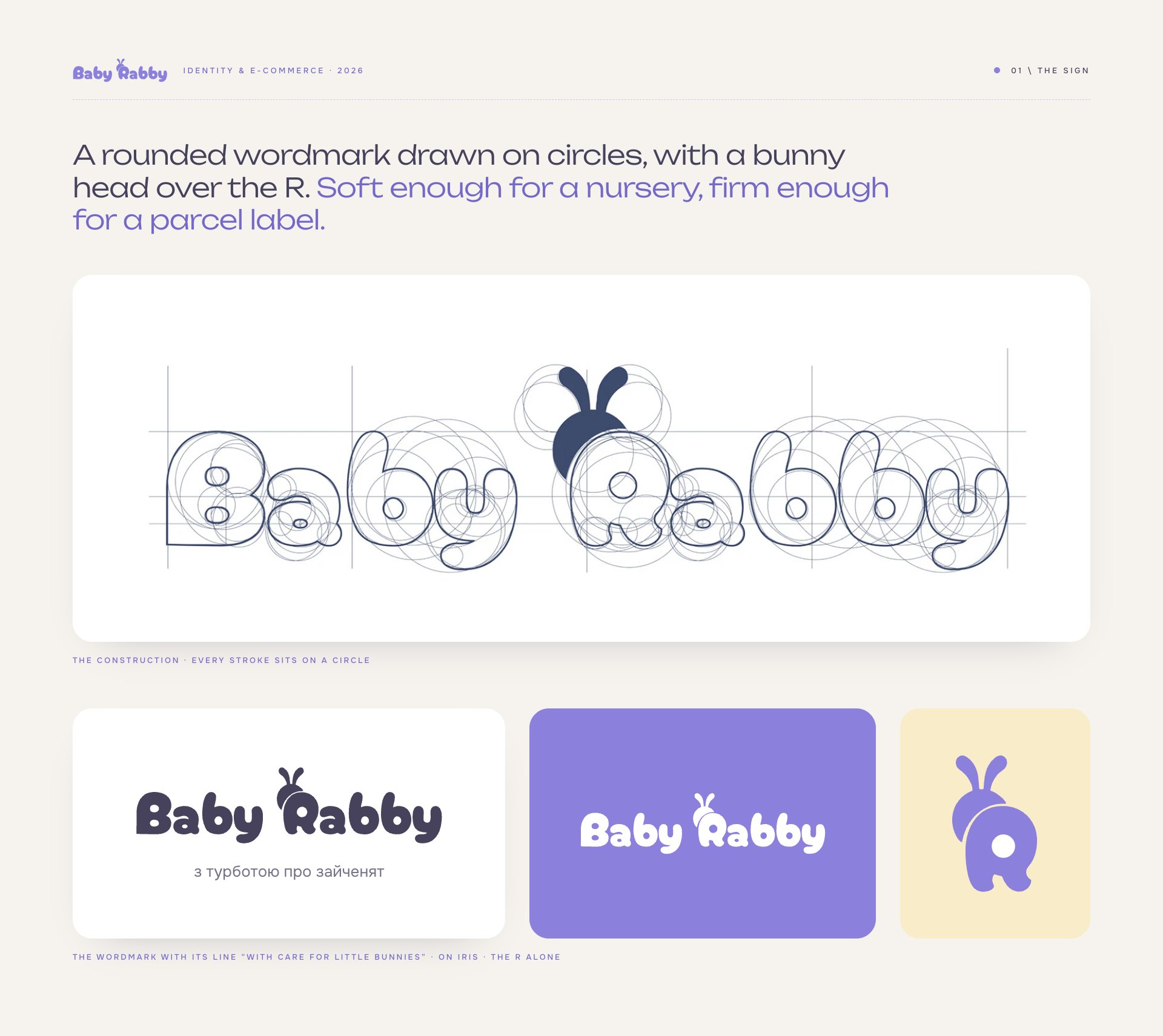
The wordmark was drawn in 2022: round letters built on circles, a bunny head over the R and the line “with care for little bunnies”. Soft enough for a nursery, firm enough for a parcel label and a tag sewn into a bodysuit. Of the old shop we kept only this sign.

Baby Rabby sign: the construction on circles, the wordmark with its line, on iris and the R alone

02. The R is a bunny from behind

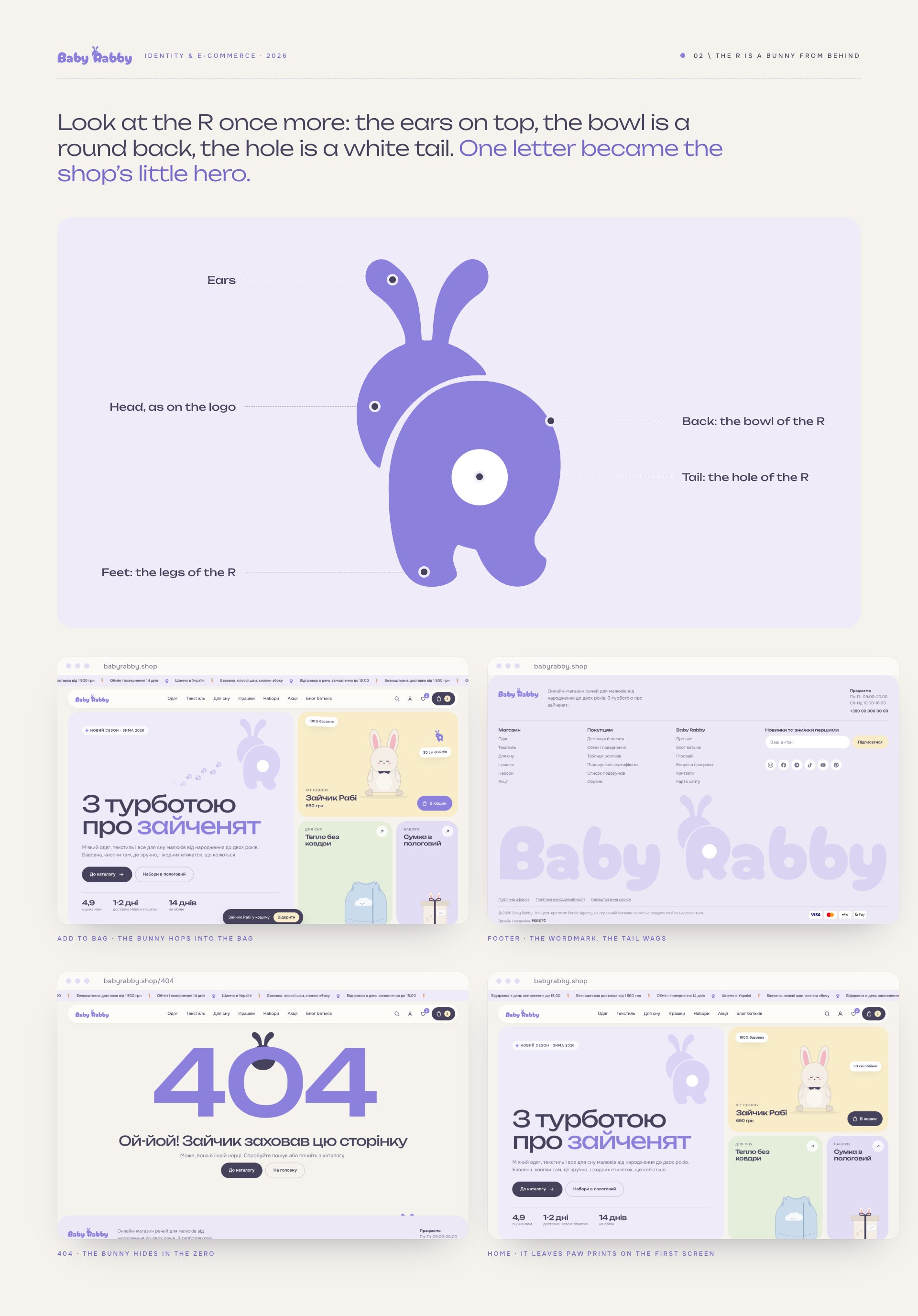
Looking at the sign again, we saw it: the ears and the head on top, the bowl of the R is a round back, its hole is a white tail, its legs are the feet. One letter became the shop’s little hero. It hops into the bag when you add something, wags its tail in the footer wordmark, hides in the zero of the 404 and leaves paw prints on the first screen.

Baby Rabby: the R drawn as a bunny from behind, and the bunny at work on the site

03. Colours, type, drawings

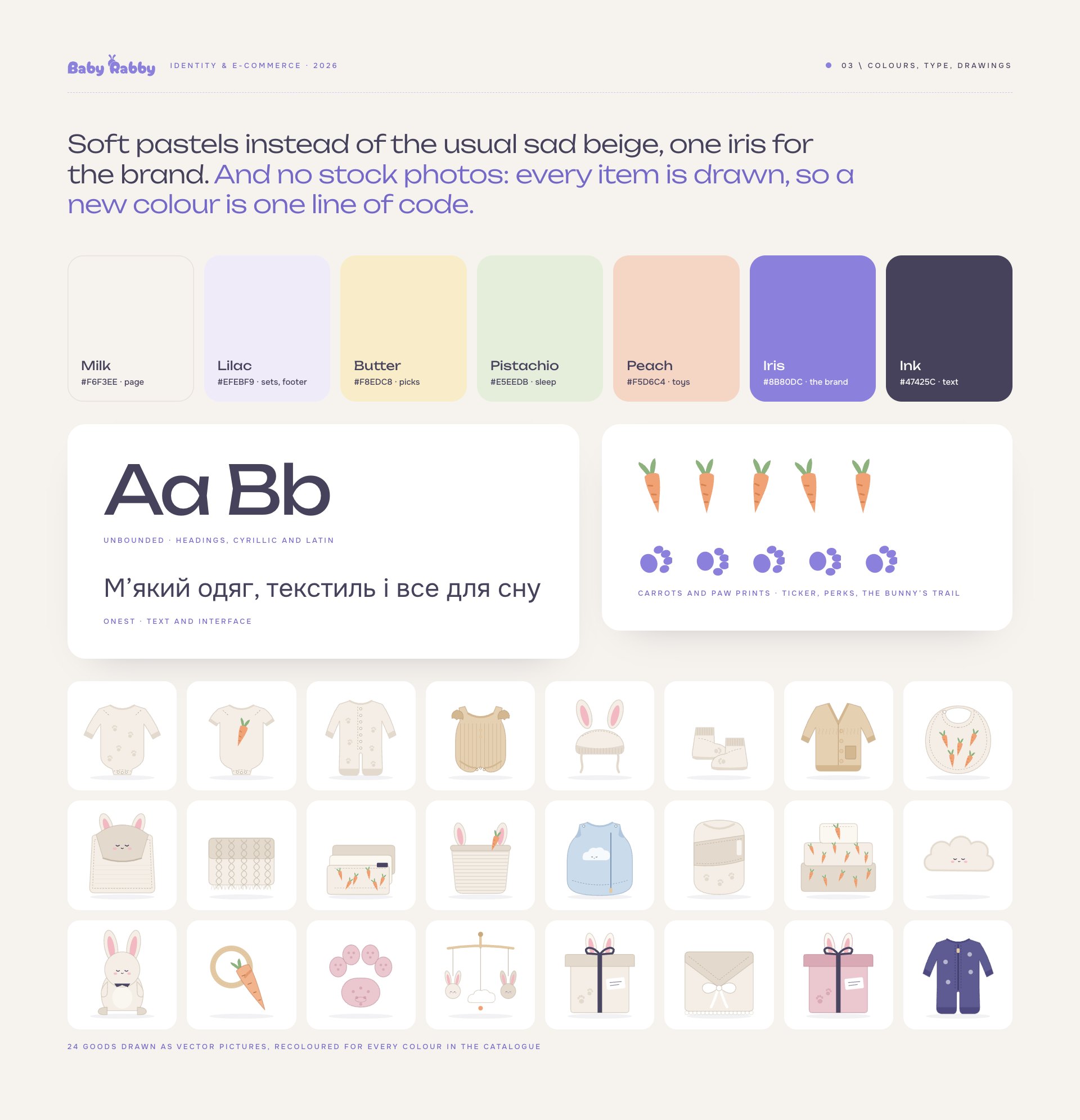
Soft pastels instead of the usual sad beige: lilac, butter, pistachio and peach on a warm milk page, one iris for the brand and a calm ink for the text. Unbounded for headings, Onest for text, both with full Cyrillic. Carrots and paw prints run along the ticker, the perks and the bunny’s trail. The goods are drawn, so a new colour in the catalogue is one line, not a photo shoot.

Baby Rabby palette, the two typefaces, carrots and paws, and 24 drawn goods

04. The first screen

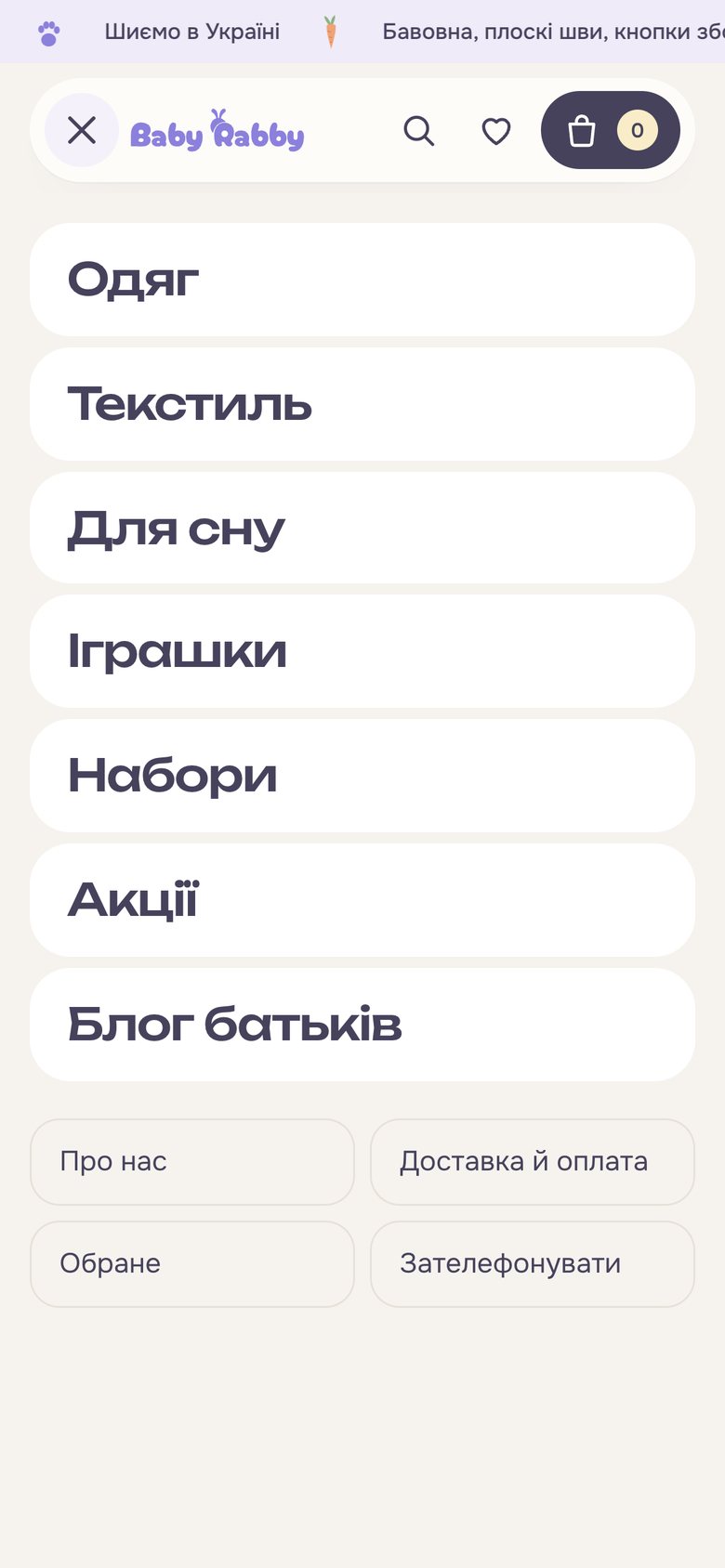
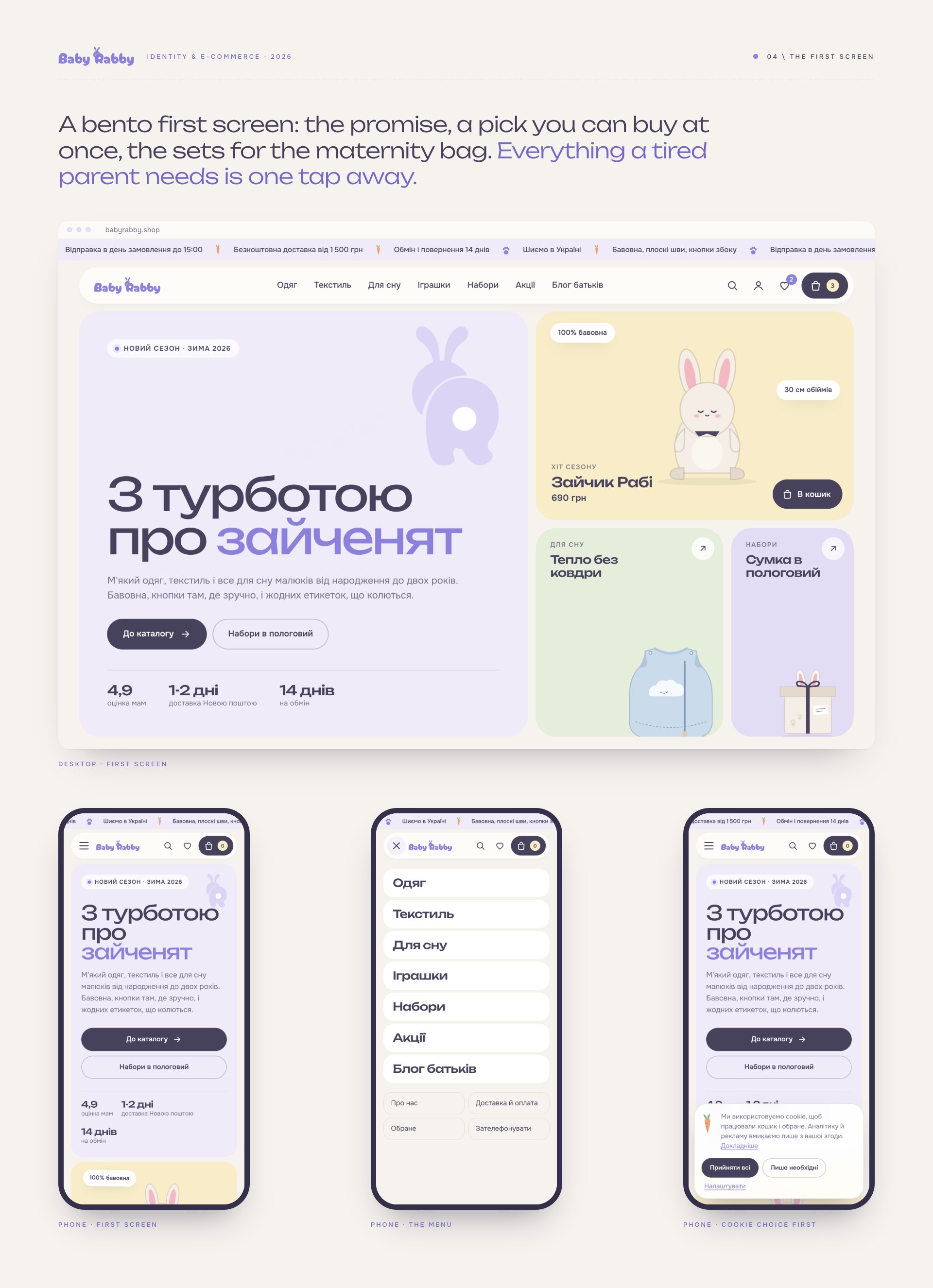
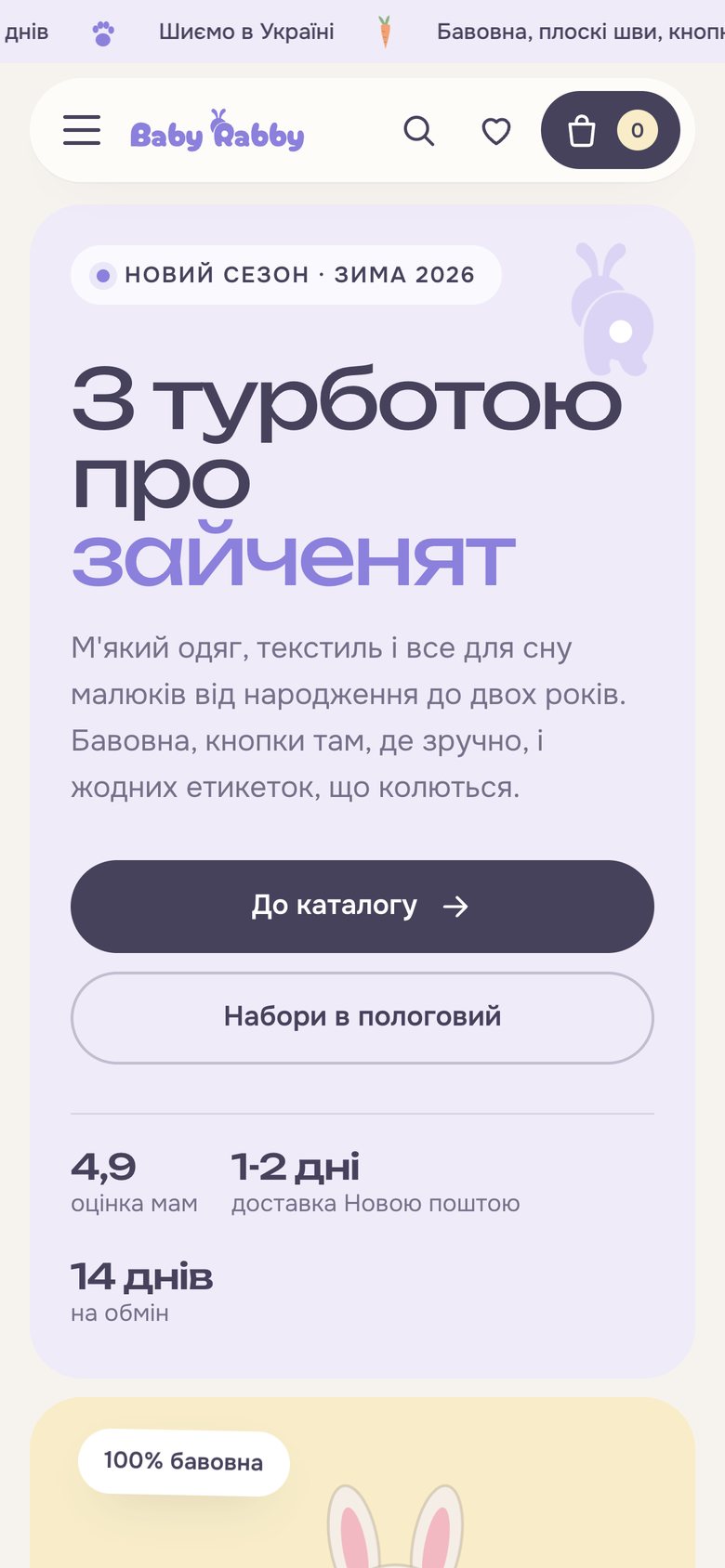
A bento first screen: the promise on the left, a pick you can add to the bag without leaving the page, and two tiles for sleep and for the maternity bag. On a phone the menu opens as large soft buttons, and the cookie choice comes first, before anything optional runs.

Baby Rabby home page on a computer, and the first screen, menu and cookie choice on phones

05. Catalogue and product

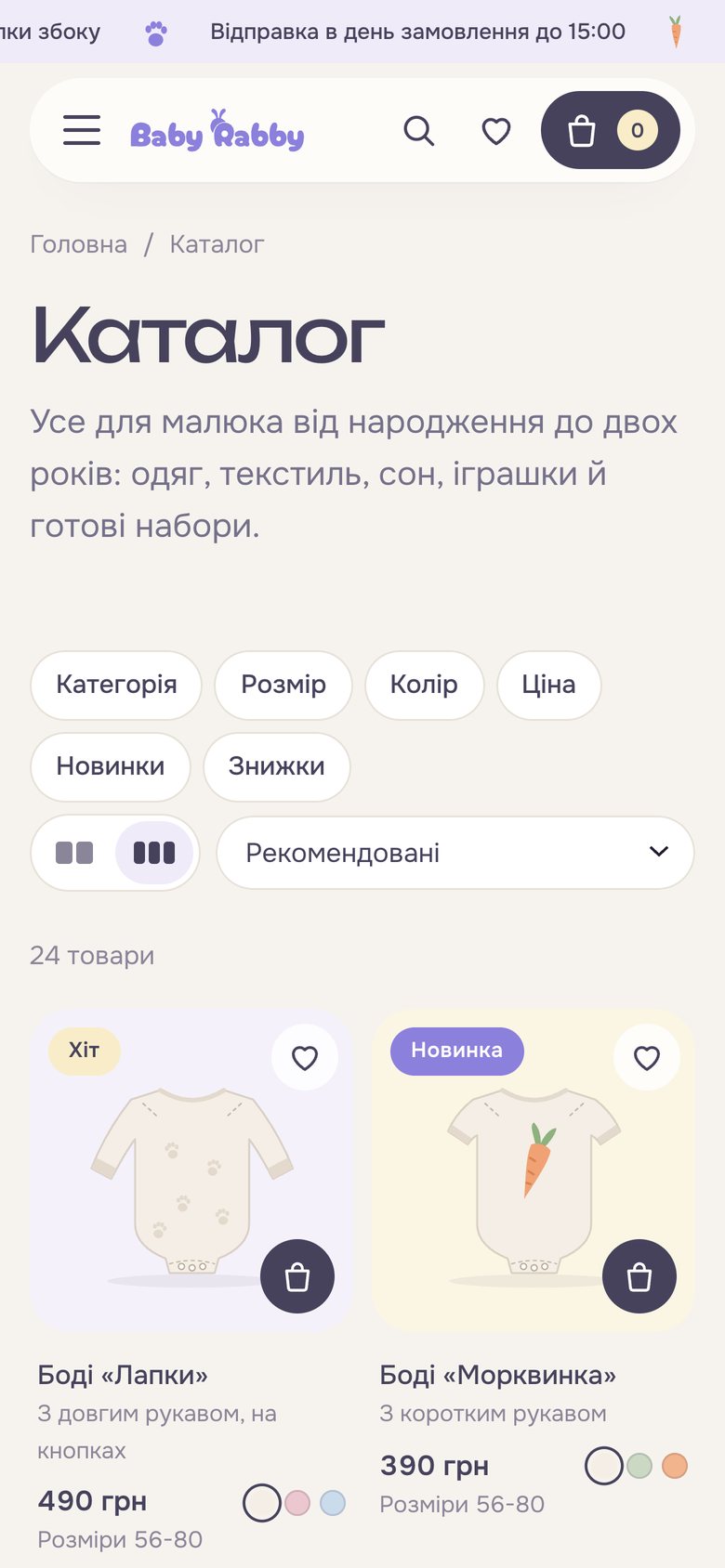
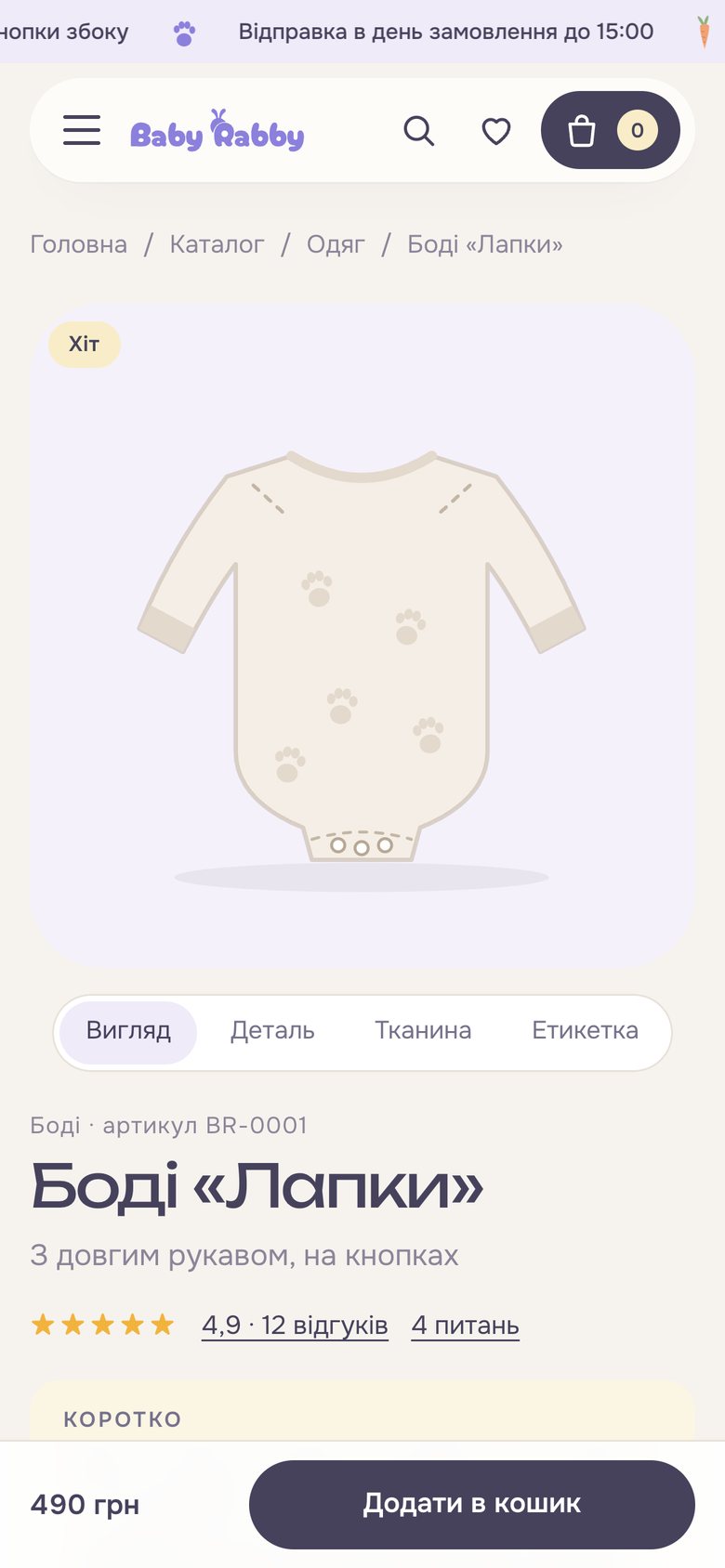
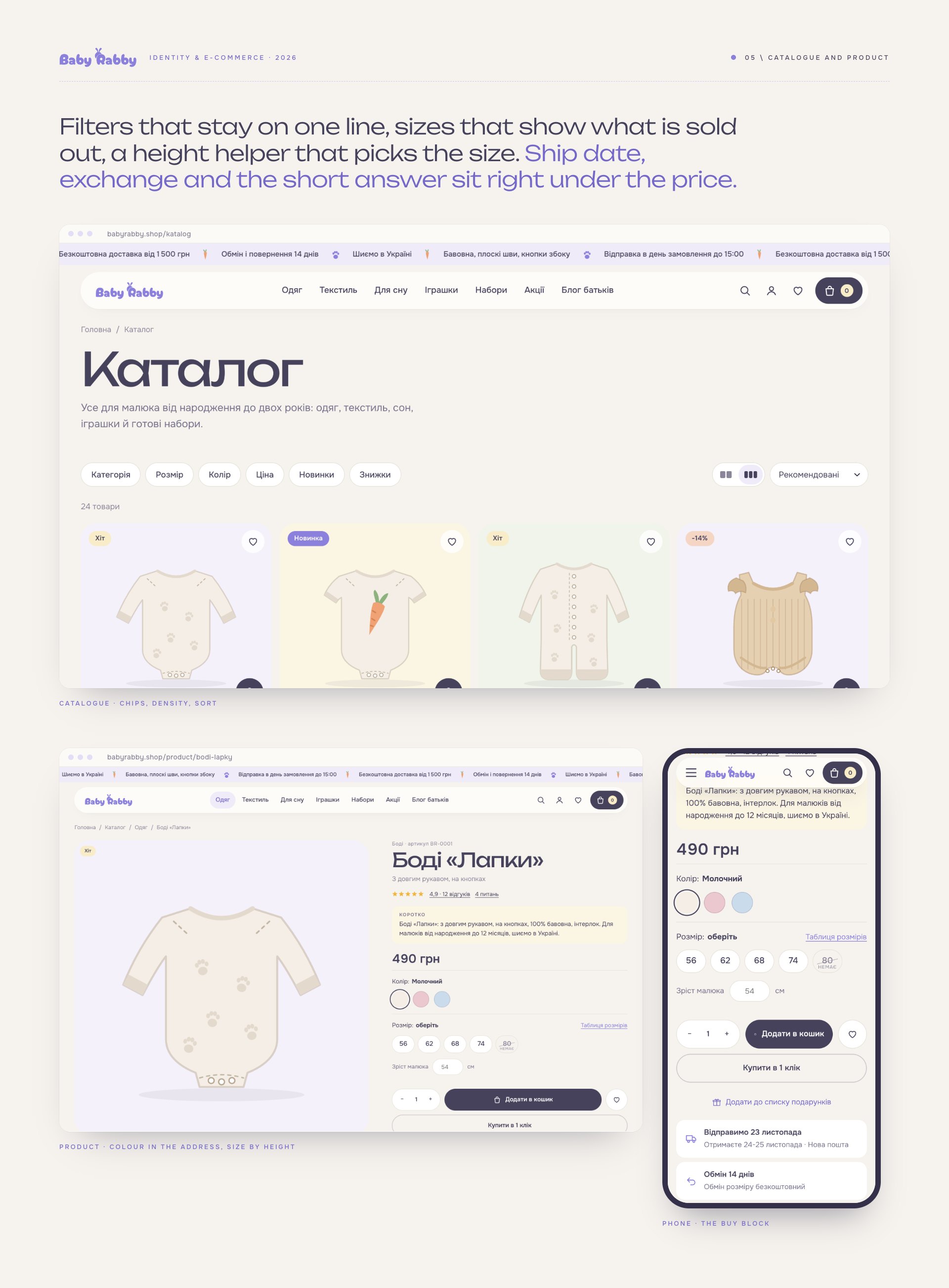
Filters stay on one line, the catalogue shows twelve more at a tap, and a toggle switches between large and small cards. On a product page the colour lives in the address, sold-out sizes stay visible with a “tell me when it is back” button, and a height helper picks the size. The ship date, the 14-day exchange and a short answer about the item sit right under the price.

Baby Rabby catalogue and product page on a computer, and the buy block on a phone

06. Bag, gift list, checkout

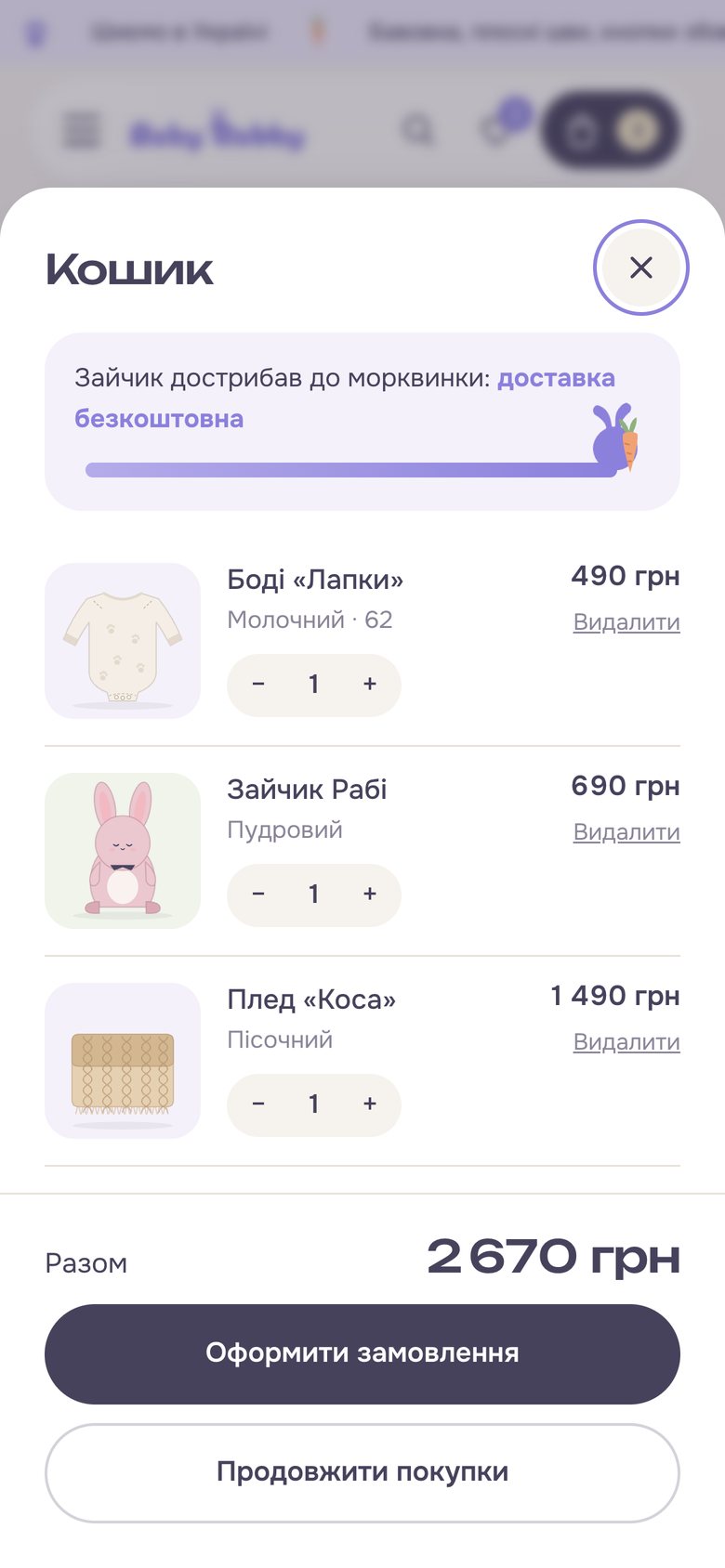
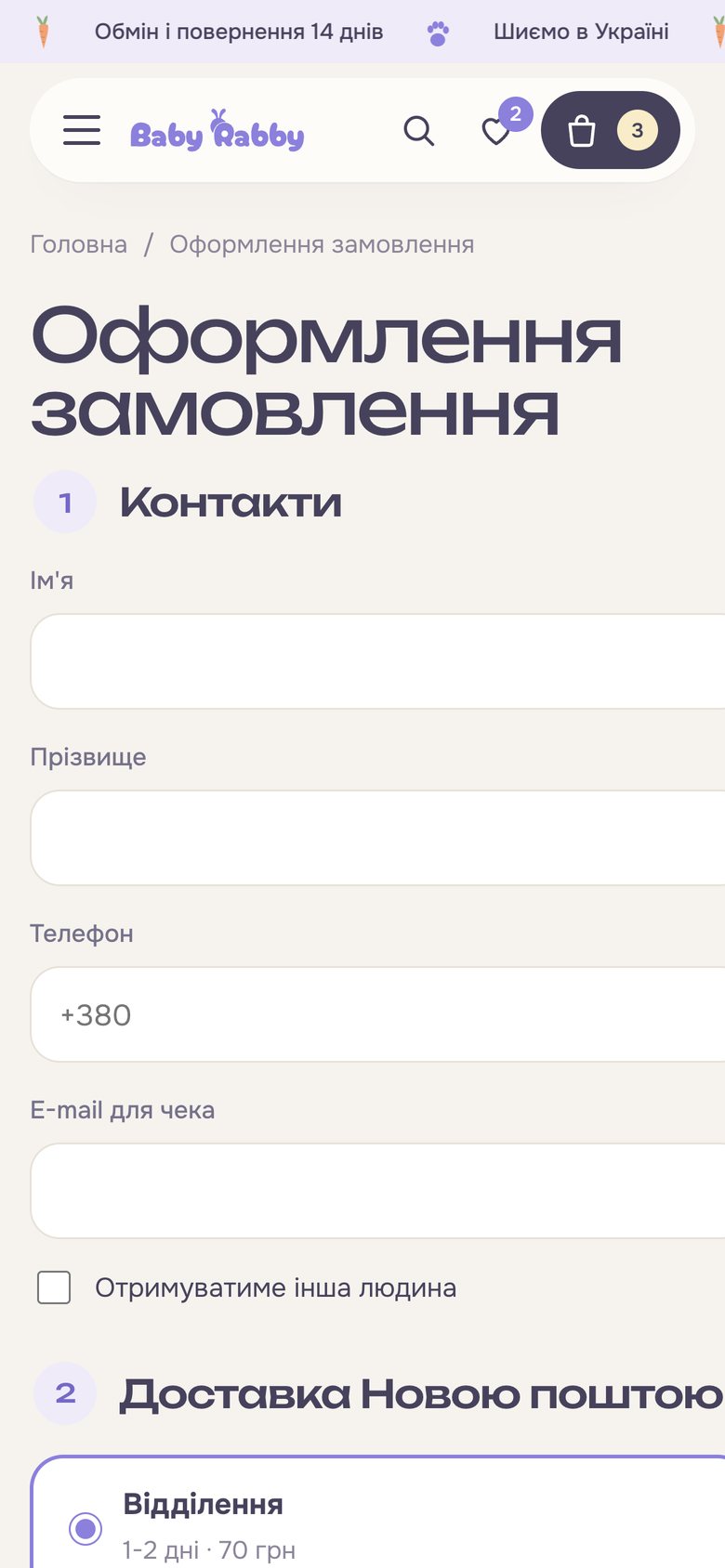
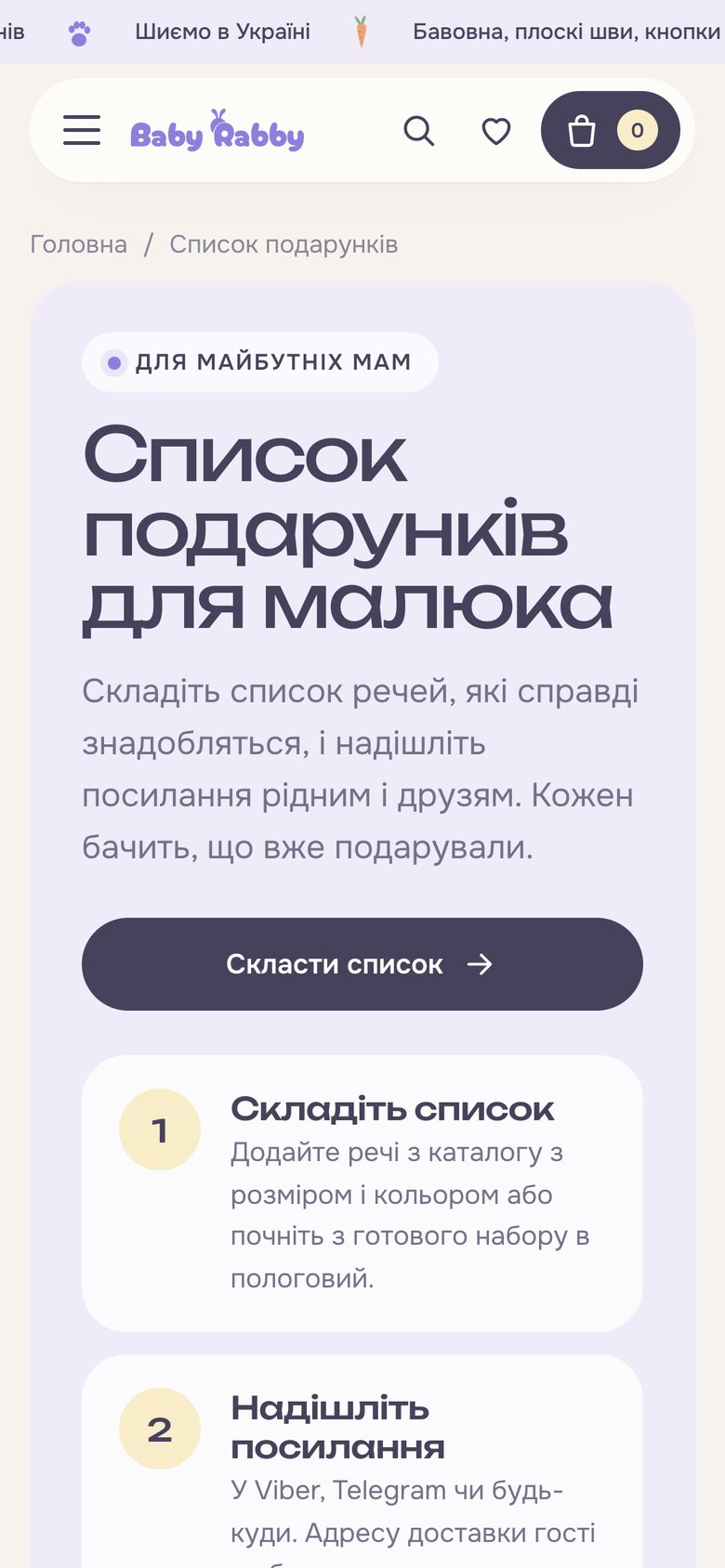
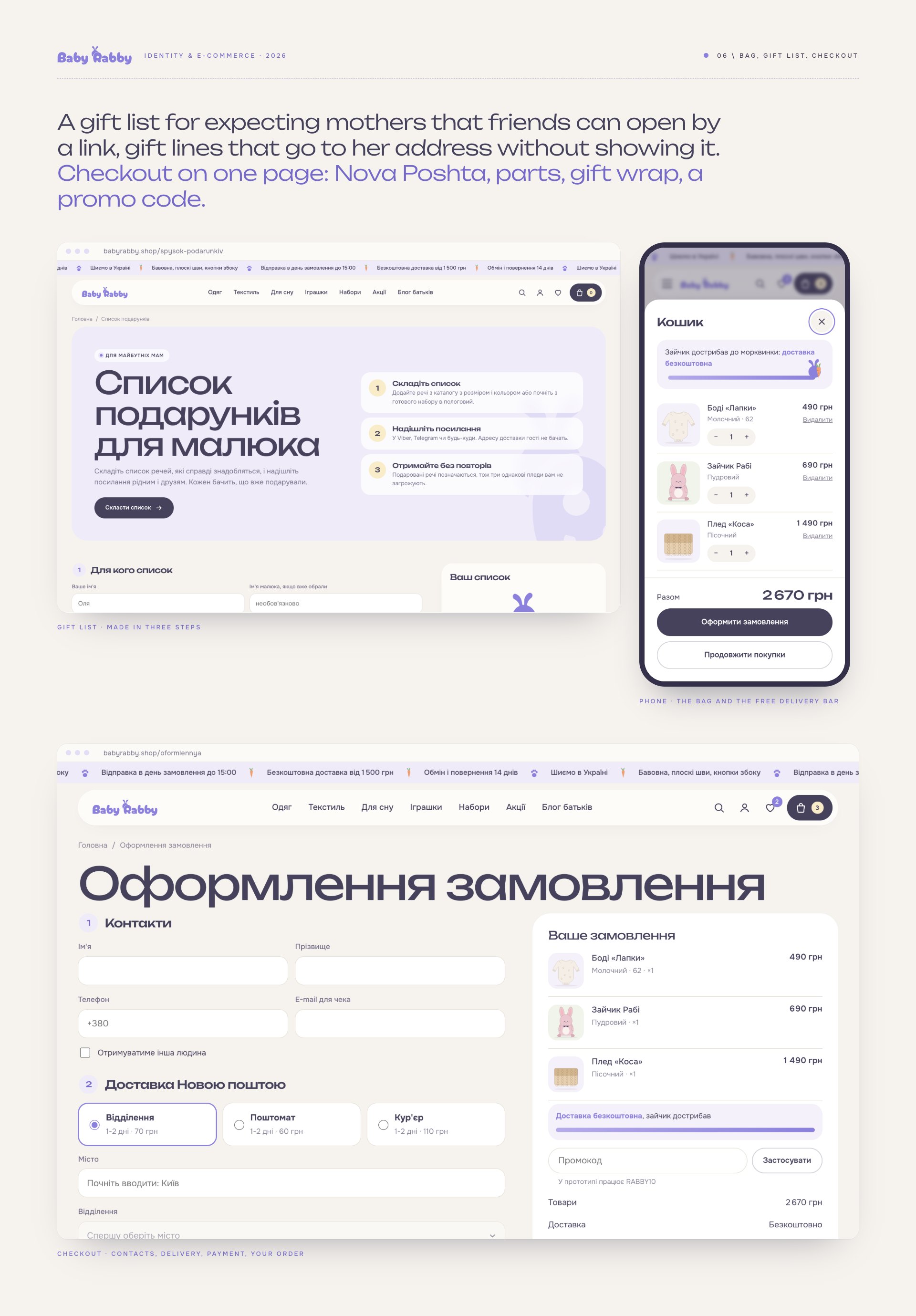
A gift list for expecting mothers: she picks the things, sends a link, and friends see what is already given. A gift goes to her address without showing it to the guest. Checkout is one page: Nova Poshta city and branch, a different recipient, payment in parts, gift wrap with a card, a promo code, and a bar that shows how far the bag is from free delivery, with the bunny hopping towards a carrot.

Baby Rabby gift list, the bag on a phone and the checkout page

07. Written for search and AI

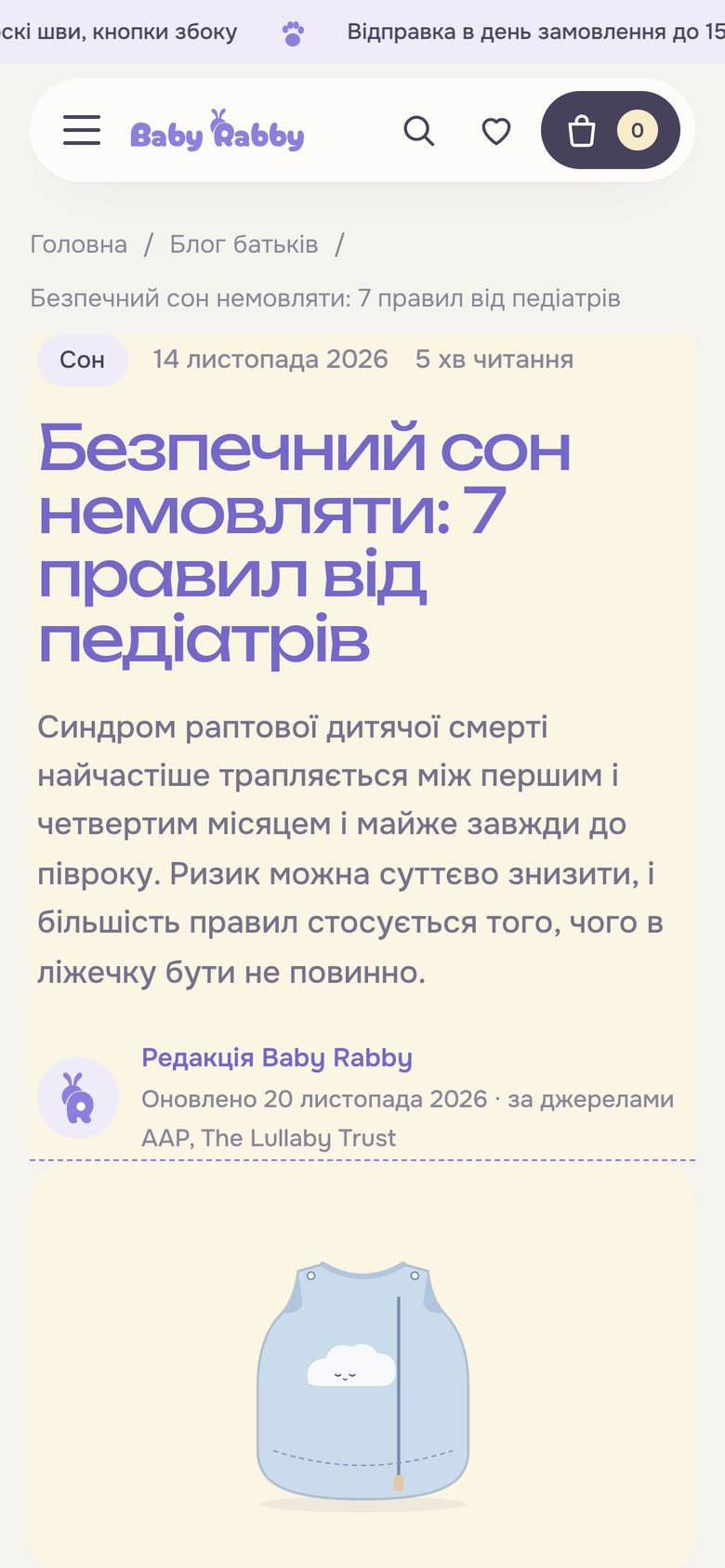
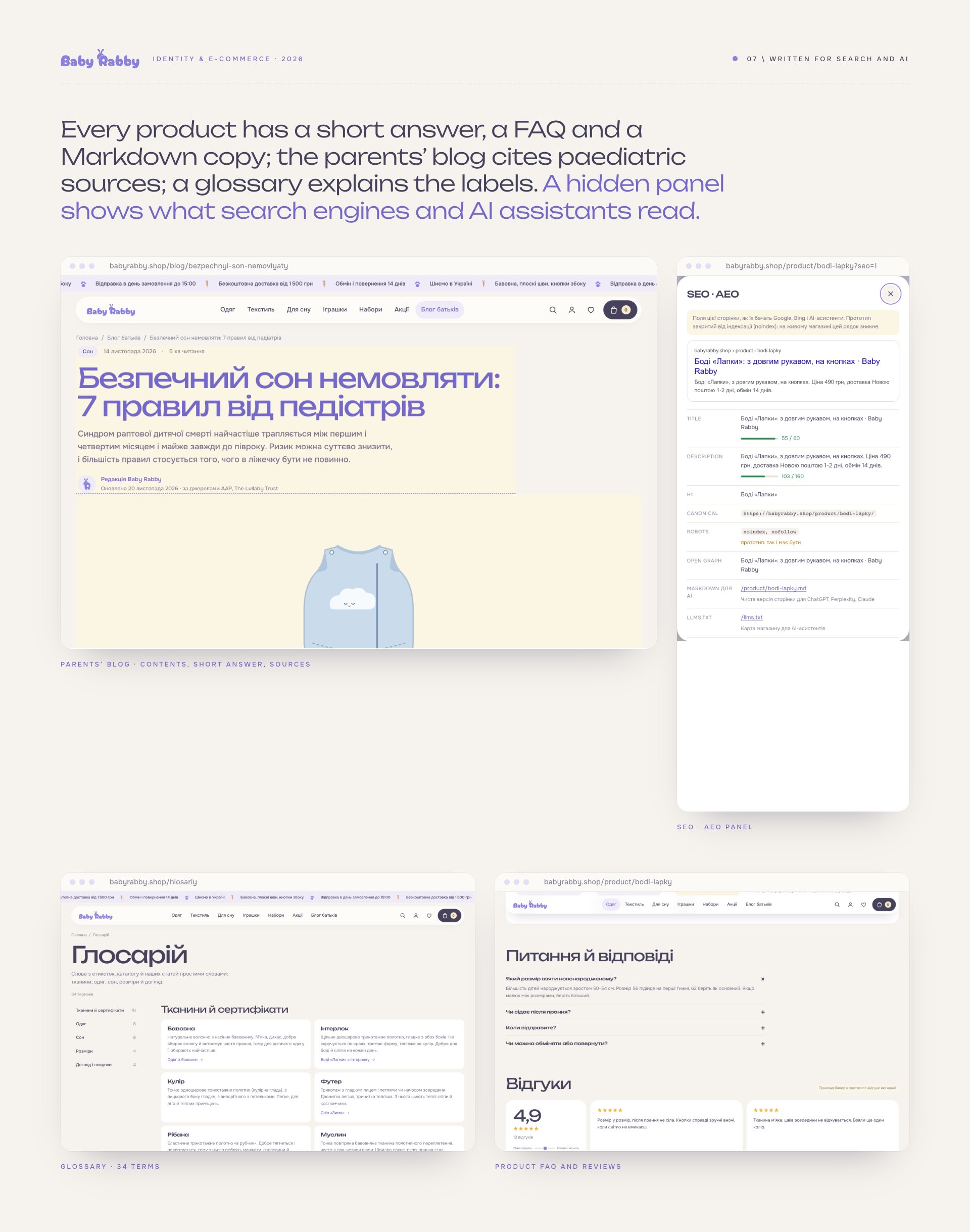
Every product has a short answer, a FAQ, structured data and its own Markdown copy for AI assistants. The parents’ blog explains safe sleep, sizes, sleeping bags and the maternity bag with paediatric sources, and a glossary of 34 terms explains the labels. A hidden SEO · AEO panel shows what Google, Bing and AI assistants read on each page: title, description, canonical, robots, the Markdown copy.

Baby Rabby parents’ blog article, the SEO and AEO panel, the glossary and the product FAQ

08. The pages a shop must have

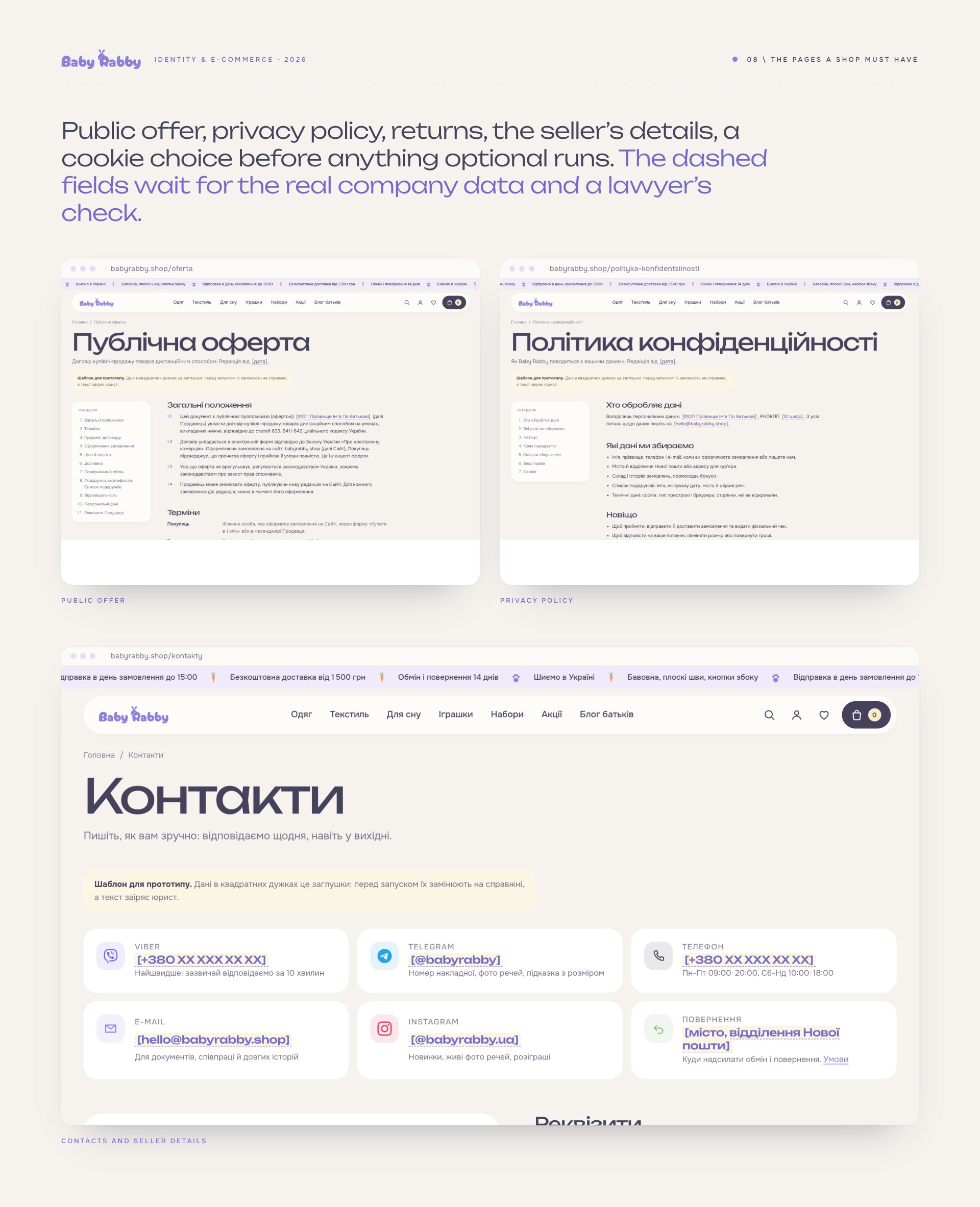
Public offer, privacy policy, delivery and returns, contacts with the seller’s details, and a cookie choice that really holds analytics and ads until the visitor agrees. The dashed fields wait for the real company data, and a lawyer reads every page before the launch.

Baby Rabby public offer, privacy policy and contacts with the seller’s details

09. Stage two: from prototype to a working shop

The prototype answered the questions that are cheap to answer early: what a parent sees first, how a size is chosen, what the bag and the checkout ask for. It was then frozen as the reference. Then the shop moved onto Laravel and grew what a prototype cannot have: the parent’s cabinet, the admin, purchasing and the warehouse. Nothing was redrawn on the way: the new shop had to match the prototype page by page before it was allowed to replace it.

10. The same shop, now on Laravel

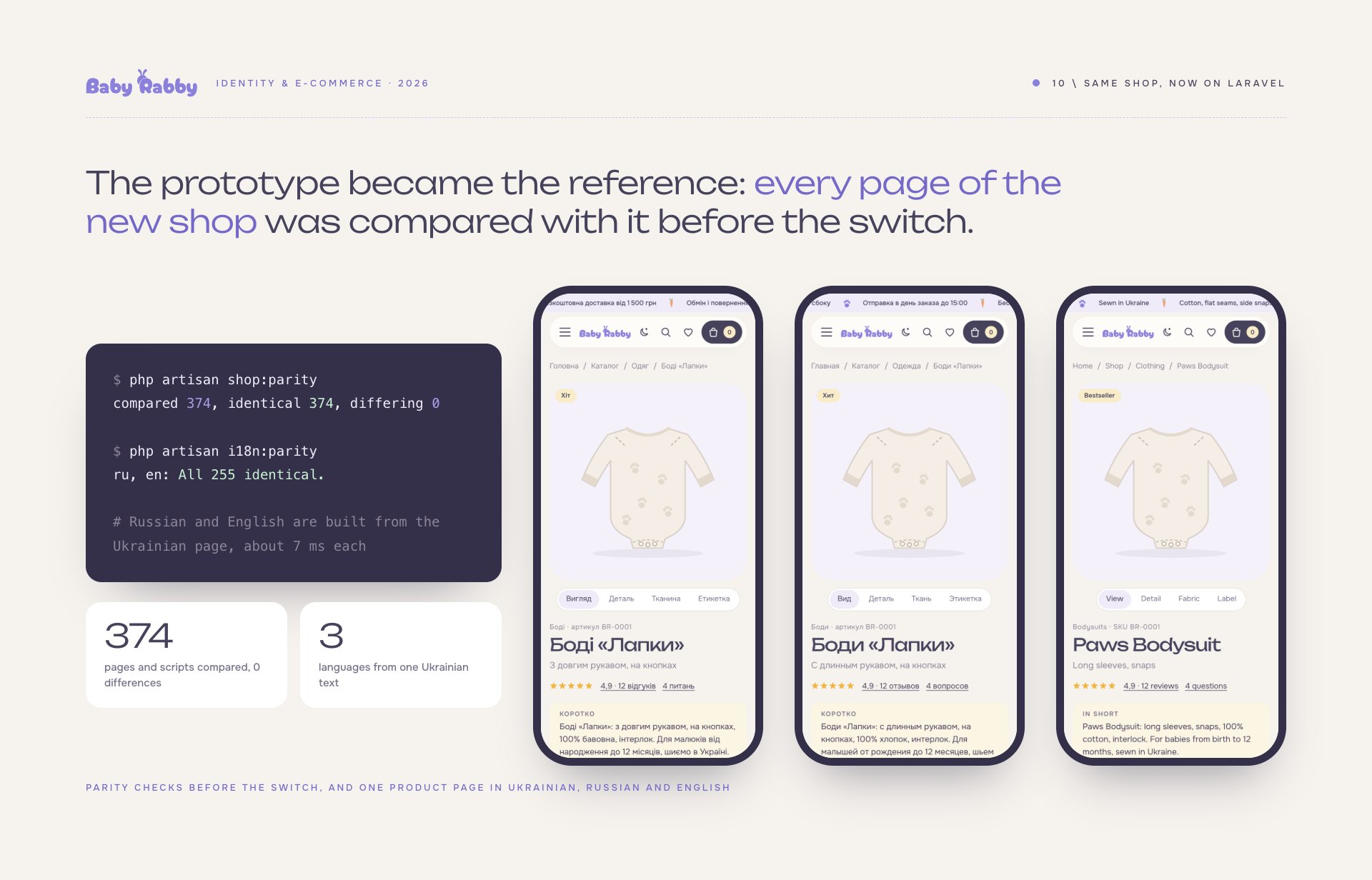
Every page now comes from the database through Blade templates: goods, categories, the blog, the glossary and the required pages. Before the switch a check compared the new shop with the prototype file by file: 374 pages and scripts, 0 differences. Russian and English are built from the Ukrainian page through a table of translated lines, about 7 ms a page, and a second check found all 255 translated files identical to the prototype’s. The switch itself was one link on the server, and the static prototype stays next to it as the way back.

Baby Rabby on Laravel: parity checks against the prototype and one product page in Ukrainian, Russian and English

11. The parent’s cabinet

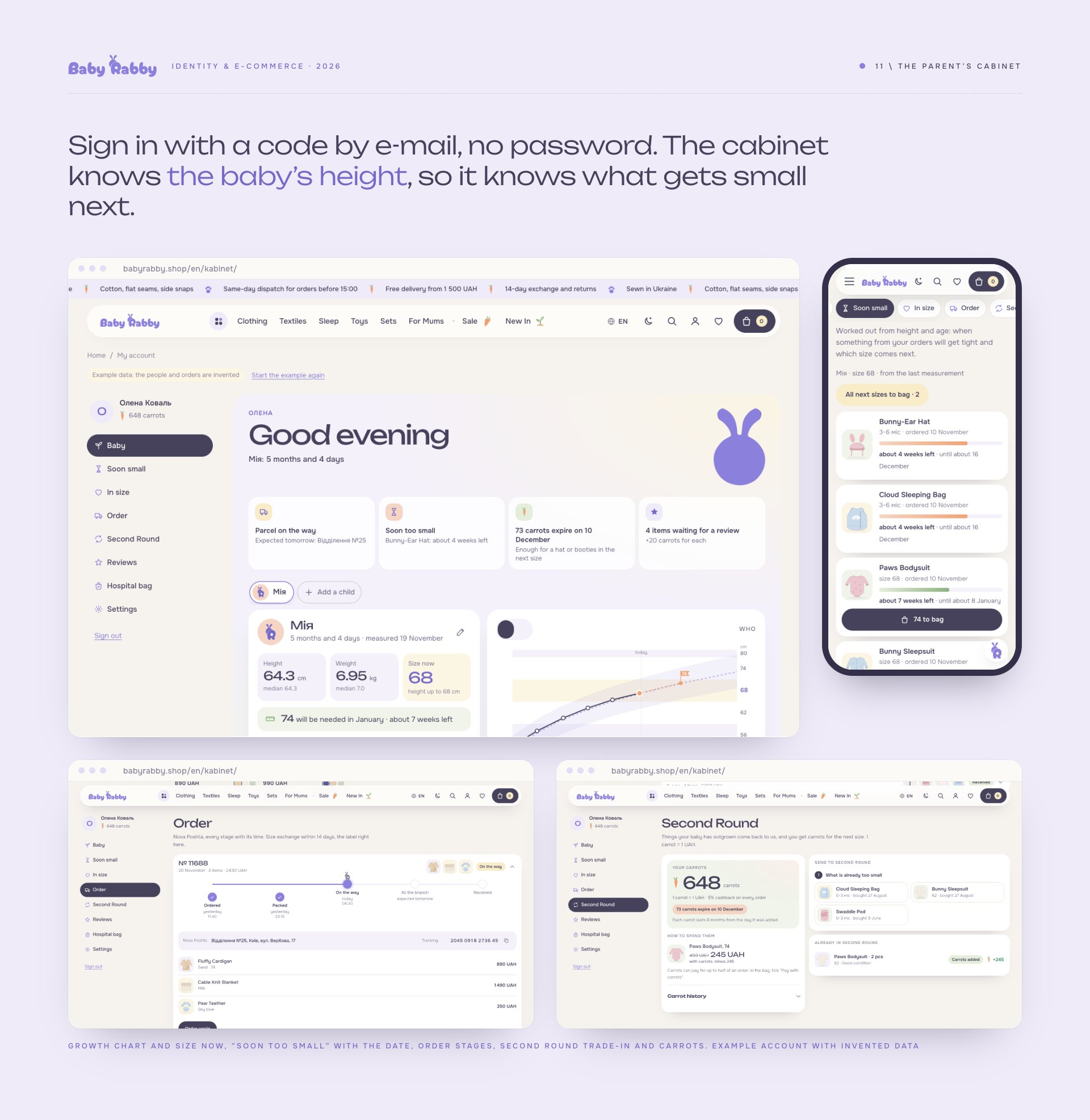
No passwords: a parent types an e-mail and gets a code, and orders placed with that address show up by themselves. The cabinet keeps the baby’s height and weight and works out the size now and the next one from WHO growth medians, so it can say that the 68 bodysuit will be tight in about seven weeks and offer the 74 in time. New in and sale are filtered by that size. Orders show their Nova Poshta stage and tracking number, and a size exchange stays open for 14 days after delivery.

Second Round takes back outgrown Baby Rabby items for carrots, the shop’s bonus, to spend on the next size. A review earns carrots too. The hospital bag list from our blog article can be ticked off here and shared with a friend.

Baby Rabby parent’s cabinet: growth chart and size now, soon too small, order stages, Second Round and carrots, on an example account

12. An admin built for daily work

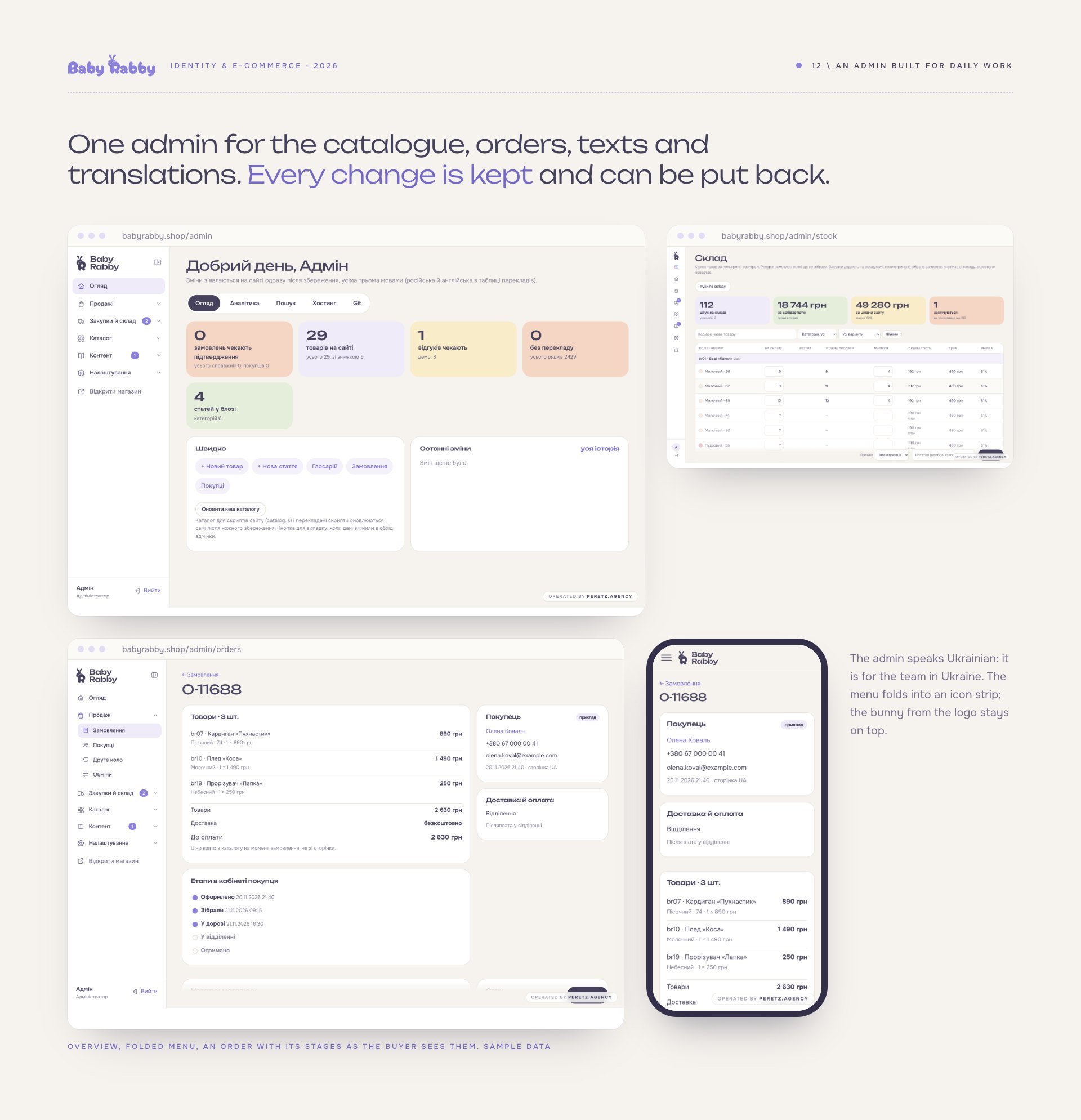
The daily work happens in Ukraine, so the admin speaks Ukrainian and is built for that work, not for a demo. It runs on the panel engine we first built for the DeZZign admin: goods with colours, sizes and photos, orders, buyers, exchanges, trade-ins, posts, the glossary and every translated line. Each save keeps what was there before, so any change can be put back, and a form that has gone out of date is refused instead of overwriting someone else’s edit. Changed pages that are open to search go to search engines through IndexNow right after the save.

Baby Rabby admin: overview, the menu folded into icons, an order with the stages the buyer sees, and the same order on a phone

13. Purchasing and the warehouse

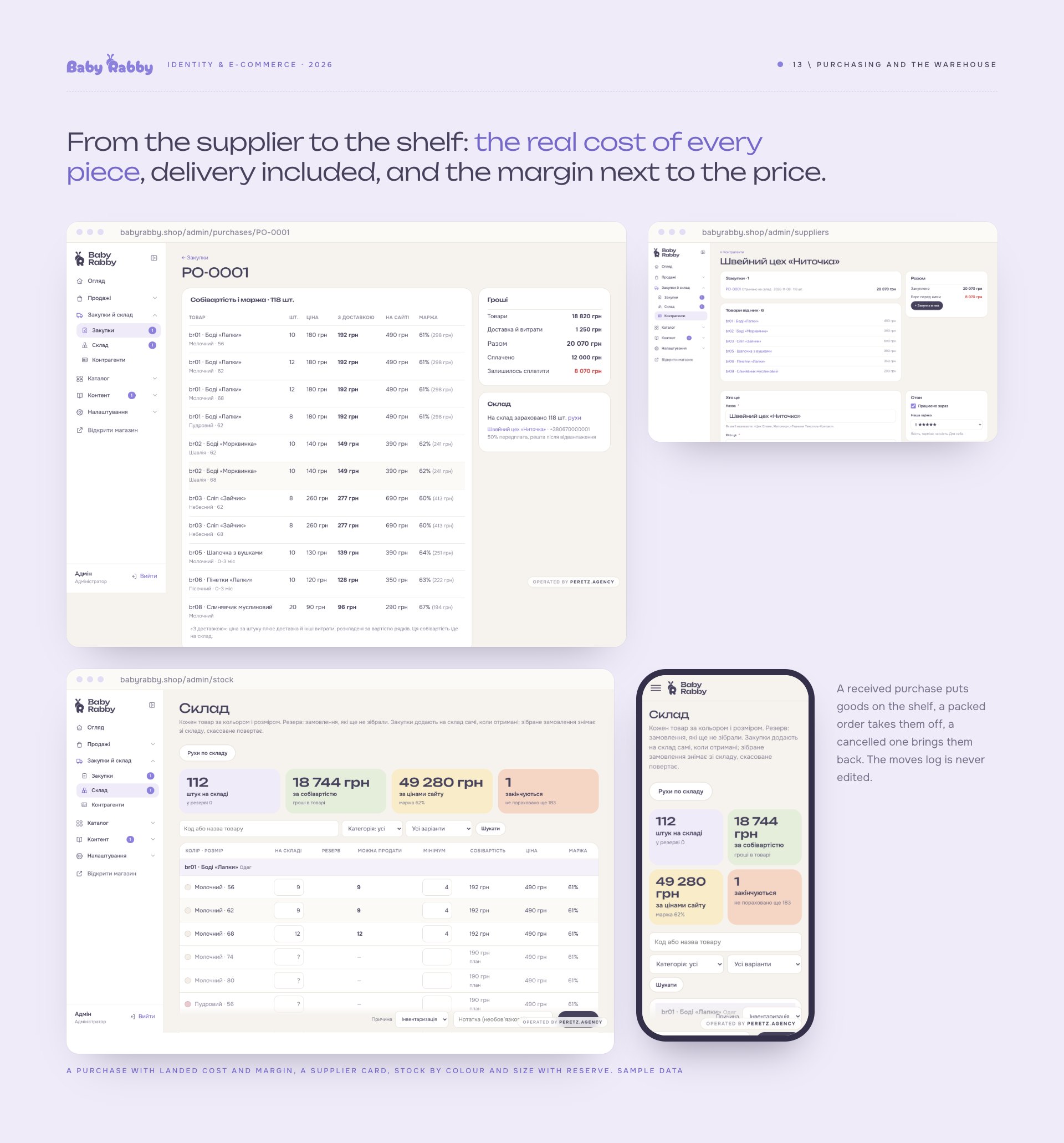
A purchase lists what was ordered by product, colour and size, with the price per piece. Delivery and other costs are spread over the lines by value, so every piece gets its landed cost, and the margin stands next to the site price before the goods arrive. When the purchase is marked received, the pieces go on the shelf at that cost. A packed order takes them off, a cancelled one brings them back, and an exchange moves both sizes.

Every change is a line in the moves log with the reason, the document and the person; a mistake is corrected by a new line, never by editing an old one. The stock page shows what is on hand, reserved and free to sell, what runs low, and which sold-out sizes on the site no longer match the shelf, with one button to put them right. Purchasing is visible to administrators only.

Baby Rabby purchasing: a purchase with landed cost and margin, a supplier card, stock by colour and size with reserve

14. Search, opened step by step

The goods are still drawn, so the shop stays closed to search engines. The blog and the glossary are open: they are written to launch quality, with sources, and can start earning trust now. Every other page carries noindex, and the sitemap lists only open pages. Google Analytics starts only after a visitor allows it in the cookie choice. Search Console and IndexNow are connected, and the admin shows what is open, the robots rules for each crawler and the hosting’s own bot block.

15. What is left before the first sale

Right now the shop is preparing for an active launch, and new features are connected every day. Before it opens it needs photos of the real goods instead of drawings, the seller’s details in the offer, online payment and the Nova Poshta connection with real branches. The stock is counted first, so the warehouse starts from real numbers.

Which documents, pages and checkout settings a shop needs before its first sale in Ukraine, the Gulf and the USA, we wrote up in a launch checklist built on Baby Rabby. How to plan the marketing budget for the first year and whether to start on a marketplace or your own store are in the next two articles.

Why we built stage two in this order, and how each part works, is in our case study Baby Rabby, stage two: from a prototype to an online store built to grow.