PERETZ Launches The Structure, a Technical Due Diligence Brand for Software M&A


In November 2026 our work on software deals moved into a brand of its own: The Structure, with its own site, method and tools, with Valeriya Chumachenko as Advisor to the Board.
In short
What is new
PERETZ is spinning its M&A direction out into a separate brand, The Structure. It does one job: an independent read of the technology of a software company for the people who buy and sell it. Buyers learn what they are taking over and what it will cost to own, while sellers see what a buyer's reviewers will find, early enough to fix it on their own schedule.
For now The Structure is a brand inside our group, under common ownership with PERETZ, with its own name, site and rules of work. Its focus is lower middle market software deals in the United States, and it is based in Seattle, where our founder lives. The site at thestructure.io went live in November 2026.
Yevhen Borovoi, the founder of PERETZ, is the founder of The Structure. We are glad that Valeriya Chumachenko is with it as Advisor to the Board, the same role she has held at PERETZ since 2020.
Why
Why a brand of its own
Since the summer of 2026 this work has grown inside PERETZ: the Technical Due Diligence Session, the articles of our M&A section and the reviews of products before a purchase. The further it went, the clearer it was that a technical review in a deal needs rules that an engineering company cannot keep under its own name.
The main rule is independence. A buyer or a seller has to trust that a finding is there because it is true, and that nobody wrote it to win the repair work. So The Structure works for one side per deal, takes a fixed fee with no success fee, and never prices or sells the fix inside the review. Every cost to fix in its reports is written for any competent team, with the assumptions stated, so the client can get a second quote on each line.
A review is worth something only if it does not sell the fix.
The second reason is the reader. A report for a deal is read by a buyer, a lender, counsel and an insurer, and each of them needs a finding in terms of the deal: price, escrow, a closing condition. In large software deals a technical review is routine. In smaller ones the deal often has a banker, a lawyer and an accountant, and nobody whose job is to read the technology. The Structure is built for that gap.
Leadership
Valeriya Chumachenko, Advisor to the Board
Valeriya has spent fourteen years in technology M&A and investment analysis: valuation, buy-side research and the question of what makes a software company worth buying. On our blog she wrote about how to audit a digital product before you buy it, why tech companies are valued with different math and the hidden discount of founder dependency, and co-wrote our guides to technical due diligence before selling and presenting a company to a buyer.
The team works in pairs. Every review is led by a senior engineer, who reads the code, the infrastructure and the access lists and talks to the people who run them. Someone with years on the deal side then reads every finding as a buyer, a lender or an insurer would. When a finding is technically true but does not say what it means for the deal, it goes back for rewriting. Clients meet the people on their engagement by name before they sign.
Expertise
What The Structure checks
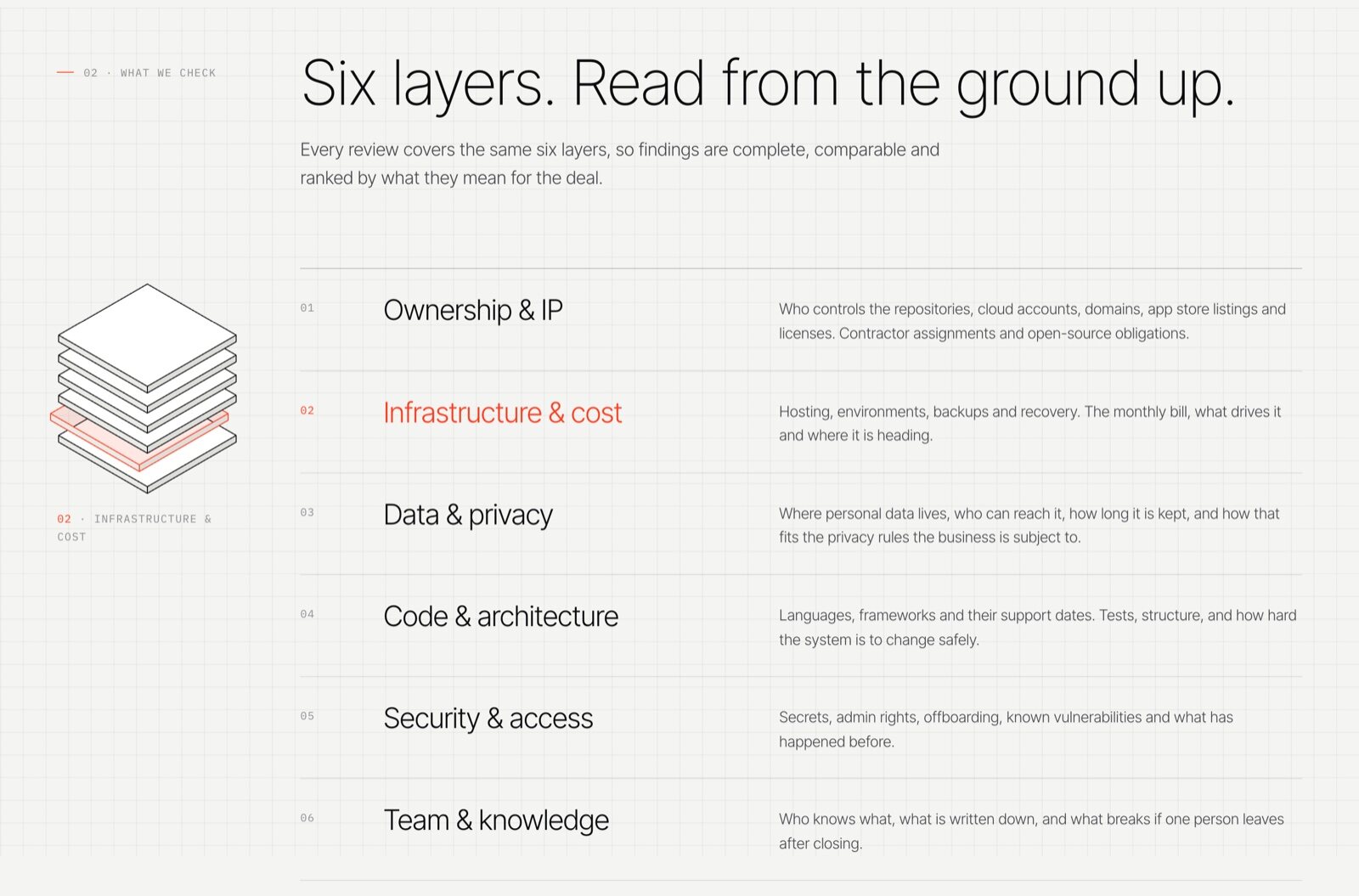
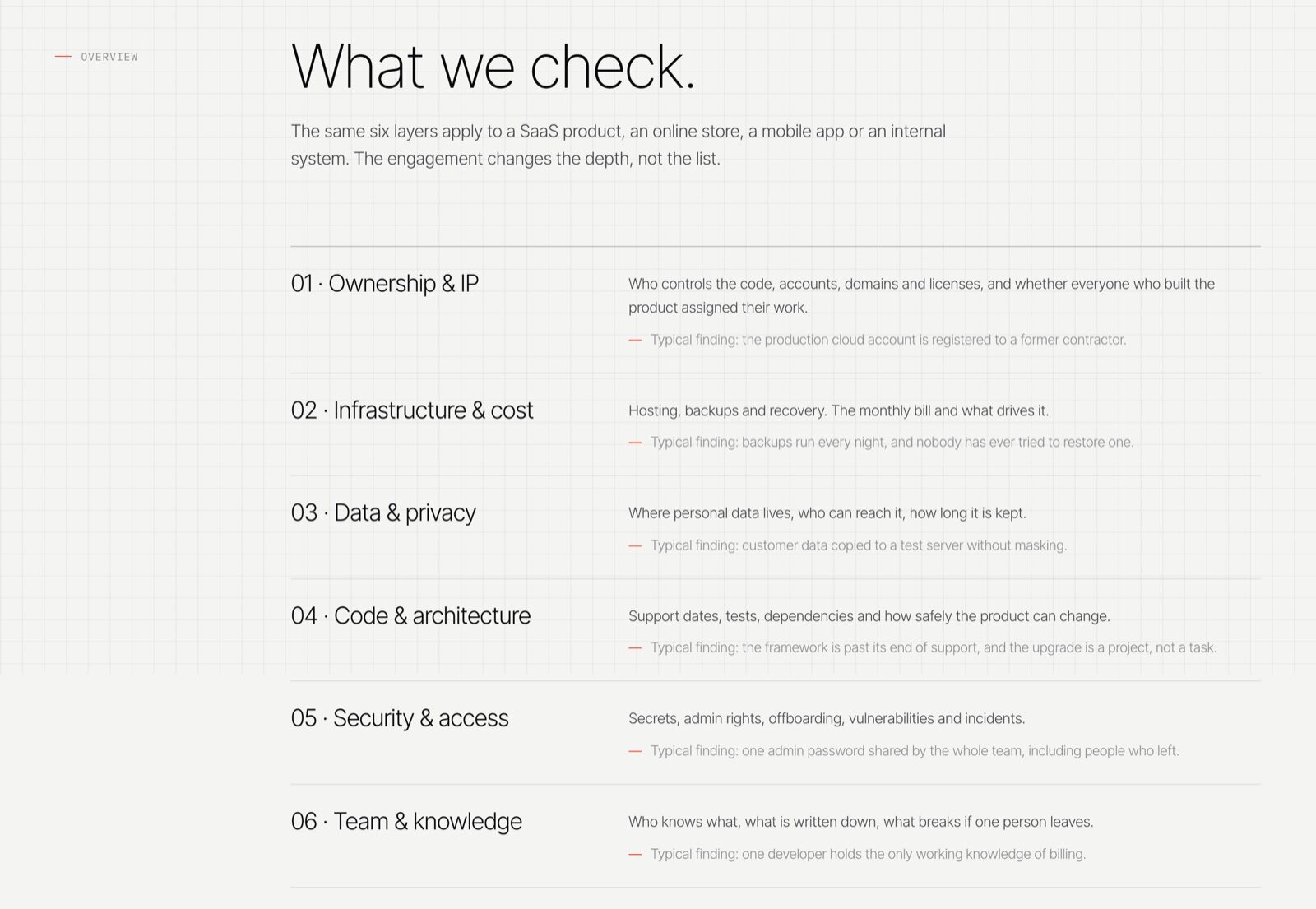
Every review reads the same six layers of a software company, from the ground up:
- Ownership and IP: who controls the repositories, cloud accounts, domains, app store listings and licenses, and whether everyone who built the product assigned their work.
- Infrastructure and cost: hosting, backups that have been restored at least once, and the monthly bill with what drives it.
- Data and privacy: where personal data lives, who can reach it and how long it is kept.
- Code and architecture: frameworks and their support dates, tests, and how safely the product can change.
- Security and access: secrets, admin rights, offboarding, known vulnerabilities and past incidents.
- Team and knowledge: who knows what, what is written down and what breaks if one person leaves after closing.
Each finding gets one of four ratings (Critical, High, Medium or Low), the evidence behind it, its business impact and a cost and time to fix. The engagements differ in depth and timing:
| Engagement | Side | What it is for |
|---|---|---|
| Red-flag memo | Buyer or seller | A focused check of what could stop or reprice a deal, usually in 5 to 10 business days |
| Technical due diligence | Buyer | The full review of all six layers inside exclusivity, with interviews and a fix plan with costs, usually 2 to 4 weeks |
| Vendor due diligence | Seller | The same review ordered by the seller and shared with buyers, usually 3 to 5 weeks |
| Exit readiness | Seller | A monthly program 6 to 18 months before a sale: baseline, fix plan, tracking and a mock review at the end |
Beyond the six layers, the team works with the questions that come up most in current deals. The Insights section of the new site already covers products written largely with AI, AI products that may be thin wrappers around someone else's model, carve-outs from a parent company and aging platforms. It also covers technical debt as a cost range, the technology behind SaaS gross margin, key-person risk, the technical section of a data room and the path from due diligence to a 100-day plan.
Tools
What we built for it
The Structure starts with a full working set, built by our own team. The site carries the approach with the questions asked in each layer and typical findings, the four engagements, the clients it serves (founders and boards, search funds and independent sponsors, private equity, advisors), a detailed FAQ and author pages. It opens with seventeen reviewer's notes, written by Valeriya and Yevhen, and has its own site search.
The method itself is written down so a client can check it: one severity scale, a report with a two-page summary for decision makers and full findings for engineers, and an access protocol. Access is read-only, through named accounts, limited in time and closed at the end of the review with written confirmation, under an NDA signed before the first document.
Behind the site sits its own console. Articles, author pages and inquiries are managed there, and one dashboard shows how the site is seen in search and which search and AI crawlers visit it. It grew out of the indexing audit we first built for our own site. Every inquiry is recorded before any email is sent, so none is lost, and The Structure answers within one business day.
Review and repair stay separate, even under common ownership.
PERETZ
What changes for PERETZ clients
PERETZ stays what it is: a software and design company that builds products shaped by the logic of a business. For The Structure it becomes the engineering partner. When a client wants the findings fixed, PERETZ can do that work under a separate contract: framework upgrades and Laravel development, project takeover from another contractor, a fractional CTO for the months after closing, or systems integration after an acquisition. It is never a condition of a review, and clients are free to choose any other team.
If PERETZ has worked on a company The Structure is asked to review, The Structure says so before it starts, and declines when that could affect its view. Our M&A section stays on this blog, with guides on the data room for selling a company, the pitch deck for investors and passing a business to the next generation.
FAQ
Questions about The Structure
What is The Structure?
A technical due diligence brand for software M&A, spun out of PERETZ in November 2026. It reviews the technology of software companies for buyers and sellers across six layers, from who owns the code and accounts to what the team knows.
Who is behind The Structure?
Yevhen Borovoi, the founder of PERETZ, is its founder. Valeriya Chumachenko, with fourteen years in technology M&A and investment analysis, is Advisor to the Board, as she has been at PERETZ since 2020.
Does a review mean I have to hire PERETZ for the fixes?
No. Fixes are a separate decision and a separate contract. The report prices each fix for any competent team, so you can get quotes elsewhere, and The Structure checks the result the same way whoever does the work.
How is a review priced?
One fixed fee, agreed in writing before the work starts, based on the size of the product and the depth of the review. There is no success fee: the fee is the same whether the deal closes or not.
What does The Structure not do?
It does not arrange, negotiate or execute transactions, and it does not give legal, tax, accounting or investment advice or valuations. It works alongside the advisors who do.
Buying or selling a company that runs on software? Let's look at what its technology will cost to own.
- Share
-

-

-

-

One notification a week with the new PERETZ articles. Nothing else.
Related Reading
-
31. 10. 2026

PERETZ Opens Teams and Launches New Development Services

-
03. 11. 2026

Selling Your Company? What a Buyer's Technical Due Diligence Will Find, and What to Fix First
-
04. 11. 2026

How to Prepare a Data Room When Selling a Company or Raising Money: What Goes In, in What Order, What Goes Wrong