How to Pass a Business On So It Survives: the Order, and What Breaks




A buyer arrives with auditors. A successor arrives with gratitude, and inherits everything nobody looked at. Here is how to choose who takes over, the order that gives the company its best chance, and the places where a handover usually breaks.
IN SHORT
The short answer
Pass a business on in this order: find out who can run it and truly wants to; separate ownership, management and family money; test whether the company runs without you; have it inspected the way a buyer would; move accounts, rights and relationships out of your name; hand over management in stages; transfer ownership on the schedule your lawyer and accountant set; then actually leave. Plan on years. What breaks is usually what nobody checked, because in a handover nobody is paid to check.
The options are family, a partner, the management team, employee ownership or a sale after all, and the choice depends on three plain facts: whether a named person wants it, whether you need the money from it to live on, and whether the company can already run without you. The first two are conversations. The third is a test you can run.
Three limits, stated now. Tax, inheritance and company law belong to a lawyer and an accountant in your own country, and nothing here is legal or tax advice. We have not published a family succession case, so where we draw on our own work, each tie is labelled for what it was. And this takes years and experienced people. A session can tell you where you stand; it cannot do the handover.
THE 30 PERCENT
The figure everyone quotes
You have probably read that only 30% of family businesses survive to the second generation, 13% to the third and 3% to the fourth. We wanted to use that figure here, so we went looking for where it comes from. It turned out to be a weak statistic, and an owner deciding what to do with thirty years of work deserves to know that.
It goes back to one study. In his 1987 book Keeping the Family Business Healthy, John Ward reported on family firms in the United States. James Grubman's 2022 review in The International Family Offices Journal describes the base: public records on 200 family businesses, one industry (manufacturing), one state (Illinois), with success meaning that majority family ownership passed to the next generation. We could not open the book itself, so this rests on Grubman and on Family Business Magazine, which reported in 2011 that Ward had acknowledged the limits, and that researchers Nason and Nordqvist called the figures "low, out of context and not generalizable" at a 2010 Family Firm Institute conference.
Then there is the definition. Craig Aronoff, of the consulting firm Ward belonged to, wrote in 1999 that the numbers mean family leadership and control. So a company handed to its employees, sold well to a competitor or wound down on purpose falls outside them. An owner who sold for a good price and a company that went bankrupt land on the same side of that 30%. It also lacks a baseline: the same magazine piece notes that, on Census data, 50% to 60% of US start-ups founded in 2000 failed within five years and only 25% lasted a decade. Measured against that, three in ten over a generation may not be a scandal at all.
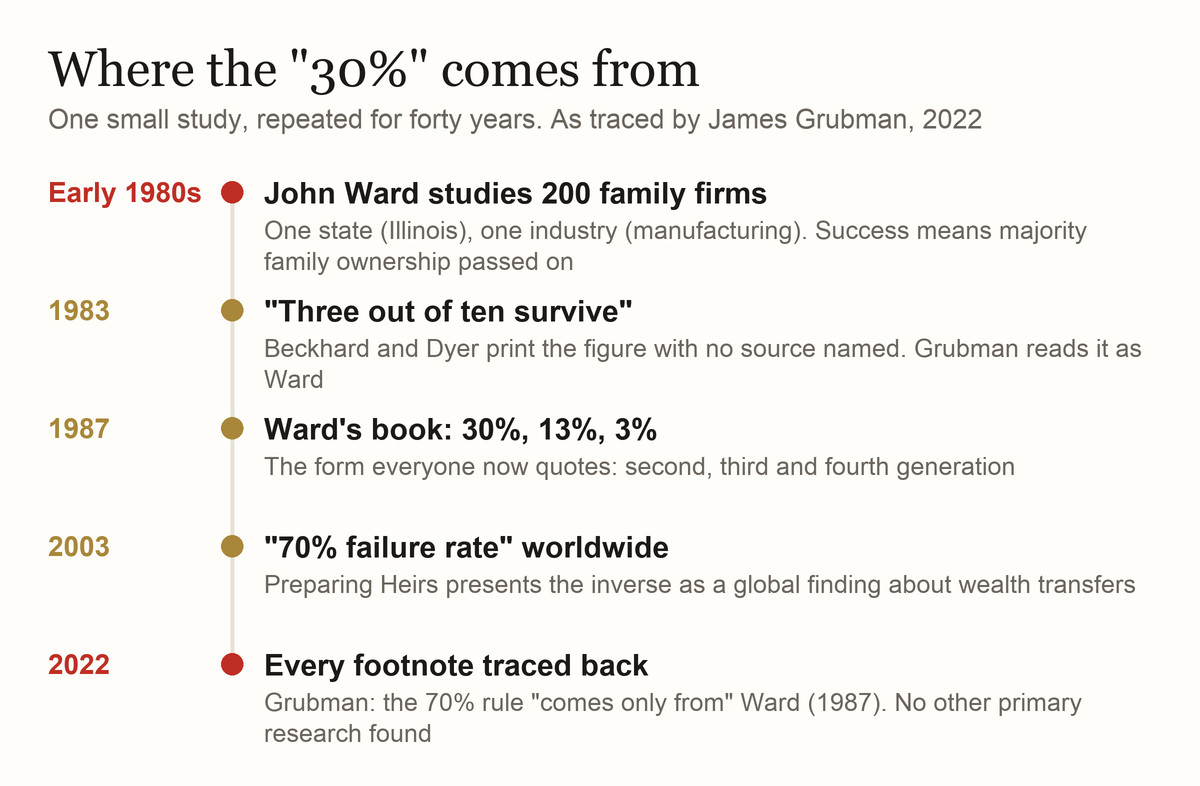
The companion claim, that 70% of wealth transfers fail, is the same number turned over. Grubman followed its citations through every footnote and concluded that it "comes only from" Ward's study. The seventy percent in our own The Number Nobody Tells You is a different figure on a different question, owners who go looking for a buyer, and that article's self-check is worth running whichever way you lean.
Here is what can be said with a date and a sample. None of it tells you your odds, and we know of no good number that does.
- PwC, 2025, 1,325 family businesses in 60+ territories, interviewed April to June 2025: 28% have no clear leadership transition plan, 47% keep their original timeline and 10% are delaying.
- Exit Planning Institute, 1,162 US owners, 2023: 75% want to exit within 10 years and 49% within 5, while only 24% have a will and 30% an updated estate plan. The institute trains exit planners, so it has a stake.
- US Census Bureau, data year 2018, 4.1 million responding owners of employer businesses: 51% were 55 or older.
So plan without a survival rate. The useful numbers concern preparation, and most owners can change those.
FIVE ROUTES
Five routes, and how to choose
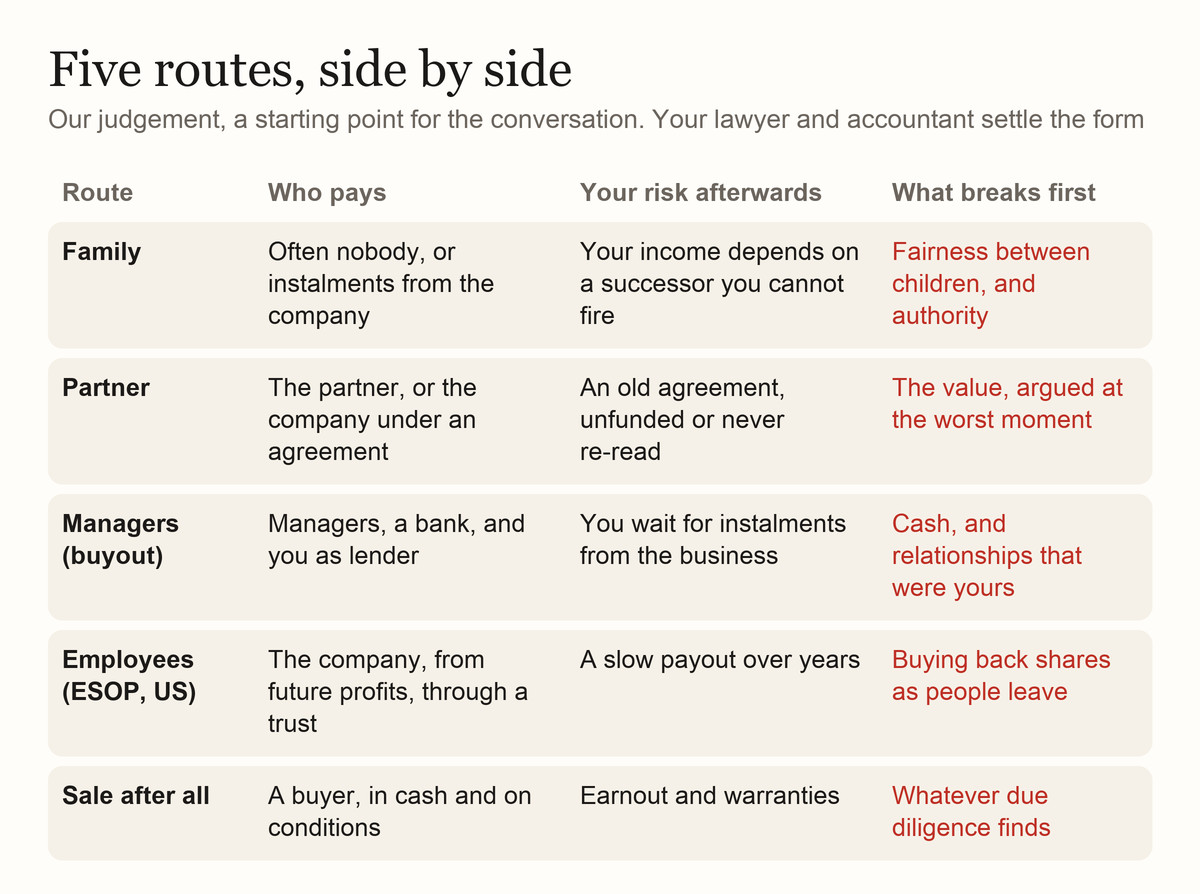
Family. It is the favourite: 70% of the owners in the Exit Planning Institute's 2023 survey preferred an internal transition, with family first among those options. The best evidence on results is sobering. Bennedsen, Nielsen, Pérez-González and Wolfenzon studied 5,334 CEO successions in Danish limited liability firms from 1994 to 2002, 1,776 of them to family members. Their design used the gender of the departing CEO's first child to separate cause from coincidence, and they found that family succession lowered operating return on assets by at least four percentage points around the transition, most of all in fast-growing industries, in those with highly skilled staff and in larger firms. It is one country and an average from over twenty years ago, and it says nothing about your daughter. It does say that a surname is no qualification, and that a child may hold the shares while someone hired runs the company.
A partner. A partner already knows the business, which removes much of the learning. Two things usually go wrong: partners are often close in age, so the question returns soon, and the agreement that was meant to settle it is old, unfunded or was never read again.
The management team. A management buyout hands the company to the people who already run it, and they rarely have the money. The price tends to come from a bank and from you, paid over years out of the company's own profits, so you become a lender to the people you stopped supervising. In the US, SBA 7(a) loans list complete or partial changes of ownership among their uses. The route works when the team has really been deciding things for some time, and fails when they have only been carrying out your decisions well.
Employee ownership. In the US this usually means an ESOP, and NCEO counts 6,411 companies with one, on 2023 data updated in January 2026. Under the usual design, a trust holds the shares, the company funds the purchase from future profits, a private company needs an outside valuation every year, and it must buy shares back from people who leave, which is a long-term call on its cash. Bob's Red Mill is the well-known case: the founder, fending off offers from large corporations, announced an ESOP on his 81st birthday, and the company reached 100% employee ownership on April 30, 2020, ten years later. An ESOP is an American legal form with American tax rules, and it does not travel by itself.
A sale after all. If nobody can or wants to take it, a good sale is a success, whatever the 30% says. How that decision forms is in Nobody Wakes Up One Morning and Decides to Sell, and the question beneath all the routes is in Before You Sell, Retire, or Hand It Down. The routes also combine: the family owns, a hired manager runs, and later a part is sold.
Four questions narrow it down faster than any comparison:
| Question | If yes | If no |
|---|---|---|
| Is there a named person who can run it and has said, in their own words, that they want to? | Family, partner or team stay open | Hire a manager and keep the shares, or sell |
| Do you need money from the business to live on? | Cash from a buyer, or instalments your lawyer secures | A slower transfer becomes possible |
| Can the company pay for its own transfer from profit? | Buyout or employee ownership can work | Outside money, or a sale |
| Would it run for 90 days without you? | Every route is open | Fix this first, since every route suffers |
NOBODY CHECKS
Why this is harder than a sale
A sale to a stranger has a hostile reader built in. The buyer's team opens everything, because it is about to pay. Bad news becomes a discount, a holdback or a line in the warranties, which is unpleasant and effective. A handover removes that reader.
| Sale to a stranger | Handover | |
|---|---|---|
| Who inspects | Auditors, lawyers and analysts paid by the buyer | Usually nobody |
| Who can walk away | The buyer, up to closing | In theory the successor, in practice rarely, since it means saying no to a parent or a boss |
| Bad news | Priced into the deal | Stays unsaid and arrives later as the successor's problem |
| Protection | Warranties, disclosure, sometimes escrow | Often none |
| The former owner | Leaves, usually after a transition period | Stays close, often as shareholder, often at Sunday dinner |
The successor inherits all of it: debts, disputes, promises made to staff over the years and never written down, the customer who is really your friend, the contractor who holds the only copy of the code. So run the due diligence anyway, and give the results to both of you. You pay for it, people independent of you both do it, and it gives the owner and the successor the same facts, perhaps for the first time. It also gives the successor an honest moment to say no, and if the company is sold in ten years, much of the work is already done.
What such a review finds on the technology side is listed in Selling Your Company? What a Buyer's Technical Due Diligence Will Find, and the wider look is in Before You Hire Bankers, Diagnose the Business. An owner's self-check is only a first look. A real review takes people with long M&A experience, sometimes licensed, and analysts who understand someone else's code from top to bottom, while finances and contracts belong to accountants and lawyers. Valeriya Chumachenko, who has more than ten years in technology M&A, leads our technical reviews. None of this is free or fast.
A buyer gets a data room. A successor gets a set of keys.
THREE QUESTIONS
Ownership, management, family money
In a founder's head, three questions are one question. Who owns it, who runs it and who lives on it have had the same answer for thirty years. The classic picture of this is the three-circle model that John Davis and Renato Tagiuri developed at Harvard, with family, ownership and business as overlapping circles, and the trouble sitting where one person stands in two at once. A handover pulls them apart whether you plan it or not.
| Question | How it usually looks | What separating it means |
|---|---|---|
| Ownership | "The kids will get it equally one day" | A written plan: who holds what, when, with which votes, and what happens on death, divorce or a wish to leave |
| Management | The eldest runs it because the eldest is the eldest | A real job description, the bar you would set for an outsider, and someone other than a parent who can say it is not working |
| Family money | Salaries as allowances, cars and rent through the company, undocumented loans, the building in your name | Market pay for work, distributions for ownership, your own income settled separately |
The hardest case is the child who works in the company and the child who does not. Equal shares can mean that one carries the business and the other holds a veto over it. Unequal shares can end a family. There is no formula for this, and people who sell one should be doubted, but it has to be discussed while you can still chair the discussion. Your lawyer will know which documents can carry the result, often a shareholder agreement and sometimes a family charter.
Conflict deserves more planning than it gets. In PwC's 2025 survey, 38% of family businesses globally report family conflict from time to time and 10% regularly. Among those who have any, 54% handle it within the immediate family, 12% apply a resolution mechanism of their own and 10% use a third party. An agreed way to settle a dispute costs little while everyone is speaking to each other.
Then there is your own money, the item people avoid most. If the company is your retirement, the successor starts life owing you an income, and that has to be counted early, with an accountant, because it may decide the route on its own.
IN YOUR HEAD
What you hold, and how to test it
Our glossary has the vocabulary: key-person dependency, tacit knowledge, transferability and the bus factor. Founder Dependency: The Discount Nobody Puts in the Deck explains how a buyer prices all this.
What you hold comes in three kinds, and each moves differently:
- Facts. Which supplier ships on time, why the invoice run happens twice at month end, what the 2019 contract really says. These can be written down, and a stranger's questions show you what to write.
- Relationships. The customers who take your call and nobody else's. These move only by introduction, slowly, with the successor in the room and then in the lead.
- Judgment. When to refuse a client, which number to distrust, when a complaint matters. This one resists documents.
The third kind is why a handover takes years. Writing about our own company, Yevhen once asked how he would teach the next CEO what he does, and his answer in that essay was a walk: watch, do it together, try, make a mistake, discuss why, try again. He adds in the same essay that he may be wrong. It is the closest thing we have to a method, and it fits a parent and a child better than a manual does.
The 90-day test usually gets asked as a thought experiment. Run it as a real one, in steps. Start with two weeks with no email and one person authorised to decide. Then thirty days, reachable only by that person. Then ninety. Set in advance what would call you back: cash, a safety problem, a named customer. Keep a log of every question that reached you, why it came to you, and who decides next time. That log is your to-do list, and you repeat the test until it runs short. If your people have never decided anything, the first two weeks will be rough, and that is the finding.
Write the facts for someone with no history. On our own site we keep running notes on where each scheduled job lives, what must never be done there and why, and where each rollback copy sits, so that a person arriving cold can carry on. A company's version is longer, but the test is the same: can someone who was not there follow it?
A process can be written down. Judgment has to be watched.
THE DAY AFTER
Logins, domains and passwords
Picture Tuesday morning. You are unreachable, and the domain renews on Friday. Who can pay it? Who can reach the bank, approve payroll, restore the database, or log in to the ad account that brings half the leads? In many companies built by one person, the honest answer is a phone in that person's pocket.
| What | Where it often sits | What to do |
|---|---|---|
| Domain | Your name, a personal mailbox, a registrar from long ago | The company as registrant, a role mailbox, a second admin, a payment method that outlives one person |
| Company email | One super admin | A second super admin and recovery options you have tested |
| Ads, analytics, app stores | Your personal Google or Apple login, or a former employee's | Company-owned accounts, access by role |
| Code, hosting, cloud | A developer's account, or yours | Company accounts, and signed papers on who owns the code |
| Bank and payments | A token on your phone, you as sole signatory | A second signatory, set up with your bank and lawyer |
| Two-factor codes | One SIM card | Methods that do not depend on one person's phone |
Providers will not rescue you quickly, and their rules show why. For generic domains, the ICANN Transfer Policy requires a registrar to get confirmation from both the prior and the new registrant before a change of holder, then applies a 60-day lock on moving to another registrar unless the holder opted out beforehand (country domains have their own rules). Google Workspace lets you recover an admin account by proving control of the domain with a DNS record, one more reason the domain comes first. For a personal account of someone who has died, Google reviews each request and says plainly: "We cannot provide passwords or other login details". You can prepare with its Inactive Account Manager, naming up to ten people, though that is a fallback for one account and no substitute for moving things to the company.
The order is plain: list everything, add a second admin everywhere, move ownership to the company, keep the emergency access in a password manager with a named person able to reach it, and do not put passwords in a will (ask your lawyer where they belong). Then rehearse. Give the named person a day to renew the domain, change a DNS record, pay a supplier, restore a backup onto a copy and publish a small change. Each step they cannot complete becomes a line on the list. The backup step matters most, for the reasons in Untested Backups and Growing Cloud Bills.
We know the problem from our own side. Some of our own websites once sat on accounts belonging to a former partner company: legally ours, yet every server change depended on an account we did not control. Moving them took an inventory, backups, the migration, redirects and removing copies that should no longer exist. That was no succession, only the same problem in a plainer form. When we packaged Peretz as an experiment, the way a buyer's team would have to take it over, the most important item was the least visible: documents with all our developers confirming the code is ours. A lawyer drafts such papers, known as IP assignment, and a successor needs them as much as a buyer does. On app projects we write down who holds the store accounts, the signing credentials and the recovery mailbox before the first release.
DeZZign, our architecture and interior design company and one of our own products, receives offers to buy it from time to time. So we put its code, all its documentation and the company's assets in order and replaced all its SaaS with custom systems, looking at it as something someone else would have to take over. It is an example of preparation, and nothing is on offer. The principle we proposed in our partnership with Schoeffel serves as a test here: own what differentiates, rent what is standard and can be replaced.
The longer map of what you own and what you only rent is in What You Own vs What You're Renting and Most Companies Don't Own Their Website. As of November 2026, our Digital Ownership & Debt Audit starts from $1,000 and from $3,000 for larger businesses. If the person who held everything is already gone, a Project Takeover audit starts from $2,500.
The day after is a bad day to learn who holds the domain.
THE CONVERSATION
The successor who may not want it
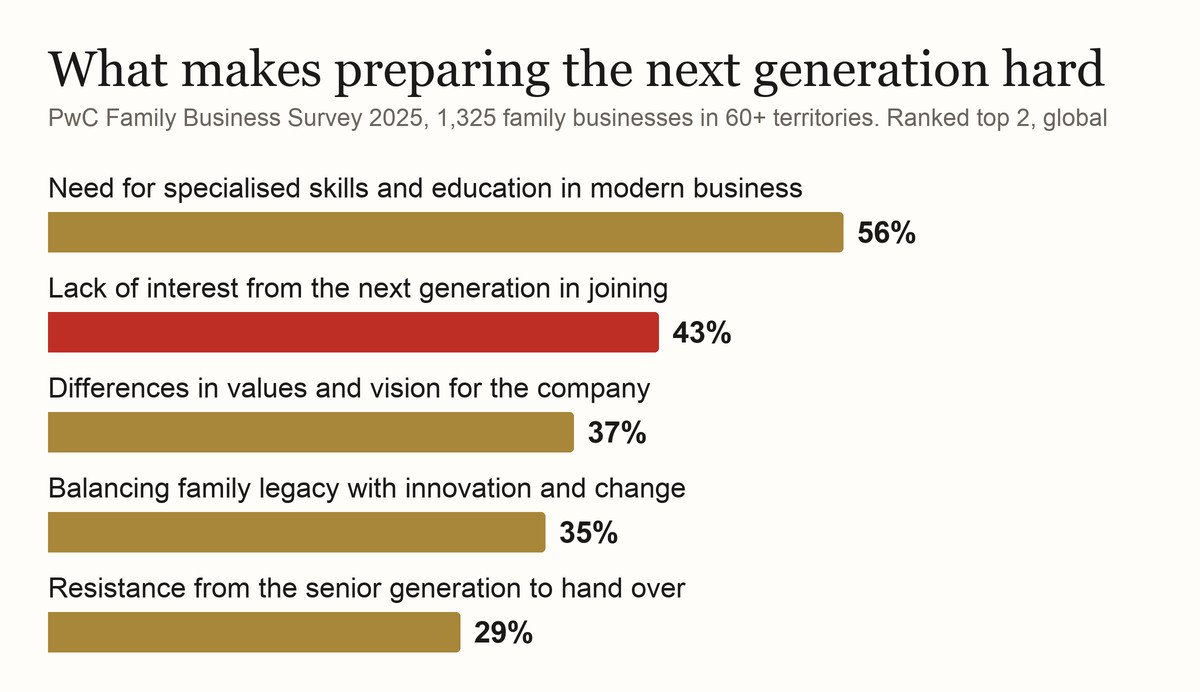
Lack of interest from the next generation is the second answer on that list, at 43%. The same survey has 58% saying the generations are aligned on succession and legacy, and 12% saying they are not. The people answering are key decision makers, so treat that as the view from the top. Resistance from the senior generation sits at 29%, and that is the owner's own line in the chart.
Most of these conversations go badly because they are offers disguised as questions. Thirty years of work on the table makes "do you want it?" nearly impossible to answer honestly. A few habits help. These are our judgement, not research:
- Ask before you offer. "What would you do if this company did not exist?" gives a truer answer than "would you take over?".
- Make no an acceptable answer, and say what happens then: a hired manager, a partner, a sale. Your income and your love should visibly not depend on the reply.
- Separate owning from running. A child can hold shares without working there, which takes much of the weight off the question.
- Open the real numbers. Debts included. Nobody can agree to something they have only seen from the dinner table.
- Let them work elsewhere first, with a boss who is not their parent. They come back with a measure of themselves, and staff see it.
- Set a date to ask again. People change at 25 and at 32.
If you are the successor, ask for things. What exactly do I inherit, including debts and promises? Which decisions become mine, on what date? What do you live on afterwards? What do my brothers and sisters get? May I see an independent review? A refusal to answer the last one is also information.
Owners should ask themselves one question too: what will you do on the Monday after? In the Exit Planning Institute's 2023 survey, 41% of US owners had a formal written plan for life after selling, and 50% an informal one. An owner with nothing to go to tends to come back to the office, and a successor who is corrected in front of staff twice a week has not really succeeded anyone.
THE YEARS
Timing: years, not a session
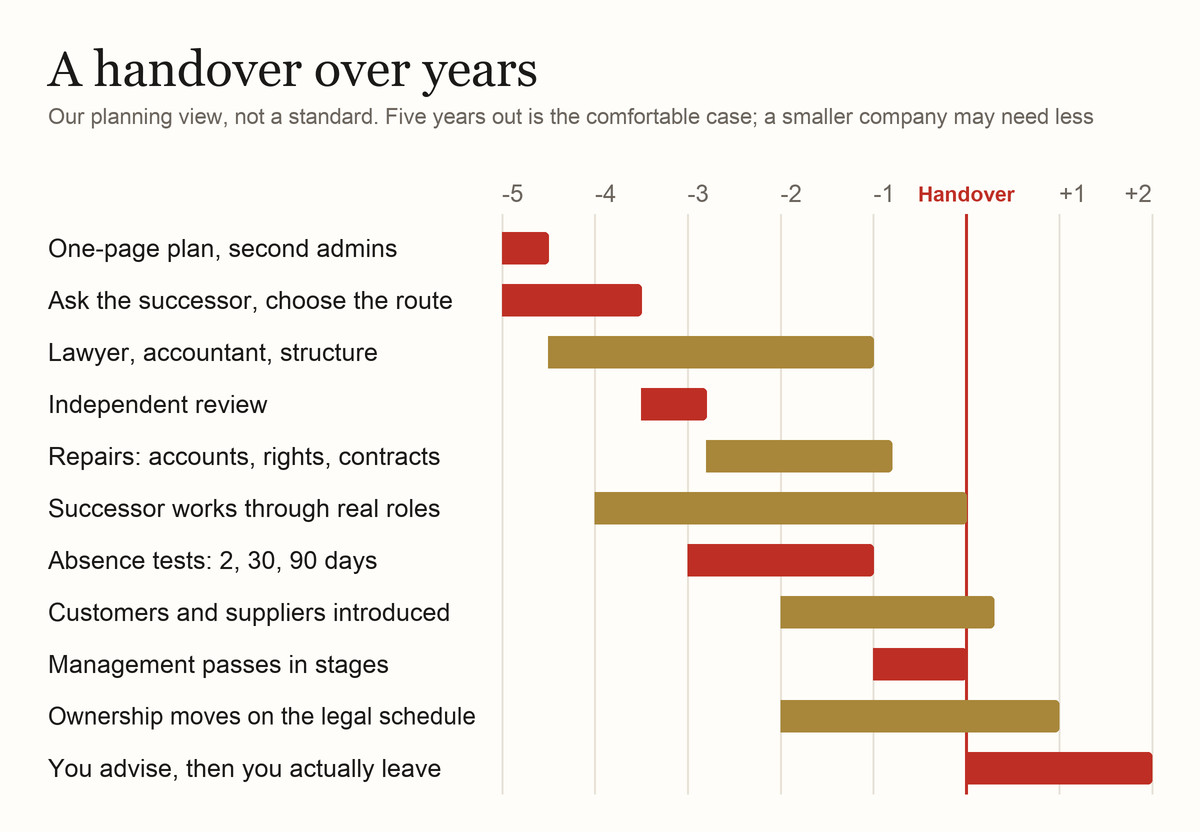
We have seen no reliable study of how long a good handover takes, so read this as our judgement. Five years ahead is comfortable for a mid-size company, and it can take ten: Bob's Red Mill took a decade from announcement to full employee ownership. Compare that with the Exit Planning Institute's finding that about half of the US owners it surveyed want out within five years.
A few things set the pace. A successor needs real roles with real consequences, including at least one bad year. Customers need time to get used to a new voice. Accounts and contracts move slower than anyone expects. And the tax side may reward planning ahead, which is a question for your accountant.
If you have less time, change the order rather than skipping steps. This month, the one-page plan from the chapter below and a second admin on everything. Next, the honest conversation and the choice of route. Then the review, which tells you where a short runway should go.
NOT OURS
Tax, inheritance and law
We do not advise on tax, inheritance or company law, and this article gives no such advice. These rules differ by country, state and company form, they change, and they can decide which route makes sense at all. Take them to a lawyer and an accountant in your own jurisdiction, early, and pay for the time.
One public case shows why a plan on paper is only the beginning. Connelly v. United States, decided by the US Supreme Court on June 6, 2024, concerned two brothers, the only shareholders of Crown C Supply, a small building supply company. They had planned ahead. An agreement meant to keep the company in the family let the surviving brother buy the other's shares, and if he declined, the company had to redeem them; the company carried $3.5 million of life insurance on each brother to pay for it. Michael died, Thomas declined, and the company paid $3 million to the estate. The IRS counted the insurance money in the company's value, and the estate owed another $889,914 in taxes. The Court unanimously agreed with the IRS, and it noted that a different arrangement between the brothers was available. We draw no tax lesson for you from this. The point is narrower: a signed and funded agreement still produced a bill the family took all the way to the Supreme Court, and an adviser's second reading is cheap by comparison.
Take these questions with you, as questions only:
- If I die or cannot act tomorrow, who may legally run the company, and who inherits the shares?
- What do our charter or shareholder agreement say about transferring shares, and to whom?
- How is the transfer taxed for me and for the successor, and how is the company valued for that?
- What happens to the shares in a divorce, mine or the successor's?
- Are any assets, heirs or companies in another country?
- Which of my guarantees and personal loans stay with me after I step back?
NO PLAN
What happens if there is no plan
In our judgement the order of events tends to repeat, though every company differs. First the operational locks: nobody can sign, pay, log in or renew. Then the people: good staff start answering recruiters, because nobody can tell them what happens next. Then the customers who were really yours, and the suppliers who extended credit to you personally. Then the family, who may be learning how the company works in the same weeks they are grieving, and who may disagree about what to do with it. In the Exit Planning Institute's 2023 survey, only 24% of US owners had a will.
If this is more than you can face this year, do the minimum this month. A single page, kept with your lawyer:
- Who acts if you cannot, and under what signed authority (your lawyer drafts it).
- Where the list of accounts is, and how that person reaches the emergency access.
- Which advisers to call first: lawyer, accountant, the person who knows the systems.
- What you would want: keep it, hire someone, or sell, in three sentences.
Add a second admin on the domain, the email and the bank, and that alone removes the worst of the first week. It is not succession planning, but it buys the time to do some.
If you are the successor and it has already happened, begin with access, cash and people, in that order, before any big decision. Our Project Takeover audit follows that logic for systems whose owner has gone: collect the access, check the code, servers and integrations, write down what is there, and decide after that.
OUR PART
Where we fit, and where we do not
Our part is the view from outside, the technology and the accounts. We look at the company as a buyer or a successor would, and we repair what lives in systems. Schoeffel shows how we think about this, and it needs a careful label. At Schoeffel, a pearl house founded in 1921, we are a strategic partner and hold a percentage of the company, and we are not describing a family succession there. When you build a business the grown-up way, you calculate the scenarios of how it may develop, and this one is built in: processes meant to make the company worth hundreds of millions rather than tens of millions, with everything ready when the owner needs to exit. That is an aim and work in progress, and no measure of value today. In the first article on that project the test was whether a decision helps the house enter its next century without losing what carried it through the first, and that test travels well.
Keep the assessment and the repair apart. As of November 2026, an Exit & Succession Readiness Session costs $1,500 and gives you an outside read on the business, its dependencies and timing; the preparation program after it starts from $5,000 and is priced on what the session finds. A Technical Due Diligence Session costs $1,500 and a full review starts from $7,500, priced on the scope of the business. Each of these gives an assessment and a direction. Neither fee is credited toward later work. The repair that follows has no starting price, because we would have to see the product first.
That work can be large, and everything we do is outsourcing or outstaffing, from a big pool of vetted developers of European and Ukrainian origin at reasonable prices. What we build is shaped around the logic of your business, with no templates, and belongs to you, with code and deployment handed over under the contract. That matters more than usual when the next person to hold it is someone you love. The law, the tax, the family's decision and the years of apprenticeship remain with you and your advisers.
QUESTIONS
Frequently asked questions
How do you pass a family business to the next generation?
Ask early whether they can and want to. Then separate ownership, management and family money, test whether the company runs without you, get an independent review, move accounts and rights to the company, hand over management in stages, and transfer ownership on the schedule your lawyer and accountant set.
Is it true that only 30% of family businesses survive to the second generation?
The figure traces to one 1987 study of 200 Illinois manufacturers, and companies sold or passed to employees fall outside its definition of survival. Researchers have called it not generalizable. We know of no reliable current number, so we would not plan around this one.
How long does business succession take?
In our judgement, plan on about five years for a mid-size company, and longer if the successor is young or the owner holds most relationships. Bob's Red Mill took ten years to reach full employee ownership. If you have less time, keep the order and shorten each step.
What should we do if my children do not want the business?
Treat it as useful information. Your remaining options are a hired manager with the family keeping the shares, a partner, the management team, employee ownership where the law allows it, or a sale. Ask before anyone feels obliged, and make sure your income does not hang on the answer.
Should a family succession go through due diligence?
Yes, though nothing forces it. In a sale the buyer's team finds the problems before paying; in a handover the successor finds them afterwards. An independent review gives owner and successor the same facts, covering finances, contracts, people and technology, with accountants and lawyers on their parts.
What happens to company accounts and domains when the owner dies?
It depends on who holds them and on the provider's rules, and it is usually slow. Domains may need confirmation from the prior holder, and Google says it cannot provide passwords. Move everything to company ownership with a second admin now, and ask your lawyer what the estate can do.
Sources
- James Grubman: There is no 70% rule, The International Family Offices Journal, June 2022
- PwC: Family Business Survey 2025, Netherlands edition with global figures, October 2025
- Bennedsen, Nielsen, Pérez-González, Wolfenzon: Inside the Family Firm, NBER Working Paper 12356, 2006; published in the Quarterly Journal of Economics, 2007
- Exit Planning Institute: 2023 National State of Owner Readiness Report
- US Supreme Court: Connelly v. United States, No. 23-146, June 6, 2024
Wondering what your successor would really inherit? Let's look at what runs without you and what does not.
- Share
-

-

-

-

One notification a week with the new PERETZ articles. Nothing else.