Rising CPC Isn't the Problem. Here's What Is




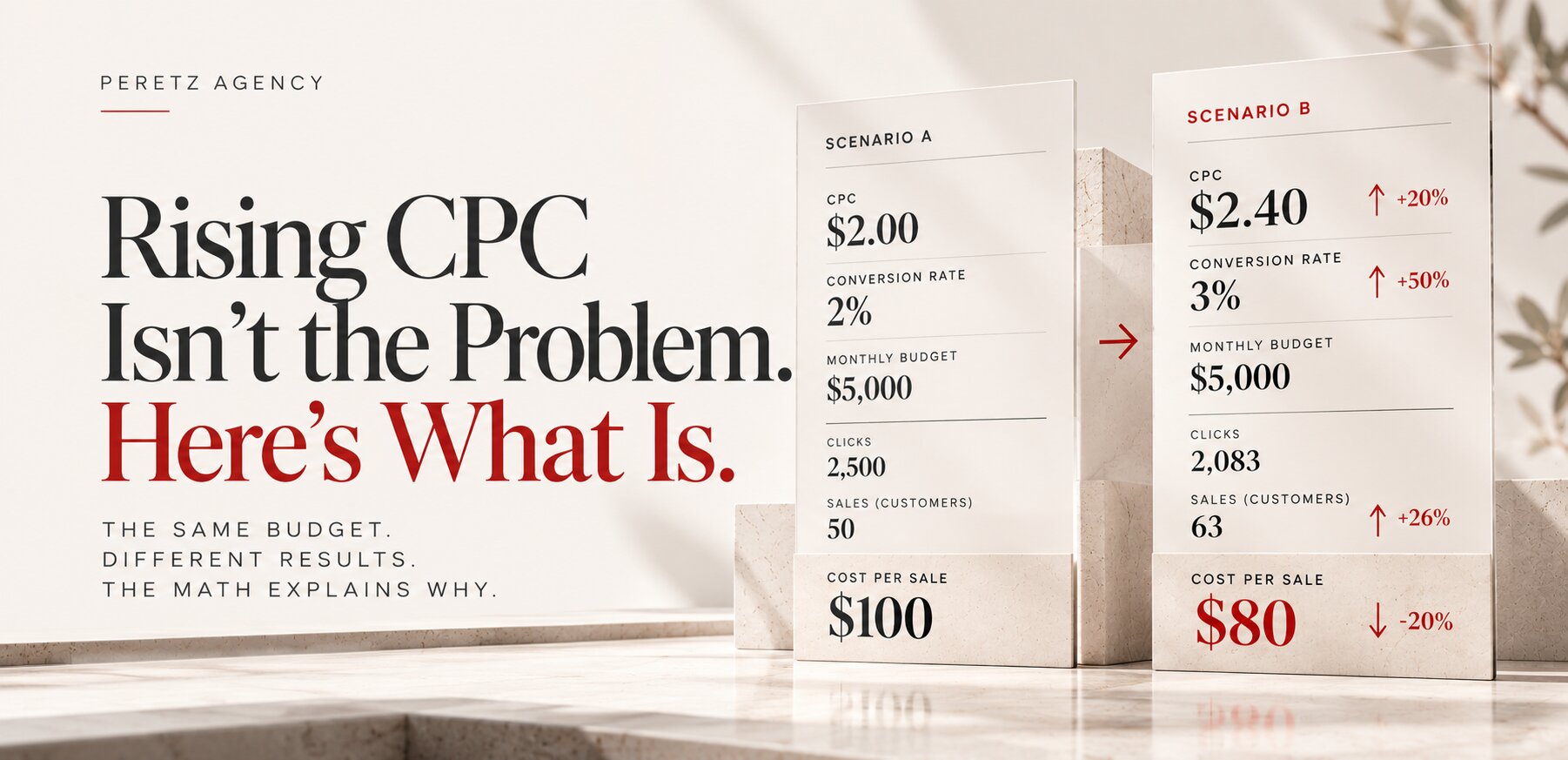
The price of a click keeps climbing, and that is what most owners watch. But what decides whether advertising pays is everything that happens after the click, and the economics of the business behind it.
SHORT ANSWER
The Click Is Not the Cost
A rising cost per click does not by itself mean advertising got less profitable: what decides profitability is how many clicks turn into customers, what those customers are worth to the business and what it keeps after the sale. WordStream by LocaliQ found that between April 2024 and March 2025 the median cost per click rose in 87% of the industries it tracks, yet conversion rates improved in 65% of them. In its newer report, covering April 2025 to March 2026, conversion rates rose in 87% of industries and the median cost per lead fell for the first time in five years.
The value of a customer is set by the business, not by the click.
This article is about that difference. We look at what the latest benchmarks say, then at four of our own projects with very different economics: a mass-market online store, a premium jewelry boutique, a car dealership and a diagnostic center. The numbers from those projects are approximate historical estimates from different markets and years, and we present them as illustrations of a principle, not as targets for current campaigns.
THE DATA
What the Benchmarks Actually Say
WordStream by LocaliQ publishes yearly medians for US search campaigns in Google Ads and Microsoft Ads. The two most recent reports tell a consistent story.
- The 2025 report covered 16,446 campaigns from April 2024 to March 2025. The median cost per click rose 12.88% to $5.26 and increased in 87% of industries. The median conversion rate rose 6.84% to 7.52% and improved in 15 of 23 industries. The median cost per lead rose 5.13% to $70.11.
- The 2026 report covered 13,474 campaigns from April 2025 to March 2026. The median cost per click reached $5.42 and the median conversion rate 8.18%, rising in 87% of industries, while the median cost per lead fell to $66.69, the first decrease in five years.
The category closest to our jewelry clients shows the same pattern in miniature.
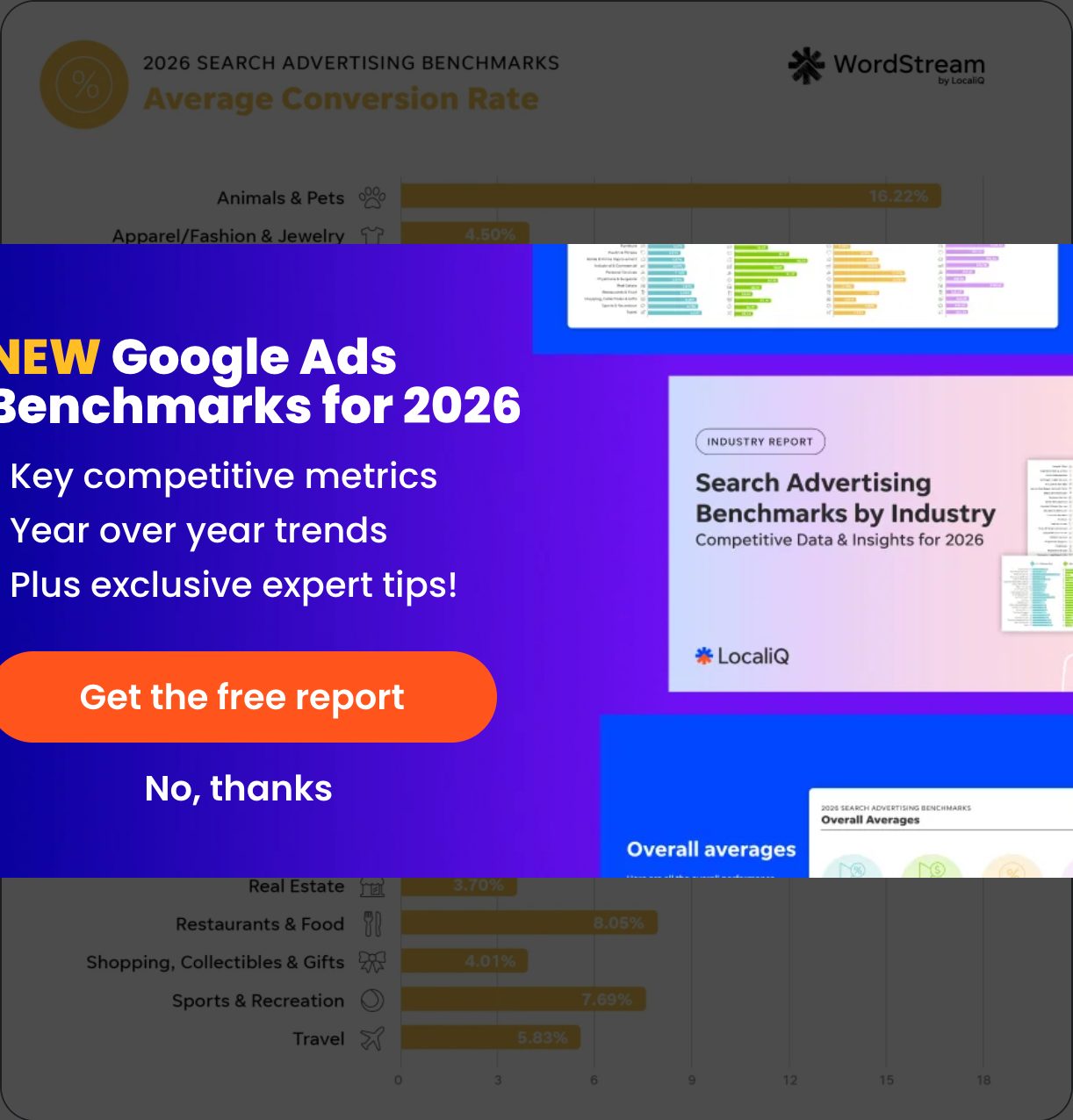
| Apparel / Fashion & Jewelry | 2025 report | 2026 report |
|---|---|---|
| Median cost per click | $4.31 | $4.44 |
| Median conversion rate | 3.99% | 4.50% |
| Median cost per lead | $101.49 | $97.51 |
The click became about 3% more expensive, and the lead about 4% cheaper. The authors of the report point to automation such as Smart Bidding and Performance Max and to account fundamentals like structure and negative keywords. These are medians across thousands of campaigns: a general direction, not a forecast for any particular store. What they do show is that a more expensive click and a worse result are not the same thing.
THREE LEVELS
Three Questions, Three Levels
When an owner asks whether advertising works, the answer depends on which of three questions is being asked. We use this frame with clients because it stops a single number from deciding the budget.
| Level | Metrics | The question it answers |
|---|---|---|
| The cost of attention | CPC | How much does one visit cost? |
| The cost of a lead | CPL, lead-to-sale conversion | How much does a potential customer cost, and how many of them buy? |
| The economics of the result | CAC, gross margin, repeat purchases, LTV | How much does the business earn from the customer over time? |
Most arguments about advertising happen on the first level, and most money is made or lost on the third. A cheap click that never becomes a sale is expensive, and an expensive click that brings a customer who returns for years can be the best money the business spends.
A cheap click that never sells is the most expensive click.
The arithmetic behind this is short: the advertising cost of a sale equals the cost per click divided by the conversion rate. At $2 a click and a 2% conversion rate, a sale costs $100 in clicks. At $2.40 a click and 3%, it costs $80. The click became 20% more expensive, and the sale 20% cheaper. These are illustrative numbers, but the formula is the reason a rising CPC on its own tells an owner so little.
AFTER THE CLICK
What Happens After the Click
A click buys a visit, nothing more. Whether that visit turns into a sale depends on the site and the business: whether the visitor finds the product quickly, trusts what the page says, sees an assortment that fits the request, understands the price and delivery, and can complete a form or checkout without friction.
This is where many advertising budgets leak. Traffic is paid for in full, then lost on a slow product page, a missing size, an unclear return policy or a form that asks for too much. We described how much the product page itself decides in our guide to product page SEO, and in our test of 15 US online stores even well-known brands lost buyers to popups, hidden terms and prices that changed at checkout.
The practical consequence is simple. Before paying more for clicks, it is worth checking what the site does with the clicks it already gets, because an improvement in conversion lowers the cost of every sale without touching the bid.
MASS E-COMMERCE
When a Cheap Lead Comes for the Cheapest Product
In a large online pet supply store we worked with, a lead cost roughly $1 to $2. On paper that looks excellent. In practice, many of those buyers came for a promotional item or a product with almost no margin, so the first order alone rarely paid for much.
The store's profit did not come from that first order. It came from what followed: related products in the same basket, cross-sales, repeat orders of food and supplies, and customers who stayed with the store for years. Judged by the first transaction, the advertising looked weak; judged by the customer's whole history, it was part of a healthy business.
The same pattern is visible at the scale of the US market. Chewy, one of the largest online pet retailers in the country, reported that customers on its Autoship subscription accounted for 83.3% of net sales in fiscal 2025, about $10.5 billion of $12.6 billion, up from 79.2% a year earlier. In this category, the business is built on the reorder, and the first purchase is only the way in.
The reverse is also true: a cheap lead is not a good result by itself. If the customer never buys again and the margin on the first order is close to zero, a low cost per lead says very little. In mass e-commerce, the numbers that matter are the margin of the whole basket, the share of repeat buyers and how quickly an acquired customer pays back.
A PREMIUM BOUTIQUE
When $150 to $250 per Buyer Is a Bargain
One of our clients was an exclusive jewelry boutique focused not on mass models but on expensive pieces and limited collections. Its audience came for a level of product and service, and a visitor who was drawn in by one piece often bought another. For that reason we judged results by whether advertising brought a buyer into the boutique and to a purchase, not by whether the advertised item was the one sold.
| Measure | Approximate historical estimate |
|---|---|
| Average order value | $7,000 |
| Margin on a piece | about 30% |
| Gross margin per sale | about $2,100 |
| Cost of an acquired buyer | $150 to $250 |
| Acquisition cost as a share of margin | roughly 7% to 12% |
Measured by the cost of a click or a lead, that advertising could have looked expensive. Measured against about $2,100 of margin per sale, spending $150 to $250 to bring in a buyer was a sound decision. Because these figures describe people who actually came and bought, they are closer to customer acquisition cost than to an ordinary cost per lead. The estimate does not include other operating costs, so the remaining margin is not net profit, but the proportion explains why a premium business can afford clicks that a mass-market store cannot.
The project history also shows how the channels depended on each other. When search and display campaigns were switched off in the third, fourth and fifth months, leads fell sharply. From the sixth to the eighth month, the rest of the system began to work: SEO, publications in specialized business magazines, reputation management in search results, the boutique's Facebook and Instagram and the owner's personal account. At the same time, the site itself was changing from a luxury catalog into a store: we rewrote the filters, reworked the product pages and made the code lighter so the pages loaded faster. Conversion started to rise again without paid traffic. When search and display advertising were switched back on at the end of the eighth month, leads rose quickly, the cost of a lead was considerably lower than before the pause, and the cost per click fell by about 30%. A brand that had become better known and better described online was cheaper to advertise, and no single channel did that on its own. As with every case in this article, it was not a controlled test, and seasonality or the market may have played a part as well.
A CAR DEALER
KIA: A Lead Price Means Little Without the Sale
For the KIA dealership in Kharkiv, a lead cost roughly $40 to $80 depending on the model. These are figures from about six years ago, in a different market, and they cannot be compared directly with current US campaigns: auctions, competition, budgets and market conditions have all changed since then.
The case is useful for a different reason. A $60 lead for a car is neither cheap nor expensive until you know how many leads became test drives and how many test drives became sales. Without the conversion from lead to purchase, no one can derive the cost of a customer or the return on advertising from the cost per lead alone. For any business with a long sales cycle, the most valuable number is often not in the advertising account at all, but in the sales team's records.
US dealer data shows how wide that gap can be. Foureyes analyzed more than 8 million dealer sales opportunities in the first half of 2025 and found an overall 30-day close rate of 16.2%. Its benchmark report for 2024, built on more than 22,500 dealership websites, found that 43.2% of sales leads were mishandled, through missed calls, leads never logged in the CRM and follow-ups that lapsed, while 60% of buyers purchased within three days of their first inquiry. The same lead is worth very different money depending on whether someone calls back that day.
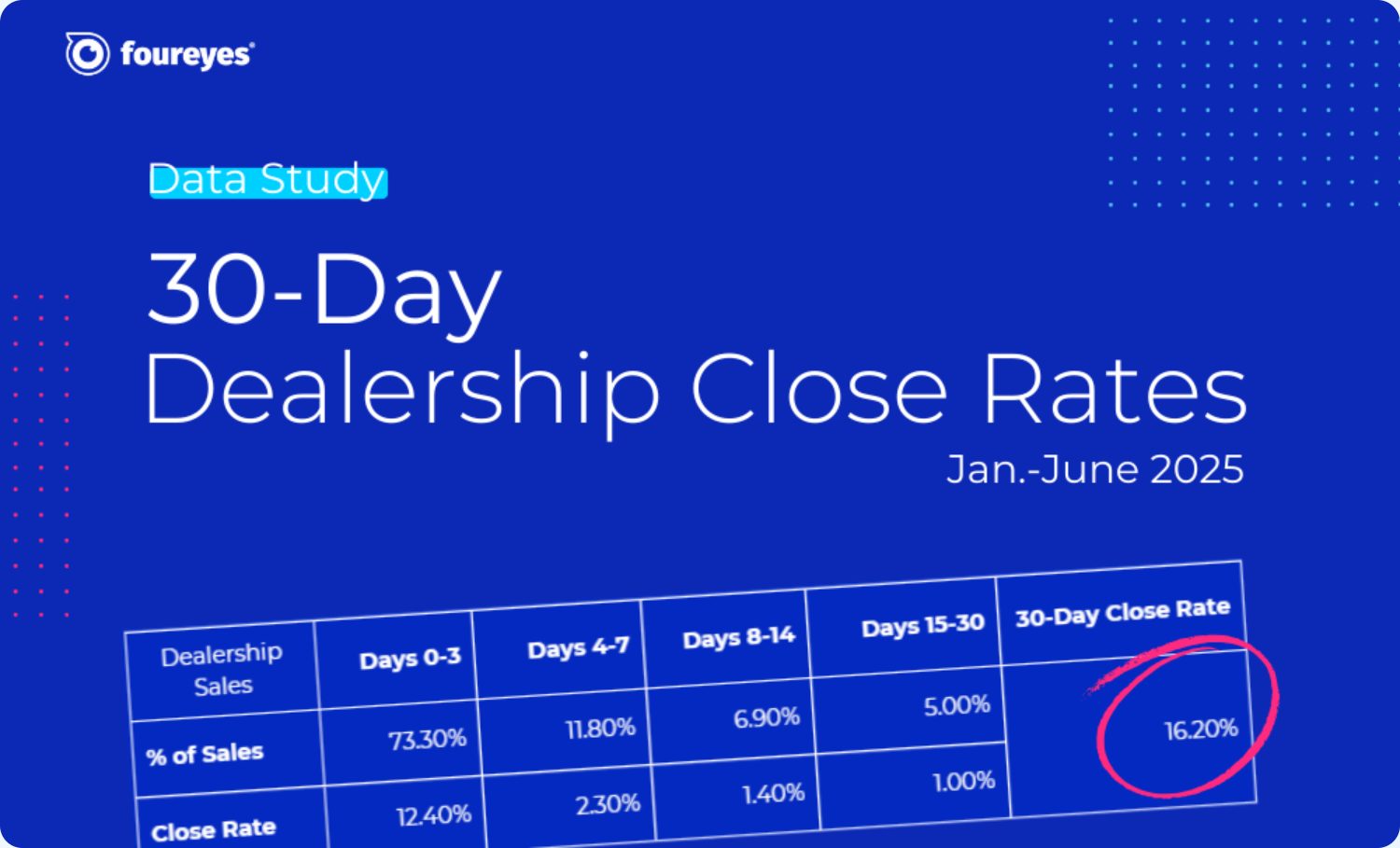
A lead price means nothing until you know how many leads bought.
SEO AND ADS
MDC Lux: When Organic Grew and Clicks Got Cheaper
Our work with MDC Lux, a diagnostic center, began with a new website, followed by SEO. Early on we found that some texts that ranked well and brought patients were not medically accurate. We removed them and rebuilt the approach to content: the center's staff, including doctors, prepared expert materials and cases, and the SEO content was built on top of them.
Good SEO takes time, so search and display advertising ran in parallel. Over roughly three to four months, our team saw organic visibility grow while the average cost per click gradually fell, from about $0.80 to about $0.55. As we remember it, competition did not ease during that period: new diagnostic centers kept opening. At the campaign scale of the time, the difference came to roughly $800 a month in advertising spend.
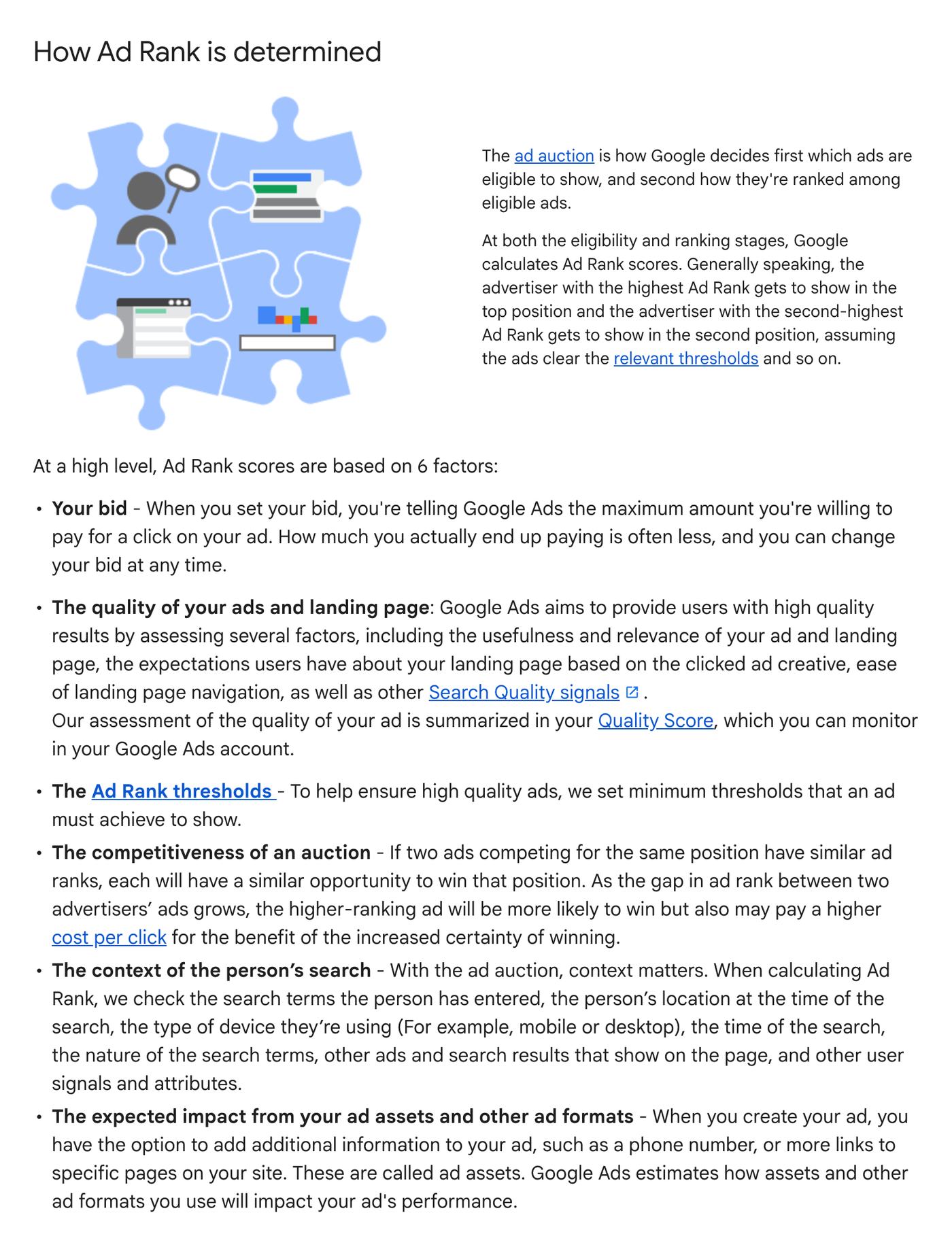
We are careful about what this shows. We observed the two trends together, but we cannot claim that organic growth caused the cheaper clicks. Google's own documentation describes a mechanism that makes the connection plausible. Ad Rank combines the bid with the quality of the ad and the landing page, measured at auction time through expected click-through rate, ad relevance and landing page experience, and Google states that "higher quality ads can often lead to lower CPCs." The advertiser also pays not the maximum bid but what is needed to clear the thresholds and beat the ad ranked below. A better site and stronger expert pages can therefore lower the price of a click without any change in the bid. Other factors may have played a part as well, and these figures belong to a past period, not to a forecast.
Remarketing brought interested visitors back to the site and led to appointment requests through the booking forms, and there were many of them. Calls to the old phone numbers kept coming even after advertising stopped and the center closed, for reasons that had nothing to do with marketing. Without archived data, we cannot separate the contribution of remarketing, organic search, brand awareness and other factors, and we do not try to.
BRAND SEARCH
When Advertising Pays for Visits That Would Come Anyway
Not every paid click is a click the business would otherwise lose. Two well-known studies mark the range. In 2011, Google statisticians analyzed more than 400 cases where advertisers paused their search ads and found that, on average, organic results made up for only 11% of the lost paid clicks: 89% of paid clicks were incremental, and the figure was consistently high across verticals.
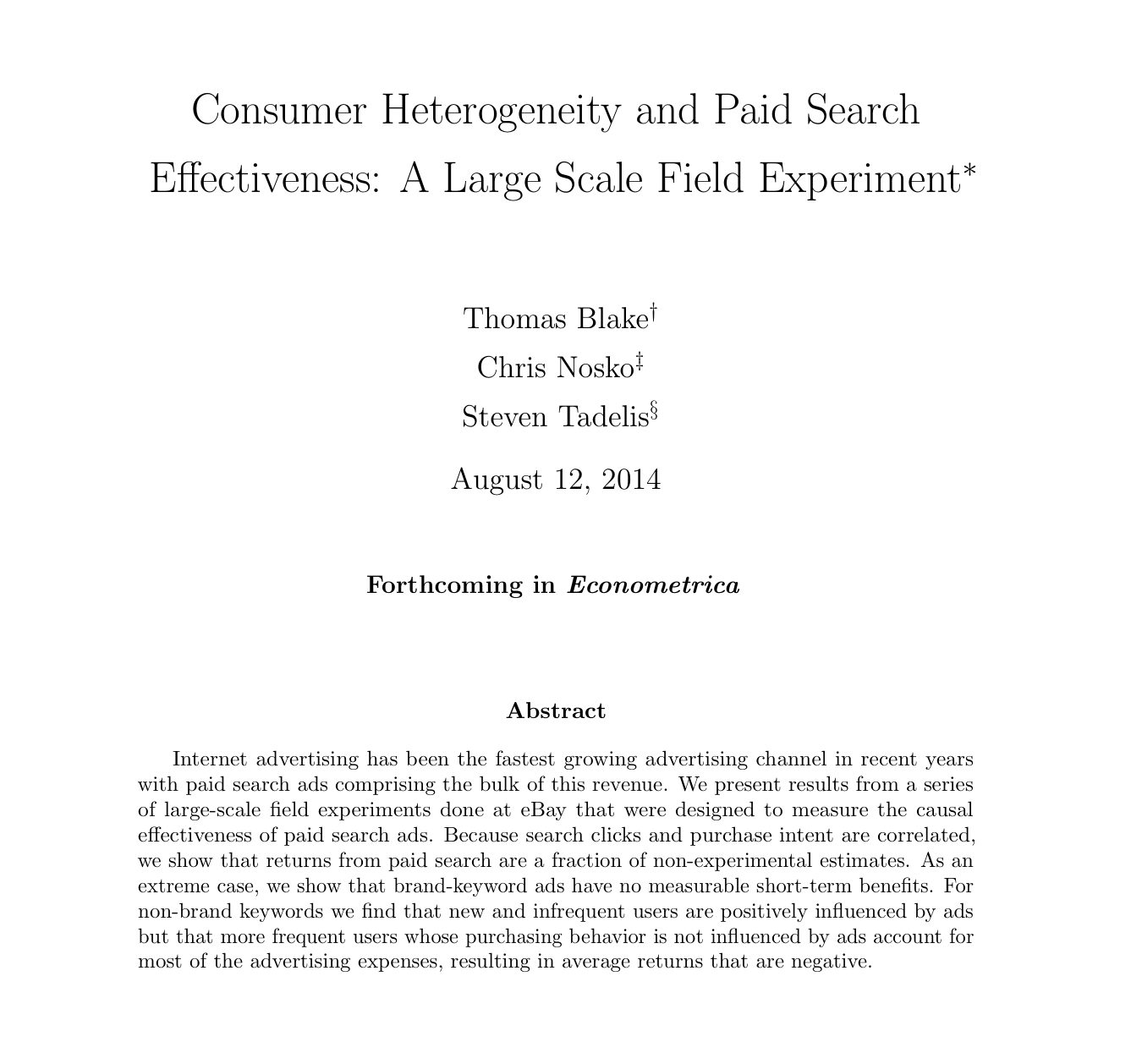
The opposite end is eBay. In a randomized experiment published in Econometrica in 2015, Thomas Blake, Chris Nosko and Steven Tadelis switched off eBay's ads on brand keywords and found that 99.5% of that traffic still arrived through the free organic results. For Edmunds.com, a much smaller brand, organic results replaced less than half of the traffic when brand ads were switched off.
We saw the Edmunds end of that range ourselves. At the KIA dealership, there were times when the budget arrived late and campaigns stopped for three or four days, and in those days leads from the site fell to almost zero. Organic search could not take over: SEO on dealer sites in Ukraine was the same for every dealer, and a single dealer could not change it. Visits to the site continued, but they did not convert; people read about the cars and left. It was not a planned experiment, and we have no archived figures, only what the team saw at the time, but for that business paid search was clearly doing work that nothing else replaced.
The four cases side by side show how differently the same decision can play out:
| Case | What happened when paid search was switched off |
|---|---|
| Google, 400+ studies, 2011 | On average, organic results made up for about 11% of the lost paid clicks |
| eBay, brand keywords | 99.5% of the brand-ad traffic still arrived through organic results |
| KIA dealership | Leads from the site fell to almost zero within days; organic search could not take over |
| Premium jewelry boutique | Leads fell sharply, then recovered as SEO, publications, reputation work, social media and site improvements took effect; when ads returned, the click was about 30% cheaper |
The difference is the strength of the brand and the type of query. For searches by people who already know the store and look for it by name, ads may be paying for visits that would come anyway; for new customers and non-brand queries, they usually bring traffic the business would not get otherwise. Attribution in an advertising account cannot tell these cases apart, and a controlled pause in one region or period can.
BEFORE YOU RAISE THE BUDGET
What to Check Before Raising the Budget
Before increasing spend because clicks got more expensive, or cutting it for the same reason, we suggest checking a short list:
- The real conversion of paid traffic on the site, separately for each campaign and landing page, not only the account average.
- The share of leads that became sales, taken from the CRM or the sales team rather than from the advertising account.
- The margin of the whole order, including related products, not only the price of the advertised item.
- Repeat purchases: how many acquired customers buy again within six and twelve months.
- The cost of acquiring a buyer compared with the margin from that buyer over time.
- What the site loses: slow pages, missing information, unclear delivery and return terms, forms and checkout steps where visitors drop off.
- How channels work together: whether organic search, remarketing and brand searches are growing alongside paid campaigns, and whether the same customers are being counted twice.
- Whether brand campaigns add sales, checked with a controlled pause rather than assumed from attribution.
- What the bids optimize for: with the cost of goods sold in the Merchant Center feed, Google Ads can report gross profit, not only revenue, and the New Customer Value goal lets a campaign bid higher for new customers than for existing ones.
If those numbers are healthy, a more expensive click may simply be the price of a competitive market. If they are not, a cheaper click will not fix the business behind it.
HOW WE WORK
How We Look at Advertising
We do not judge advertising separately from the business. We look at how the website, organic search, paid campaigns, remarketing and the sales model work together to bring in customers and margin, and we start with the economics of the client's business before we touch the bids. That is a stronger promise than lowering the cost per click, because it does not chase a single metric.
For online stores, this work is part of our e-commerce SEO and Google Shopping ads. If you want to understand whether your advertising pays before deciding on the budget, a strategic session is the fastest way to look at the numbers together.
FAQ
Frequently Asked Questions
Why is cost per click rising in Google Ads?
Competition for ad space, inflation and more advertisers have pushed prices up over the years. In WordStream by LocaliQ's 2025 report, the median cost per click rose in 87% of industries, and its 2026 report put the median at $5.42, more than twice the 2016 level.
Does a higher CPC mean my advertising is getting worse?
Not necessarily. In the same 2025 report, conversion rates improved in 65% of industries, and in the 2026 report the median cost per lead fell. What matters is how many clicks become customers and how much margin those customers bring.
Should I advertise on my own brand name?
It depends on the brand and the market. In eBay's experiment, 99.5% of brand-ad traffic came back through organic results when the ads were switched off, while for a smaller brand less than half did, and at a car dealer we worked with, leads almost stopped whenever ads paused. Test it with a controlled pause before deciding.
Is a cheap lead always a good lead?
No. A cheap lead who buys a low-margin promotional item and never returns may cost the business more than an expensive lead who becomes a loyal customer. Judge leads by what they turn into, not by what they cost.
Can SEO lower my cost per click?
There is no guarantee. In two of our projects, the cost per click fell by roughly 30% while organic visibility and brand presence grew, but we cannot prove one caused the other. Better pages can improve the landing page experience Google considers in ad quality, so SEO and advertising are worth planning together.
Should I raise my budget when clicks get more expensive?
Only after checking the conversion of paid traffic, the share of leads that buy, order margin and repeat purchases. If those are healthy, the higher click price may be worth paying; if not, more budget will mostly buy more of the same problem.
Sources
- WordStream by LocaliQ: Google Ads Benchmarks 2025
- WordStream by LocaliQ: Google Ads Benchmarks 2026
- Google Ads Help: About Ad Rank
- Google Ads Help: Actual cost-per-click
- Google Research: Studies Show Search Ads Drive 89% Incremental Traffic (2011)
- Blake, Nosko, Tadelis: Consumer Heterogeneity and Paid Search Effectiveness, Econometrica (2015)
- CEPR VoxEU: An experiment to estimate the effectiveness of branded search ads
- Foureyes: Every Lead Counts, Inside the 30-Day Close Rate Curve (2025)
- Auto Remarketing: Almost half of dealership website sales leads are mishandled (2025)
- Subscription Insider: Chewy's Autoship customer sales reached 83.3% of net sales in fiscal 2025
- Google Ads Help: Conversions with cart data
- Google Ads Help: About customer lifecycle goals
Clicks keep getting more expensive? Let's check whether your advertising still pays.
- Share
-

-

-

-

One notification a week with the new PERETZ articles. Nothing else.
Related Reading
-
28. 07. 2026
Why Your Cost Per Lead Keeps Going Up in 2026 (10 Fixes)

-
09. 07. 2026
Traffic But No Leads? Your Customer Is Doing Math You Never See
-
24. 10. 2026
We Sent an AI Agent Shopping in 15 US Online Stores. Here Is Where It Gave Up
-
23. 10. 2026
Product Page SEO: Descriptions, Reviews and Structured Data That Earn the Click