How Much Does Laravel Development Cost in 2026?





You have a Laravel proposal on the table, or two of them, and the numbers are far apart. One agency quotes $75 an hour, a freelancer offers half that, and a third proposal gives a fixed price without saying what is inside. Here is what a Laravel project costs as of November 2026, where the money goes, when a middle developer is enough, what you keep paying after launch and how to read a quote line by line.
IN SHORT
What Laravel development costs in 2026
As of November 2026, Laravel development at Peretz Agency costs $75 an hour or a fixed project price from $15,000. A Laravel developer working inside your team costs $45 to $65 an hour, depending on seniority. A small business application usually starts at $20,000 to $25,000, a CRM at $30,000 and an ERP at $50,000. After launch, plan for support from $1,000 a month and one framework upgrade a year.
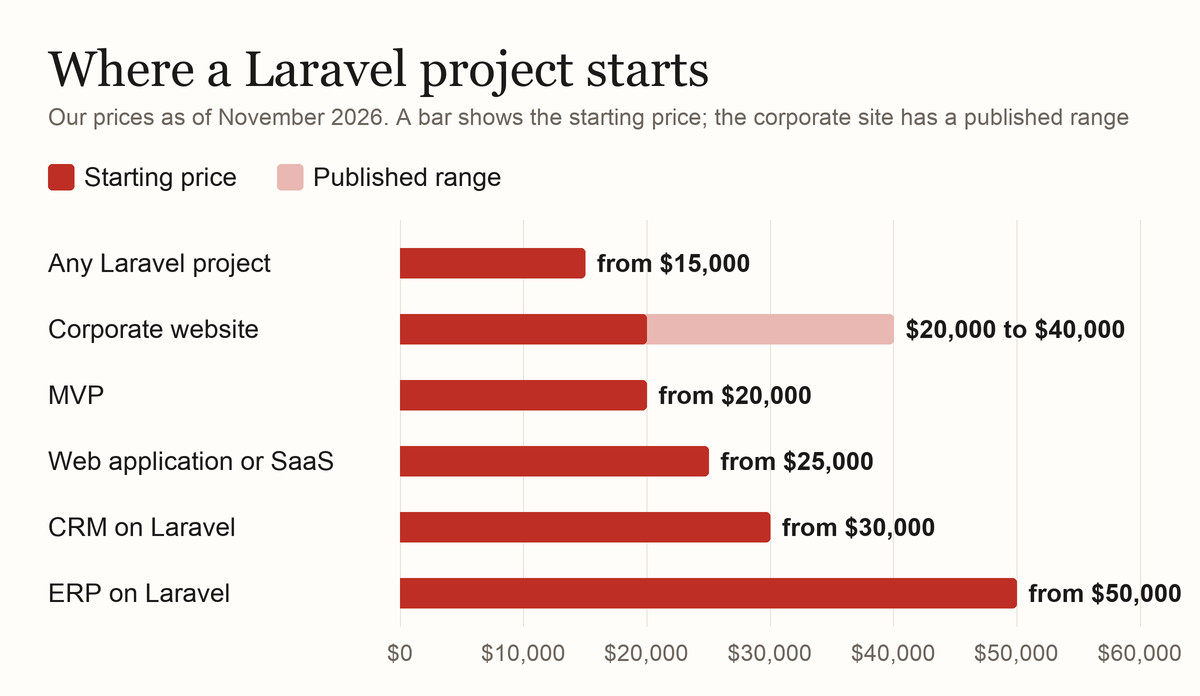
The framework itself costs nothing. Laravel is released under the MIT License, so you pay for the people who write the code around your business, for the admin screens your team will work in, for the integrations and for keeping all of it current. The table shows our prices for the most common kinds of Laravel work.
| Kind of work | Our price, November 2026 | What moves the price most |
|---|---|---|
| Laravel development, any scope | $75 an hour, or projects from $15,000 | Number of business rules, roles and integrations |
| Corporate website, custom build | $20,000 to $40,000 | Content editing, languages, forms tied to your CRM |
| MVP | From $20,000 | How much of the product the first release must prove |
| Web application or SaaS | From $25,000 | User roles, billing, integrations; large products go in stages |
| CRM on Laravel | From $30,000 | Your sales process and the systems it must talk to |
| ERP on Laravel | From $50,000 | Warehouses, production, accounting links |
| Laravel developer in your team | $45 to $65 an hour | Middle, senior or lead; full or part time |
| Support and maintenance | From $1,000 a month | Hours, response time, number of systems |
| Audit before taking over a project | From $2,500 | Size of the codebase and its documentation |
Against US rates, the same 500 hours of work cost $50,000 to $74,500 at a typical US agency and $28,750 to $37,500 with us; the calculation is in the chapter on US prices below.
These figures come from the work we run on Laravel now. We are moving SHTAYER to a Laravel platform, moving MEDPRESSO from an old Laravel version to a current one, building the new UHRS website and the systems behind Schoeffel. This site runs on Laravel too, and we moved it from Laravel 7 to 13 ourselves.
If you are still deciding whether you need a custom website at all, our article How Much Does a Custom Website Cost in 2026? covers that question for any technology. This one is only about Laravel: what makes its price, and what it keeps costing.
WHAT YOU PAY FOR
Where the money goes in a Laravel project
A Laravel project has no licence fee and no plugin store to buy from, so almost the whole budget is time. The time goes into five kinds of work, and their share changes with the project.
The largest part is your business logic. Price rules for wholesale and retail buyers, order statuses that depend on stock in two warehouses, an approval step before an invoice goes out: each of these is a few lines in a brief and several days of work, because every rule needs its own data, its own screen and its own tests. Two projects with the same number of pages can differ in cost several times over for exactly this reason.
The second part is integrations. Payment providers, delivery services, accounting software, a CRM, an ERP, a marketplace feed. A well-documented API with a sandbox takes days. An old system with no documentation and one person who remembers how it works can take weeks, and nobody can promise how many until someone has looked inside.
The third part is the admin side, the screens your staff use to manage content, orders and customers. On Laravel this is built or assembled for each project, and we give it its own chapter below because it is the line most first quotes leave out.
The fourth part is moving data. An existing catalogue, customer base or order history has to arrive in the new system clean and complete. The cost depends less on the number of records than on how messy they are: duplicates, empty fields and old formats are what take the hours.
The fifth part is quality: automated tests, a staging copy for acceptance, monitoring, error logging and deployment that can be repeated without anyone on call at midnight. A cheaper quote often saves money here first, and you only find out on the first release that breaks something.
Same pages, very different budgets: the business rules decide.
On top of the build there are third-party costs: hosting, email delivery, maps, payment fees, paid APIs. On our web application projects the client pays these directly to the providers, so the accounts belong to the business from the first day and nothing has to be transferred later.
US PRICES
How our rates compare with US rates
When a business in the United States weighs a Laravel quote, it usually has two alternatives in mind: an American agency or a developer on its own payroll. Both have published figures, so the comparison can be made in numbers.
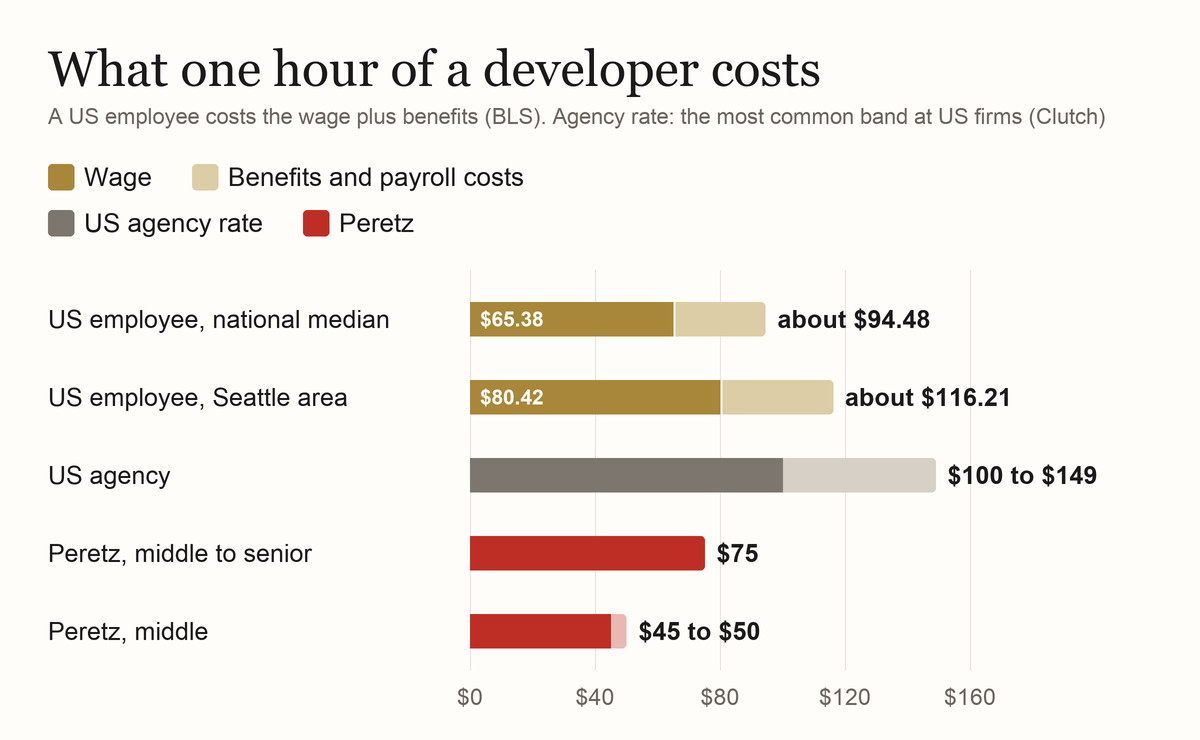
A US agency. Clutch, a platform of verified client reviews, puts the most common hourly rate of US web development companies at $100 to $149 (Clutch pricing guide, updated September 21, 2026). Our rate for strong middle to senior developers is $75 an hour.
A developer on your payroll. The median hourly wage of software developers in the United States was $65.38 in May 2025, and $80.42 in the Seattle-Tacoma-Bellevue area (BLS, Occupational Employment and Wage Statistics). The wage is only part of what an employer pays. In June 2026, wages and salaries made up 69.2% of total compensation costs for professional and related occupations in private industry, and benefits the remaining 30.8%: paid leave, insurance, retirement plans and legally required contributions (BLS, Employer Costs for Employee Compensation). Dividing the wage by its share gives the fully loaded cost of one hour:
- US median: $65.38 ÷ 0.692 = about $94.48 an hour
- Seattle area: $80.42 ÷ 0.692 = about $116.21 an hour
This estimate is on the low side. It leaves out recruiting, equipment, software and management time, and it assumes every paid hour goes into your project, while an employee is also paid through the weeks when there is less to do. When you work with us by the hour, you pay only for the hours actually worked.
Here is what that means for 500 hours, a realistic size for the first release of a business application or one large module.
| Option | Cost of an hour | 500 hours |
|---|---|---|
| US agency, most common rate (Clutch) | $100 to $149 | $50,000 to $74,500 |
| Developer on payroll, Seattle area, fully loaded (BLS) | about $116 | about $58,100 |
| Developer on payroll, US median, fully loaded (BLS) | about $94 | about $47,200 |
| Peretz, strong middle to senior | $75 | $37,500 |
| Peretz, senior and middle together | $75 and $50 | $28,750 |
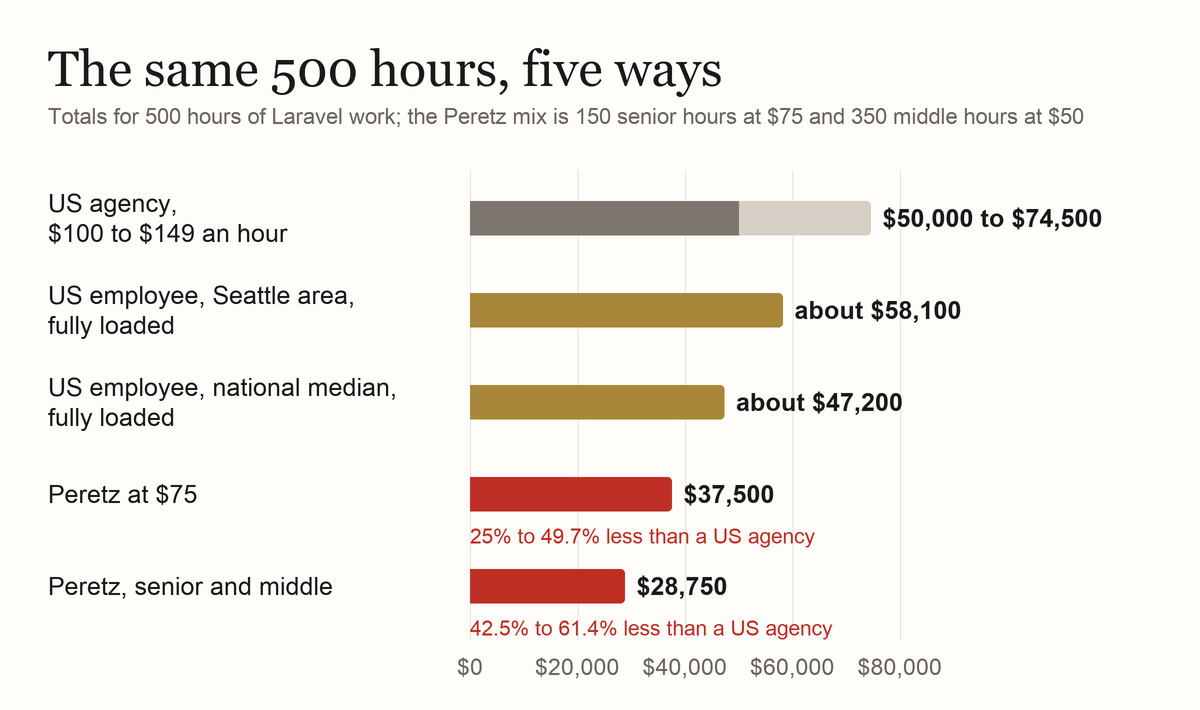
The last row is the mix described in the chapter on middle and senior developers below: 150 senior hours at $75 ($11,250) for the architecture, reviews and integrations, and 350 middle hours at $50 ($17,500) for the routine work inside that structure. Against the US agency range, the same 500 hours cost 42.5% to 61.4% less; against a fully loaded in-house developer at the US median, about 39% less.
The difference comes from overhead, not from a lower level of skill. The people who set the architecture on our projects are at the level American agencies bill as senior; what you do not pay for is US salaries, US offices and the sales machinery around them. A US agency next door has its own advantages, such as meetings in person, and for some projects they are worth the price. For most Laravel work the code, the reviews and the releases are the same wherever the team sits.
An hourly rate is only half of the comparison. A cheaper hour that needs twice the hours is not cheaper, so compare quotes for the same scope by their total, as described in the chapter on reading a quote. On a fixed project from $15,000 the same economics are built into the price.
THE ADMIN PANEL
The cost the first quote often leaves out
Laravel has no ready admin panel or visual page editor out of the box. Everything your team will touch, from the product list to the page where a manager edits the home page banner, is either written for the project or plugged in as a separate package and then fitted to your data. This is the honest minus of the framework, and it is a real cost: Laravel needs professional programmers, and it takes more time and budget than installing a CMS and choosing a theme.
There are good building blocks. Filament, for example, is an open-source framework for building admin panels, CRMs and customer portals on Laravel. It gives you tables, forms and filters that work together, and it saves weeks compared with writing every screen by hand. Fitting it to your business still takes work: which fields a manager sees, who can approve what, how a product with twelve variants is edited without mistakes, what the history of changes looks like.
So when two quotes differ, ask what each one includes for the admin side. A quote that lists "admin panel" as one line with no detail usually means the default screens of a package, which show your database tables as they are. That may be enough for a developer. Your sales team will want screens built around their day.
The same minus becomes the reason to choose Laravel for custom work. Because nothing is imposed, the admin can follow your process exactly instead of making the team work around a CMS. If your website is mostly pages and articles with a few forms, that freedom is money you do not need to spend, and our article Laravel or WordPress for a Business Website compares the two for exactly that case.
HOURLY OR FIXED
$75 an hour or a fixed project price
We work in two ways on Laravel, and the choice depends on how well the scope is known.
By the hour, at $75. This fits work where the scope will change as you go: an existing system that needs steady improvement, a product that is still finding its users, a set of integrations where each step depends on what the previous one revealed. You see the hours on one monthly invoice and can stop, slow down or speed up without renegotiating a contract.
At a fixed price, from $15,000. This fits a project whose scope can be written down before work starts: the screens, the roles, the integrations, the data to move. The price is agreed for that scope. Larger products are split into stages, and on web applications payment follows the milestones of those stages, so you never pay far ahead of what you can see working.
A fixed price is only as good as the description behind it. If the scope is vague, any fixed quote is either padded to cover the unknown or low and followed by change requests. That is why we often start with a strategic session: $500, credited toward the project if you start within 30 days. In a few hours we go through the business logic, the systems the project has to talk to and the parts that are still unclear, and you leave with a scope you can take to any contractor, including us.
A simple test helps you choose. If you can list the screens and the rules today and expect them to hold for the next three months, ask for a fixed price. If you expect to learn something important in the first month, start by the hour and switch to fixed stages once the shape is clear.
MIDDLE OR SENIOR
When $45 to $50 an hour is enough
Our $75 rate covers developers from a strong middle to senior level. That is the level you want for the work where a wrong decision costs months: the architecture of a new product, the structure of the database, integrations with systems that have no sandbox, moving an old project to a current version, performance problems under real load.
Plenty of Laravel work does not need that level. A new report in an existing admin, a form, an export, a page template, a change to an email, tests for code that already exists: when the architecture is set and the task is well described, a middle developer does it well. For that kind of work we can provide a middle developer at $45 to $50 an hour, and the economics of the project get even better. The usual mix is a senior who sets the structure and reviews the code, and a middle who does most of the routine development inside it.
If you want a developer inside your own team rather than a project, our Hire Laravel & PHP Developers service costs $45 to $65 an hour. The rate depends on seniority, on full or part time, and on niche skills such as large legacy migrations or heavy integrations. You pay for the hours actually worked, on one monthly invoice.
Pay senior rates for decisions, middle rates for routine work.
The opposite mistake costs more. A junior developer, or a cheap freelancer working alone, can deliver the first version for less, but the decisions made in the first weeks stay in the code for years. The bill for a weak structure arrives later as slow releases, fragile integrations and a rewrite that costs more than the original project.
AFTER LAUNCH
What a Laravel project costs over three years
The build is the first bill, not the last one. Over three years a Laravel system has three running costs: support, upgrades and hosting.
Support. Someone has to apply security updates, watch the error log, fix what breaks when a payment provider changes its API and make the small changes the business asks for every month. Our website maintenance and support starts from $1,000 a month. The amount grows with the number of systems and the response time you need.
Upgrades. Laravel releases a new major version every year, around the first quarter. Each version gets bug fixes for 18 months and security fixes for 2 years (Laravel release notes). Laravel 12 receives security fixes until February 24, 2027. Laravel 13, released on March 17, 2026, receives them until March 17, 2028. The framework team aims to make each upgrade possible in one day or less, which holds when you upgrade every year and the project has tests.
The cost appears when upgrades are skipped. Several versions behind, the upgrade turns into a project of its own, because the PHP version, the packages and the server all have to move together. Our article Upgrading an Old Laravel or PHP Site in 2026 explains how such an upgrade is planned. For a real example, Six Laravel Versions in Three Days describes how we moved this site from Laravel 7 to 13 and PHP 7.4 to 8.4, with market prices for that kind of job in its cost chapter.
Hosting. Hosting is billed separately by the provider you choose, and on Laravel it ranges from a simple shared plan to managed cloud. As one example, Laravel Cloud, the hosting platform from the Laravel team, starts at $5 a month plus usage, with higher plans at $20 and $200 a month plus usage (Laravel Cloud pricing, November 2026). For most business sites hosting is the smallest of the three running costs; the people who look after the system are the largest.
So when you compare a Laravel project with an off-the-shelf platform, compare three years, not the first invoice. Add the build, three years of support, two or three yearly upgrades and the hosting, and set that against the platform's subscription, its paid extensions and the work your team does around its limits.
AI AND LARAVEL
Why clean Laravel makes AI work cheaper
AI coding tools are now part of how development is done, and they change the cost of a project. AI works superbly with clean Laravel and PHP code. The framework has clear conventions, the code of a well-built project is predictable, and a model needs to read less of it to make a correct change. In practice that means fewer tokens and fewer credits spent per task than on a large CMS, and the difference is greatest with Magento or Shopify Plus, platforms that already cost a lot every month before any AI is involved.
On a CMS a large share of the logic lives in plugins, themes and settings stored in the database, and the tool has to work through all of it. On a custom Laravel project the business logic sits in your own code, named after your own processes, so a request such as "add a discount for repeat wholesale buyers" lands in a few files instead of a search across several extensions.
This saving is real, but it has a condition. AI speeds up a professional developer on clean code; it does not replace the developer, and on messy code it multiplies the mess faster. Every change still needs a person who understands the architecture, reviews what the tool wrote and owns the result. The rate you pay is for that judgement.
If you are leaving Magento or Shopify Plus partly because of these running costs, our article Leaving Magento in 2026: Upgrade, Shopify Plus or Custom Laravel? compares the three routes in more detail.
WHEN NOT LARAVEL
When Laravel is the wrong place for your money
Laravel is the right tool when the system has to follow your business: your rules, your roles, your integrations. When it does not, you pay for freedom you will never use.
A corporate website that is mostly pages, articles and a contact form is the clearest case. A good WordPress build gives your team a page editor on the first day, and for that job it costs less to build and to change. Laravel starts to pay for itself when the website becomes part of how you sell or operate: a client account, a price that depends on who is buying, an order that has to reach a warehouse system. Our article When Does a Business Outgrow WordPress? lists the signs.
A standard online store with ordinary checkout and no unusual logic is the second case. A hosted platform will launch it faster, and the custom route only makes sense when the platform's limits start to cost you sales or staff time.
The third case is a product whose core is real-time work or data science, such as live chat for thousands of users or a recommendation model. There the backend may belong elsewhere, and our article Laravel, Node.js or Python: Which Backend Fits Your Business Application? helps decide.
Laravel pays off when the system has to follow the business.
In every other case where the business logic is your own, Laravel is what you need. The code is written around the way you work, it belongs to you, and any qualified PHP team can continue it if you ever change contractors.
READING A QUOTE
How to compare two Laravel quotes
Two Laravel quotes for the same brief can differ several times over, and the lower one is not always cheaper by the end. These are the questions we would ask of any proposal, ours included.
Who writes the code, and at what level? Ask for the seniority of the people on the project and who reviews their work. A low hourly rate with no senior review often costs more hours in total.
What exactly is in the admin? Ask which screens your team gets, who can do what, and whether content editing is included. This is the most common gap between two quotes.
Are tests, staging and deployment included? If they are missing, the first quote is lower and every later release is slower and riskier.
Which Laravel and PHP versions, and what is the upgrade plan? A project started today should be on Laravel 13. Ask how the yearly upgrade will be handled and what it costs.
Who owns the code and the accounts? The repository, the hosting, the domain and the third-party services should be in your name from the start. You should be able to hand the project to another team without asking anyone's permission.
What happens after launch? Ask what support costs per month, what response time it buys and how many hours are included.
If you already have a Laravel system built by someone else and want a second opinion before you continue, a takeover audit gives you that picture. Our Project Takeover audit starts from $2,500, with the price fixed before the audit starts. All our prices are on one pricing page.
FAQ
Questions about Laravel development cost
How much does a Laravel developer cost per hour in 2026?
At Peretz Agency, as of November 2026, a Laravel developer inside your team costs $45 to $65 an hour, depending on seniority and skills. Project work is $75 an hour at a strong middle to senior level. For well-defined routine tasks inside an existing architecture we can provide a middle developer at $45 to $50 an hour.
Is it cheaper than hiring in the US?
For the same 500 hours, yes. A US web development agency at the most common rate of $100 to $149 an hour (Clutch, 2026) comes to $50,000 to $74,500, and a developer on payroll at the US median wage, with benefits, to about $47,200. With us the same hours cost $37,500 at $75, or $28,750 with a senior and a middle working together. The full calculation is in the chapter on US prices.
How much does a Laravel website cost?
A custom corporate website costs $20,000 to $40,000 with us. Any Laravel project with a fixed scope starts from $15,000. The price depends mostly on business rules, integrations and the admin your team needs, much less on the number of pages.
Is Laravel free?
Yes, the framework is open source under the MIT License, with no licence fee. You pay for development, support, upgrades and hosting.
Why is Laravel more expensive than WordPress at the start?
Laravel has no ready admin panel or visual editor, so the screens your team uses are built or fitted for each project, by professional programmers. For a simple content site that is money you do not need to spend. For a system with your own logic it is what makes the system fit.
How often does a Laravel project need an upgrade?
Laravel releases a new major version every year and gives each one security fixes for 2 years. Upgrading once a year keeps the job small; skipping several versions turns it into a project.
Can we start small and grow?
Yes. A project can begin with a strategic session or an MVP from $20,000 and grow in stages. On web applications each stage has its own milestone and payment.
Sources
- Laravel: Release notes and support policy, Laravel 13
- Laravel Cloud: Pricing
- US Bureau of Labor Statistics: Software Developers, Occupational Employment and Wage Statistics, May 2025
- US Bureau of Labor Statistics: Employer Costs for Employee Compensation, private industry, June 2026
- Clutch: Web Development Company Pricing Guide 2026
Not sure what your Laravel project should really cost? Let's check the scope before anyone quotes it.
- Share
-

-

-

-

One notification a week with the new PERETZ articles. Nothing else.