Finding the Right Person Is Harder Than Finding an Investor
An investor puts in money. A person puts in years of their life. On hiring for potential over resumes, and why empathy from your own hard path matters most.



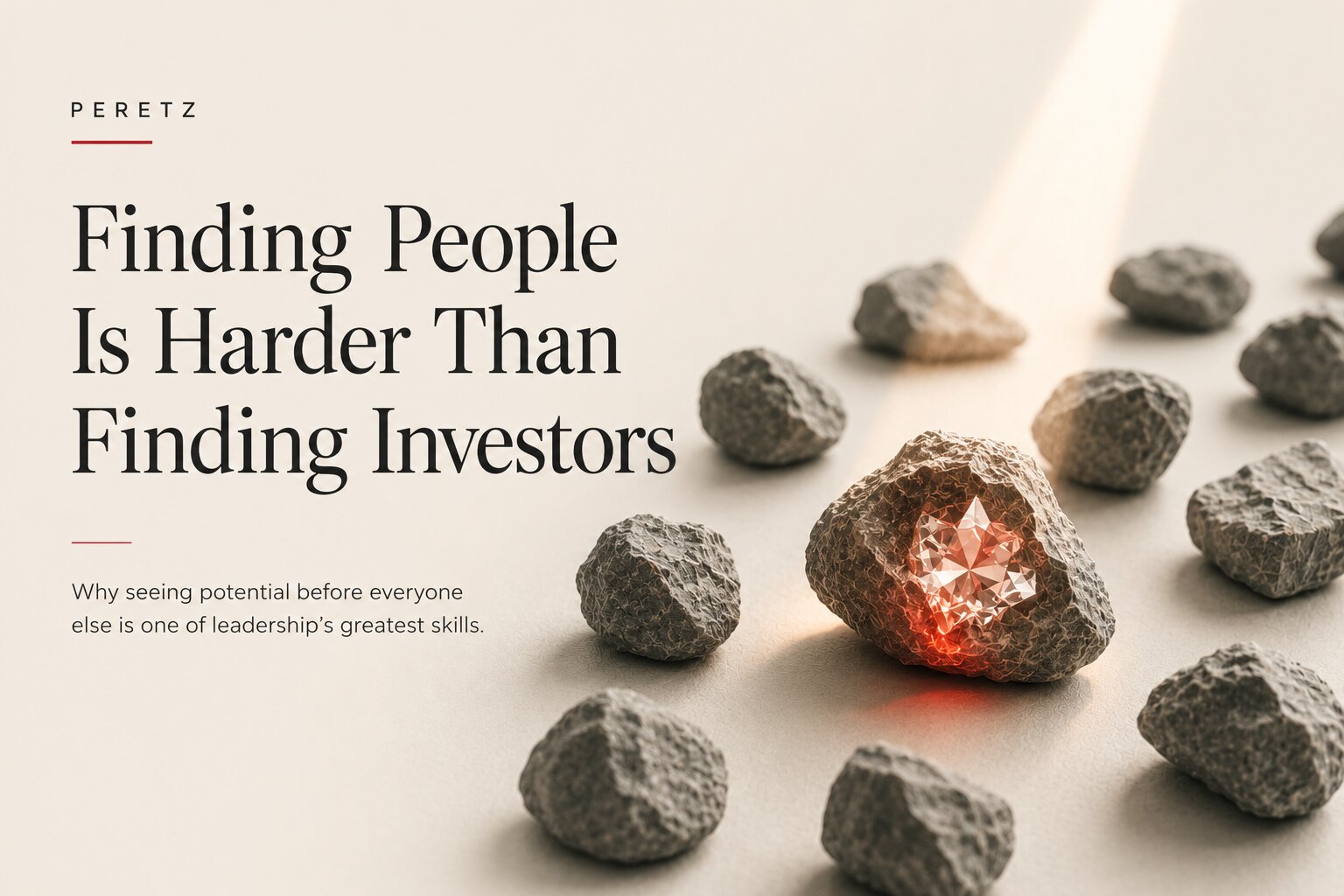
Almost every founder has talked about how hard it is to raise money. We read constantly about investment, valuation, pitching investors, building financial models. It starts to feel like the biggest challenge in growing a company is convincing someone to believe in your idea.
My experience says otherwise.
Finding the right person is significantly harder than finding the right investor.
An investor puts in money. A person puts in years of their life. They bring their character, their principles, their fears, their ambitions, their experience, their whole way of seeing the world. That's what ends up shaping a company's culture far more than any strategic decision.
Maybe that's why I've never believed companies build products.
Products change. Strategies get revised. Business models sometimes get rewritten almost from scratch. But if the right people are there, all of that is just another stage of growth. If the people aren't there, no idea, however good, saves the business.
This isn't something you learn from a book or an MBA. It comes much later, after dozens of interviews, hundreds of conversations, and a lot of mistakes.
Especially the mistakes.
HIRING IS A CRAFT
Hiring Isn't Recruiting. It's a Craft
Eventually you start noticing a pattern. It's rarely that someone isn't smart enough or experienced enough. Far more often, they're just not your person.
We're used to talking about professional fit. What actually matters far more is fit of values. Do you treat responsibility the same way? Do you handle setbacks the same way? Are you willing to argue for a better decision instead of for your own ego? Can you get through the hard stretch together, when nothing is working yet and the only thing holding the team together is belief in what's coming?
That's when I understood that finding people has almost nothing to do with recruiting.
Recruiting is a process. Finding a person is a craft.
And like any craft, it doesn't come with a universal manual.
People often ask me how to learn to spot strong people. I'd like to say there's a system, a checklist that never fails. But that wouldn't be true.
Yes, over the years you get better at reading people. You learn to listen more carefully. You start noticing small things that used to seem irrelevant. You can feel when someone is saying what they actually think versus what they think you want to hear.
But even that isn't enough.
Because there's always room for luck in this work.
And that doesn't diminish a leader's role. If anything, it makes it more honest.
You can be deeply experienced and still never meet the people you truly want to build a company with. You can see the potential in someone who isn't ready for change yet. Or the reverse: they're ready, but right at that moment you can't offer them the environment they're looking for.
Sometimes a single year makes the difference.
A year earlier, you wouldn't have understood each other yet.
A year later, they'd already be at another company, or building their own.
Maybe that's why the best teams are never born purely from a good hiring process. They emerge at a rare point where preparation, shared values, mutual trust, and a bit of luck all happen to line up.
Successful leaders often talk about intuition. I think intuition isn't mysticism. It's experience that's accumulated so deeply the brain can no longer explain why a decision feels right.
BEYOND THE RESUME
Why I Stopped Trusting the Perfect Resume
But even intuition doesn't remove the need to look closely at the person.
Not at their resume.
Not at the list of companies they've worked for.
Not at the polished phrasing on their LinkedIn profile.
At the person.
Because that's almost always where the answers live that no document contains.
The paradox is that the people who genuinely grow into strong specialists rarely make the flashiest first impression.
Over the years, I've come to trust perfect resumes less and less. Not because experience doesn't matter. It does. But experience only answers what someone has already done. What's far more interesting is what they're capable of tomorrow.
Especially now, when a great resume can be written with AI, and interview prep comes from dozens of ready-made scripts. People know exactly which words employers want to hear. They talk fluently about teamwork, ownership, leadership, adaptability. Sometimes so fluently that there's almost no gap left between the real person and the version of themselves they're presenting. What this means for candidates themselves is covered in How to Get Hired in 2026: The Job Interview Has Changed.
That's why I stopped listening only to answers a long time ago.
I'm far more interested in watching how someone thinks.
How they react when they don't know the answer.
Whether they know how to ask a question.
Whether they can change their mind when they hear a convincing argument.
Whether they can admit a mistake without immediately trying to justify it.
None of that shows up on a resume, but it's exactly what usually determines who someone becomes a few years down the line.
HIRING FOR POTENTIAL
How We Hired When We Couldn't Compete on Salary
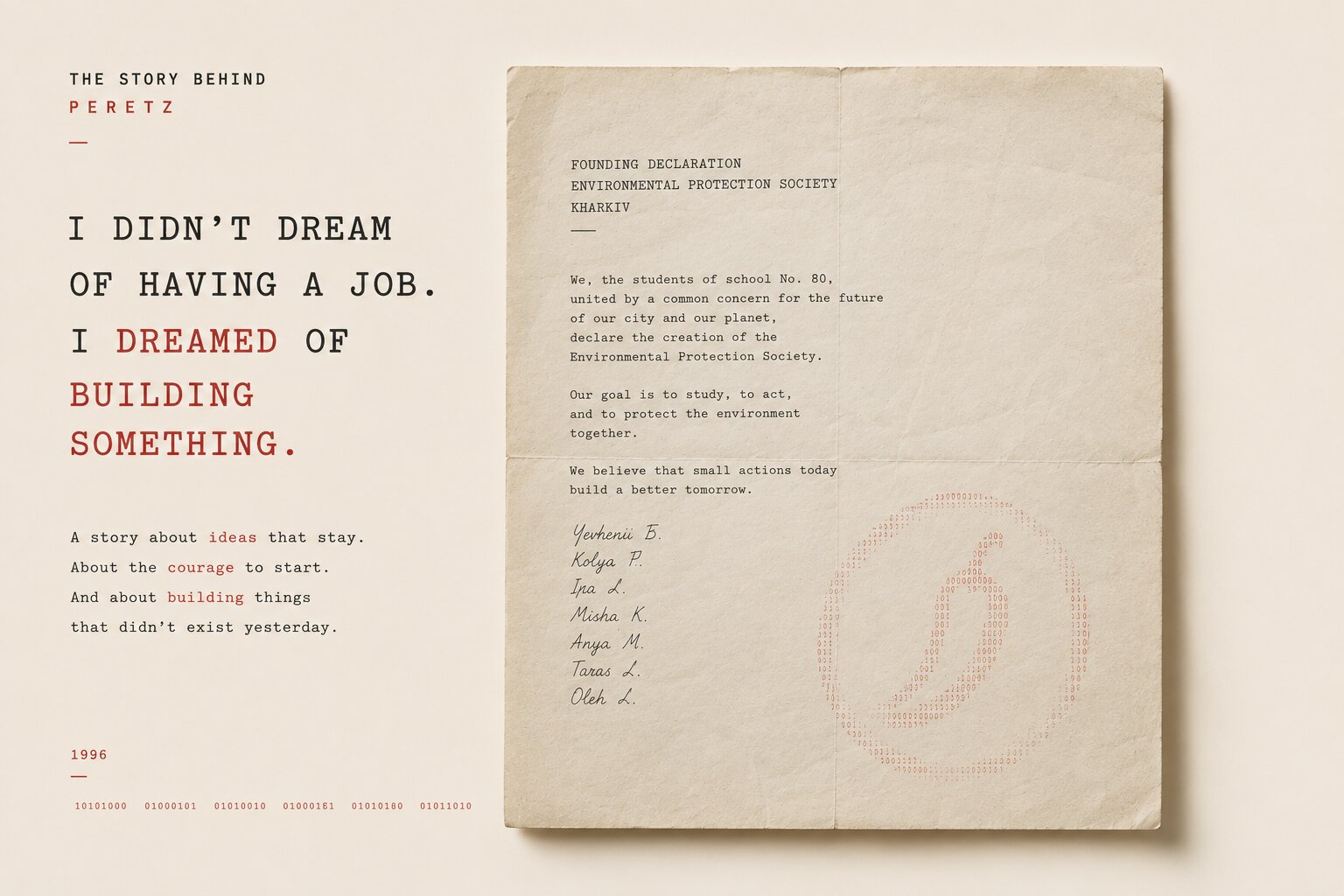
Maybe that's why our approach at PERETZ was a little unconventional from the start.
Not because we thought it was the only right way.
But because we barely had another option.
When the company was just starting out, we couldn't compete with big tech companies on salaries, bonuses, or the ability to hire ready-made senior specialists. We had no large HR department, no expensive recruiting agencies, no budget that let us search endlessly for the "perfect" candidate.
So we started looking for something entirely different.
Not a finished result.
Potential.
We didn't expect someone to already know everything. We wanted to understand how fast they were capable of learning.
WHAT WE TESTED FOR
What We Actually Tested For in Interviews
That's why interviews often didn't look anything like what was standard practice.
We didn't send take-home assignments or ask people to complete test projects alone. A candidate would come into the office, sit down next to a developer, a designer, or another future colleague, and they'd work on a real task together.
Not to test knowledge.
To watch how they thought.
A colleague might offer a hint.
Might ask a leading question.
Might help point them in the right direction.
What we cared about was something else entirely.
What would this person do with that hint?
Could they recalibrate quickly?
Would they make the same mistake twice?
Would they start arguing just so they wouldn't look weak?
Or would they take the new information and keep moving?
Sometimes a candidate made a lot of mistakes.
But you could see they weren't giving up.
You could see they were genuinely curious.
You could see they weren't afraid to say, "I don't know, show me."
And very often, that was what decided it.
People like that often turned out stronger than the ones who answered almost flawlessly.
Because knowledge can be gained.
Skills can be trained.
Experience accumulates over time.
Genuine curiosity, inner discipline, and the drive to get better are far harder to teach.
I still remember candidates who came in and said, honestly: "I barely know anything. But I love what you're building. I want to be part of it. I'm ready to learn. If you need me to, I'll start tomorrow."
Of course, not every story like that ended in success.
It would be dishonest to claim otherwise.
Some people couldn't keep the pace.
Some realized this wasn't their path.
Some simply changed priorities.
But looking back today at the people who shaped PERETZ the most, a lot of them didn't arrive with the strongest resume. They arrived with the strongest drive to grow.
Those were often the ones other companies later tried to poach.
TALENT IS CURIOSITY
Talent Is Curiosity, Not a Finished Product
That experience taught me something else important.
We often talk about talent as if it's something complete, something a person shows up with on day one.
In reality, talent rarely arrives fully formed.
Most often it looks like curiosity.
Like discipline.
Like a willingness to do a little more than expected.
Like the ability not to lose interest even when something isn't working.
That's why today, when I look at a candidate, I care far less about who they are right now.
I care much more about who they could become in three, five, or ten years.
Building a company means always looking a little further than today. And maybe that applies not just to business, but to people too.
DIFFICULT BACKGROUNDS
Why Difficult Backgrounds Don't Scare Me
Over the years I started noticing another pattern, one that's hard to prove with statistics but hard to ignore after hundreds of conversations with people.
Difficult backgrounds almost never scared me. If anything, they were often the most interesting.
If someone learned early, in childhood or their teenage years, to push through difficulty, if they had to take on responsibility young, work harder than others, start over after failure, or build their life without ready-made opportunities, they almost always approach work differently. Not because they're inherently stronger. Because life already taught them one important thing: to keep moving forward even when circumstances aren't on your side.
People like that panic less during a crisis. They don't treat the first setback as a catastrophe, because they already know life goes on after it. They handle change more calmly, aren't afraid to admit their own mistakes, and adapt faster to new conditions. Maybe that's why, among the strongest people I've worked with, a lot of them didn't have an easy path.
I'm not idealizing hardship, and I don't believe a difficult life is what makes someone strong. That would be unfair. But experience taught me to pay attention not just to what results someone achieved, but to what it cost them to get there. Sometimes that part of the story says far more about character than any degree, title, or resume line.
There's another dimension to this that gets talked about less. It isn't only about the craft of recognizing people with a hard path. It's about the fact that a founder, a leader, or a recruiter who has been through something similar, their own difficulty, their own moments of starting over, gains an empathy from it that you can't buy or learn from a textbook. That own experience is what makes it possible to see potential where someone else would only see a gap in a resume.
Someone who's been through a hard path often carries away more than resilience. They start understanding other people better.
That person knows what it means to be without support. They remember what it's like when no one hands you the right answer, when mistakes are expensive, and uncertainty is just part of daily life. That's exactly why they pay closer attention to the people around them.
They read colleagues better, because they once needed someone else's trust themselves. They understand clients better, because they know what real accountability for your own decisions actually looks like. They judge people less on the surface and try to understand first, before drawing conclusions.
I think that capacity for empathy is often what strong teams are built on.
Professional skills get the work done. But real synergy happens when people don't just work well together, they feel each other. When they know how to support at the right moment, say something difficult honestly, help without being asked, or, just as often, step back where someone needs to find the answer on their own.
I don't want to romanticize a hard life. It doesn't automatically make anyone better. But experience taught me to look not just at what someone achieved, but at how they got there. Sometimes that story holds the answer to whether they'll not just do the job, but become the kind of person who makes everyone around them stronger too.
And maybe it works both ways. To recognize that quality in someone else, you often have to recognize it in your own experience first.
THE LUCK FACTOR
The Luck No System Replaces
The longer I work with companies, the less I believe in perfect candidates, and the more I believe in the right meetings.
I'd like to say there's a system that lets you find people who can transform a company without fail. But that wouldn't be true. Experience genuinely helps you spot potential faster. It teaches you to listen more carefully, ask better questions, hold off on conclusions, and trust intuition more. But even that isn't enough.
There's one more thing needed, something business talks about far less than strategy or financial models.
Luck.
The luck to meet someone exactly when they're ready for a new stage. The luck to be ready yourself to see it. The luck to offer them not just a job, but an environment where they can actually grow into themselves. And maybe the biggest luck of all is meeting the people you'll grow alongside for years.
Because companies change. Products change, markets change, technology changes, even goals change. What seemed unquestionably right yesterday can lose relevance tomorrow. The one constant is the people who make the journey together.
Maybe that's why I've never treated hiring as closing a vacancy. To me it's always been about finding people to walk a long road with. People who don't just do their job, but help make everyone around them stronger. That's how trust is built. That's how synergy shows up. And that, step by step, is how companies get built that survive crises, market shifts, and the passage of time.
Years later, we rarely remember how much investment we raised or how well a particular strategy worked out. What we almost always remember are the people who were there in the hardest moments, who supported, argued, took ownership, and kept things moving when it seemed nearly impossible.
Maybe that's why I'm still convinced: finding an investor is hard. But finding the person you can build a truly great company with is much harder.
And without exaggeration, that's one of the most valuable skills a leader can have, one that no technology, algorithm, or AI can replace. Because the future of companies, now as always, is built by people.
Thinking about who you're building your team with, not just what role you're filling? That's exactly the kind of conversation a Strategic Session is built for.
- Share
-

-

-

-

One notification a week with the new PERETZ articles. Nothing else.