Product Design vs UX/UI: Where Does a Digital Product Actually Begin?
Product Design goes beyond UX/UI. Learn how strategy, user needs, business logic, and architecture come together before the first screen is designed.



A digital product does not begin with a screen. It begins with a problem worth solving.
There is a moment in almost every digital project when somebody opens Figma. A blank frame appears. Someone creates a button, then a navigation bar, then a dashboard, then a mobile version. It feels like progress, and technically, it is. But there is a question that should have been answered before the first screen was designed: what exactly are we designing? Not what the homepage should look like, not what color the button should be. What is the product, what problem does it solve, for whom, what should the business gain from it?
This is where Product Design begins. UX/UI is part of that work, but it isn't the whole thing, and understanding the difference matters more as digital products become more complex, more connected, and increasingly built with AI-assisted development.
You can improve the UX of the wrong product. You cannot improve your way out of a fundamentally wrong product decision.
SCREEN NOT PRODUCT
The Screen Is Not the Product
A screen is what you see. A product is what happens. Consider an e-commerce website: a designer can create a beautiful product page, excellent typography, perfect spacing, beautiful photography, a strong call to action. But the actual product includes much more. The product needs a data model, variants need to exist, pricing needs to be defined, inventory needs to be known, a customer needs to be recognized, the cart needs to persist, payments need to work, orders need to be created, the CRM needs to receive the customer.
The interface is only the visible layer. The product is the entire experience and system that makes the experience possible. That's why a beautiful interface can still belong to a badly designed product, and a product with a relatively simple interface can be extraordinarily well designed. Product quality is not proportional to visual complexity.
WHERE IT BEGINS
Where Product Design Actually Begins
It begins before the interface, with understanding the problem. Sometimes the problem is obvious, a company needs a way for customers to place orders online. Sometimes it isn't. A company may say "we need a new website," but after looking at the business, the real problem might be that sales leads disappear between departments, product information exists in four systems, or the existing CRM doesn't reflect how the company actually sells. In those situations, a redesign may be part of the answer, or it may be the least important part.
I worked with a manufacturing client last year who came in asking for a redesigned dealer portal. After two weeks of discovery, the actual problem turned out to be that dealers were re-entering the same order data into three separate systems because nobody had ever designed how those systems should relate to each other. A redesigned portal would have made the re-entry prettier. It wouldn't have removed it. Product Design asks the more uncomfortable question: what should we actually build to solve the underlying problem, not the feature request in front of us.
UX/UI focuses heavily on how people interact with a product. Product Design has a wider field of responsibility, covering business goals, user needs, product strategy, information architecture, workflows, data, technical constraints, and success metrics, alongside the actual experience of using the product. UX/UI is often one of the most visible parts of Product Design, but Product Design also asks whether the thing being designed is the right thing in the first place, which is a significant difference.
FOUR QUESTIONS
The Four Questions Before the First Screen
Before designing an interface, four questions are worth answering. What problem are we solving, not the feature request, the problem behind it. Who has the problem, since a customer, a sales representative, an administrator, and a dealer may all interact with the same system without needing to experience the same product. What should change when the product succeeds, more leads, fewer manual operations, faster onboarding, better retention. And what needs to exist to make that change possible, which is where product design starts moving toward architecture and development.
Traditional UX often begins with a user journey: landing page, product page, cart, checkout, confirmation. That's useful, but for a real business, the product doesn't end at the confirmation page. There's another flow underneath: customer, order, payment, inventory, fulfillment, CRM, accounting, support. Now there are two journeys, the user journey and the business journey, and a well-designed product has to consider both. The user sees one click. That click may initiate six systems behind the scenes.
BETWEEN WORLDS
Working Between Worlds
Good Product Design is difficult precisely because the Product Designer operates between disciplines: business and technology, strategy and execution, user needs and operational constraints, brand and functionality. A purely visual designer may produce beautiful screens. A purely technical team may build an extremely efficient system. Neither guarantees a good product. The interesting work happens in the space between them, translating "customers are abandoning this process" into "the workflow has too much uncertainty at this stage," then into "we need a different information architecture," then into a specific change in backend logic and a specific KPI target. That translation chain is product thinking.
A requirements document might say "users need to be able to compare products." Product Design asks how many products, which attributes matter, what decision the user is actually trying to make, and what action follows the comparison, adding to cart, requesting a quote, contacting a specialist. At that point you're no longer designing a comparison table, you're designing a decision-making mechanism, and that distinction is fundamental.
A polished prototype can hide enormous unanswered questions. The prototype shows the happy path. The product lives in everything that happens around it.
FIGMA MISLEADS
Why Figma Can Be Misleading
Figma is powerful, but it can create a dangerous illusion: if the screens are complete, the product is defined. It isn't. A polished prototype can hide questions like where the data comes from, who owns it, what happens when it's unavailable, what happens when there are ten thousand records instead of ten, what happens when a payment fails or the CRM rejects the request. These aren't edge cases, they're part of the product, and they rarely show up in a Figma file.
This is exactly where Product Design connects directly to digital architecture. Architecture determines what the system can reliably do. Product Design determines what the system should enable people to do. Imagine a designer creates a journey requiring configure product, save configuration, request pricing, assigned sales representative, CRM follow-up. That sounds like a UX flow, but it technically requires product configuration data, persistence, pricing logic, lead creation, assignment rules, and CRM integration. The designer can't responsibly finish the flow without understanding at least some of those constraints, and the development team can't build it well without understanding why the flow exists. Product Design is a collaboration, not a handoff: problem, product, experience, architecture, development.
NOT THE SAME THING
Product Design, UX/UI, and Product Management Are Not the Same Thing
| Discipline | Core question |
|---|---|
| Product Design | What should we build, for whom, why, and how should it work as a product? |
| UX | How should people move through and interact with it? |
| UI | How should those interactions and information be visually expressed? |
| Product Management | What's planned, in what priority, against what business objective? |
There's real overlap, and a strong Product Designer may work deeply across all four areas. But the scopes aren't identical. UX/UI can exist without much product thinking. Product Design cannot, because the product itself has to be defined first. A roadmap tells you what's planned. Product Design helps determine what the planned thing should actually become, and in smaller teams one person may do parts of all of these roles, but they still aren't interchangeable.
PERFECT UX FAILS
A Product Can Have Perfect UX and Still Fail
This happens more often than people think. The product is intuitive, the interface is clean, the onboarding is smooth, usability testing looks good, and nobody uses it. That happens because the team optimized the experience of a problem that wasn't important enough, or the product doesn't create enough value, or the business model doesn't work, or customers already have a better alternative. Usability is not usefulness, and usefulness is not automatically business value, which is one reason Product Design has to sit closer to strategy than traditional interface design does.
This connects to what might be the most valuable question in the entire discipline: do we actually need this? A feature request arrives, "let's add a dashboard," and the honest follow-up questions are which customers, what decision they'll make with the analytics, how often, and what happens if the business doesn't build it at all. Sometimes the best product decision is not building the requested feature. That isn't failure, that's design.
We saw exactly this pattern with a medical education platform we built over several years. A professional discussion forum was never part of the original specification, no client asked for it, it wasn't in the roadmap. It emerged only after years of watching how doctors actually engage with material, they don't stop when a lecture ends, they argue about it, share difficult cases, challenge each other's thinking. Education turned out to be a conversation, not an event, and building for that recognition mattered more than following the original spec. The forum eventually strengthened search visibility too, but that was a consequence, never the reason it got built.
AI MAKES IT MORE VITAL
Product Design Becomes More Important With AI, Not Less
AI is making implementation dramatically easier. A team can prototype functionality faster, build interfaces faster, generate code faster, test concepts faster. That's genuinely valuable, but it creates a real problem: the cost of building an idea is falling, which means more ideas get built, more features get tested, more software exists. The scarce resource becomes obvious, knowing what deserves to exist in the first place.
We're seeing this directly in a current engagement rebuilding the digital foundation of a century-old luxury jewelry house. The easy, least interesting move would have been bolting an AI chatbot onto the site and calling it innovation. The actual question was how AI could help the product understand the relationship between a person and an object, how discovery could become more personal, how the system could explain a piece without turning the experience into a technical catalog. AI ended up as another layer of the system, not the strategy itself, and that distinction only holds if someone treats it as a product decision rather than a feature request.
We saw this directly with a client evaluating an AI-assisted development tool that could generate five working interface concepts in an afternoon. The bottleneck didn't disappear, it moved. It stopped being "can we build it" and became "which version actually makes sense," which is product judgment, not a technical question. When execution is expensive, teams are naturally selective. When execution becomes cheap, the number of possible solutions explodes into genuine option overload, and Product Design becomes the discipline that turns possibility into direction, not by generating more screens, but by deciding which one matters.
AI products sharpen this even further. Traditional software follows input, logic, output. AI systems behave more probabilistically, the user may ask something differently each time, the system may need context, the answer may need verification. You're no longer designing buttons around deterministic functionality, you're designing how people interact with a system that can reason, generate, and sometimes be wrong.
DESIGN THE SYSTEM
Design the System, Not Just the Interface
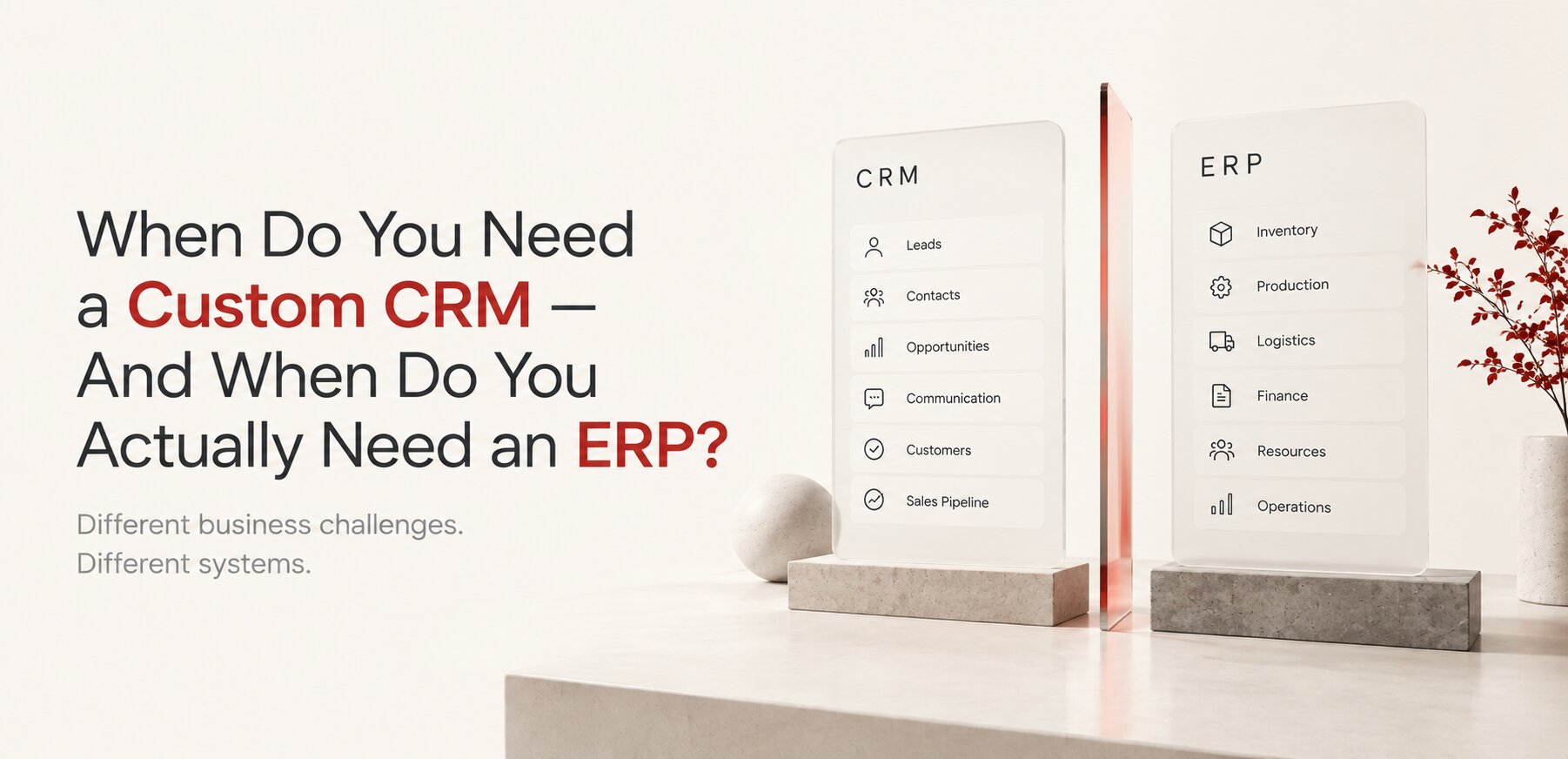
Take a CRM. A traditional UI exercise might involve a dashboard, contacts, opportunities, tasks, reports. But the real product is the sales operation itself: where does a lead enter, how is it qualified, who owns it, when does it become an opportunity, which actions require human approval. Now you're designing a product, and the screens are simply the visible expression of those decisions, exactly the same distinction we cover from the CRM side in custom CRM vs ERP.
The same logic applies to e-commerce. A storefront is not the product, the product is the purchasing experience and every system supporting it: catalog, inventory, CRM, ERP, payments, search, content, integrations. That's why some e-commerce projects become surprisingly difficult, you're not designing an online catalog, you're designing a commercial system experienced through an interface.
FAILURE + CONSTRAINTS
Product Design Has to Account for Failure and Constraints
One of the clearest differences between a prototype and a real product is what happens when things go wrong. What if there's no data, what if the payment fails, what if the CRM is unavailable, what if the AI doesn't know, what if the network is slow. These aren't edge cases, they're part of the product, and a good Product Designer plans for them from the start rather than patching around them later.
Every real product also has constraints: budget, time, technology, regulation, existing infrastructure. The mistake is treating constraints as something that happens after design. They should shape it. If an existing ERP can't update inventory in real time, the product experience needs to account for that. If a CRM has a strict data model, the workflow needs to respect it. Constraints aren't the enemy of creativity, they define the space in which good decisions can actually exist.
NOT A RELAY RACE
Not a Relay Race, and Designed for Its Second Version
A weak process looks like business handing requirements to a designer, who hands screens to a developer, who hands a final product back to the business. Problems emerge at every handoff. A stronger process looks like discovery, product definition, UX/UI, architecture, development, testing, feedback, and iteration, with the disciplines genuinely overlapping: developers challenge assumptions, designers discover technical possibilities, the client contributes operational knowledge.
Version one is rarely the final product. Customers behave differently than expected, a workflow turns out to be unnecessary, the market changes, a new integration becomes necessary. Good Product Design doesn't try to predict every future feature, it creates a structure the product can learn inside, clear boundaries, understandable information architecture, and an architecture that doesn't make every future change expensive.
The same medical education platform never treated its MVP as "the smallest possible thing." It was built as the smallest thing capable of surviving what the product might become, security, scalable architecture, multi-country certification, and a data model built for growth nobody could yet predict, all invested in before most users would ever notice any of it. Years later, when the platform needed new countries, new languages, and features nobody had originally scoped, none of that early architecture had to be torn up.
The most expensive mistake is designing the wrong product beautifully. A bad UI can be redesigned. A product that solves the wrong problem cannot be fixed with a better button.
WHAT IS DELIVERED
What a Product Designer Actually Delivers
Not just Figma files. A serious Product Design process produces a product definition (what it is and what it isn't), user and business flows, information architecture, a functional model, interaction architecture, wireframes and prototypes, visual design, a design system, product requirements, success metrics, and, most importantly, a shared understanding of why the product exists at all.
The handoff is also not the end. Once development starts, implementation changes reality, a component behaves differently than expected, an API has constraints nobody anticipated, a better solution becomes possible mid-build. The product designer needs to stay part of that conversation, because the goal was never "build exactly what was in Figma," it's "build the product we intended, and improve it when reality teaches us something better."
Where UX/UI Still Matters Enormously
None of this diminishes UX/UI, quite the opposite. Once the product is correctly defined, UX/UI becomes incredibly powerful. Good UX makes complexity understandable, good information architecture makes large systems navigable, good UI establishes hierarchy, trust, and clarity. But the interface is strongest when it expresses a well-defined product. Good UX cannot rescue unclear product thinking, it can only make clear thinking easier to experience.
This is why Product Design isn't another service sitting next to UX/UI, it's the discipline that connects strategy, branding, UI, and development into one coherent product decision. At Peretz, we increasingly think about digital products as systems rather than isolated interfaces, a website, a mobile app, an e-commerce store, or a CRM are all just interfaces to something larger, and before any of them get designed, the more important question is what the system should actually enable the business and its customers to do. A button is a decision. A workflow is a decision. Even choosing not to build something is a decision. Product Design brings those decisions together, and when they're coherent, the result feels simple, not because the system is simple, but because someone did the difficult thinking before the user ever arrived.
FAQ
Frequently Asked Questions
Do we need a Product Designer if we already have a UX/UI designer?
It depends on how complex the underlying system is. For a simple marketing site, UX/UI may be enough. For anything involving a CRM, e-commerce logic, multiple user roles, or systems that need to talk to each other, the product itself needs defining before interface work can be reliable.
Isn't this just what a good Product Manager already does?
There's overlap, but Product Management typically owns strategy, priorities, and roadmap. Product Design translates those decisions into the actual product experience and operating model, information architecture, workflows, and how the system should behave, not just what gets built and when.
How does AI change what a Product Designer actually does day to day?
It removes very little of the judgment work and speeds up nearly everything else. AI can generate interface variants and even working code quickly, which means the actual bottleneck shifts to deciding which version is worth shipping, a decision AI doesn't make for you.
What's the biggest sign a project skipped Product Design?
The interface looks finished, but nobody can clearly answer what happens when something goes wrong, a payment fails, data is missing, a system is unavailable. That gap between "the happy path is designed" and "the product actually works" is almost always a missing Product Design step.
Not sure whether your project needs Product Design, UX/UI, or both? We start by understanding what the system actually needs to do before designing a single screen.
The four questions before the first screen are really a compressed version of a full discovery process, see Product Discovery.
Mobile carries its own version of this same discipline, see when does a business actually need a mobile app.
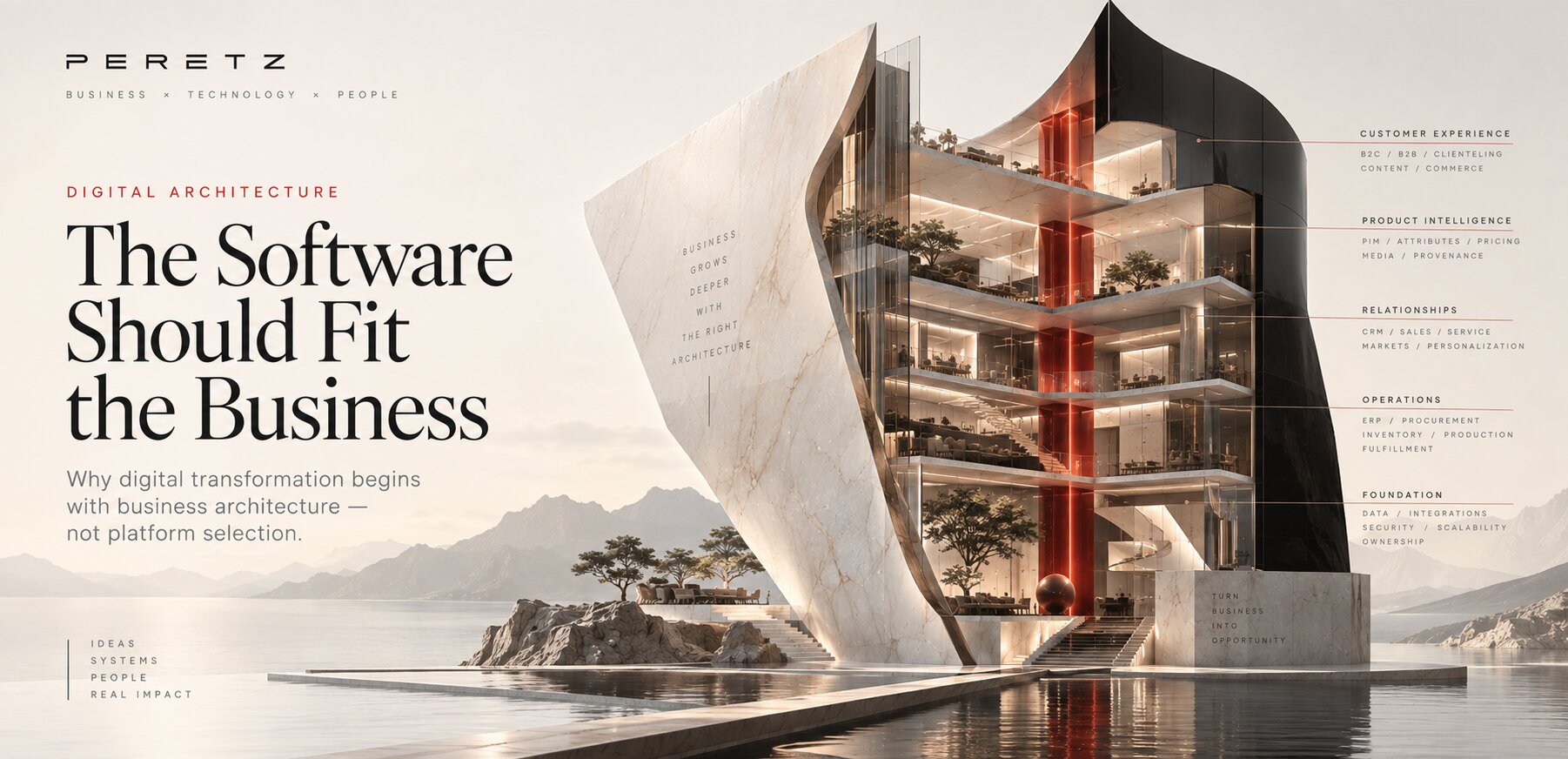
See the fuller architecture thesis, with real cases, in the software should fit the business.
- Share
-

-

-

-

One notification a week with the new PERETZ articles. Nothing else.
Related Reading
-
11. 09. 2026

Digital Architecture: How to Build a System That Can Grow With Your Business

-
10. 09. 2026
Custom CRM or ERP? The Difference, and When You Need Each
-
12. 09. 2026

Product Discovery: What Should You Know Before You Start Designing?
-
17. 09. 2026
When Does a Business Actually Need a Mobile App?
-
21. 09. 2026
The Software Should Fit the Business