Multi-Country E-Commerce for Large Catalogues: The Architecture Decisions That Set the Ceiling

Chapters
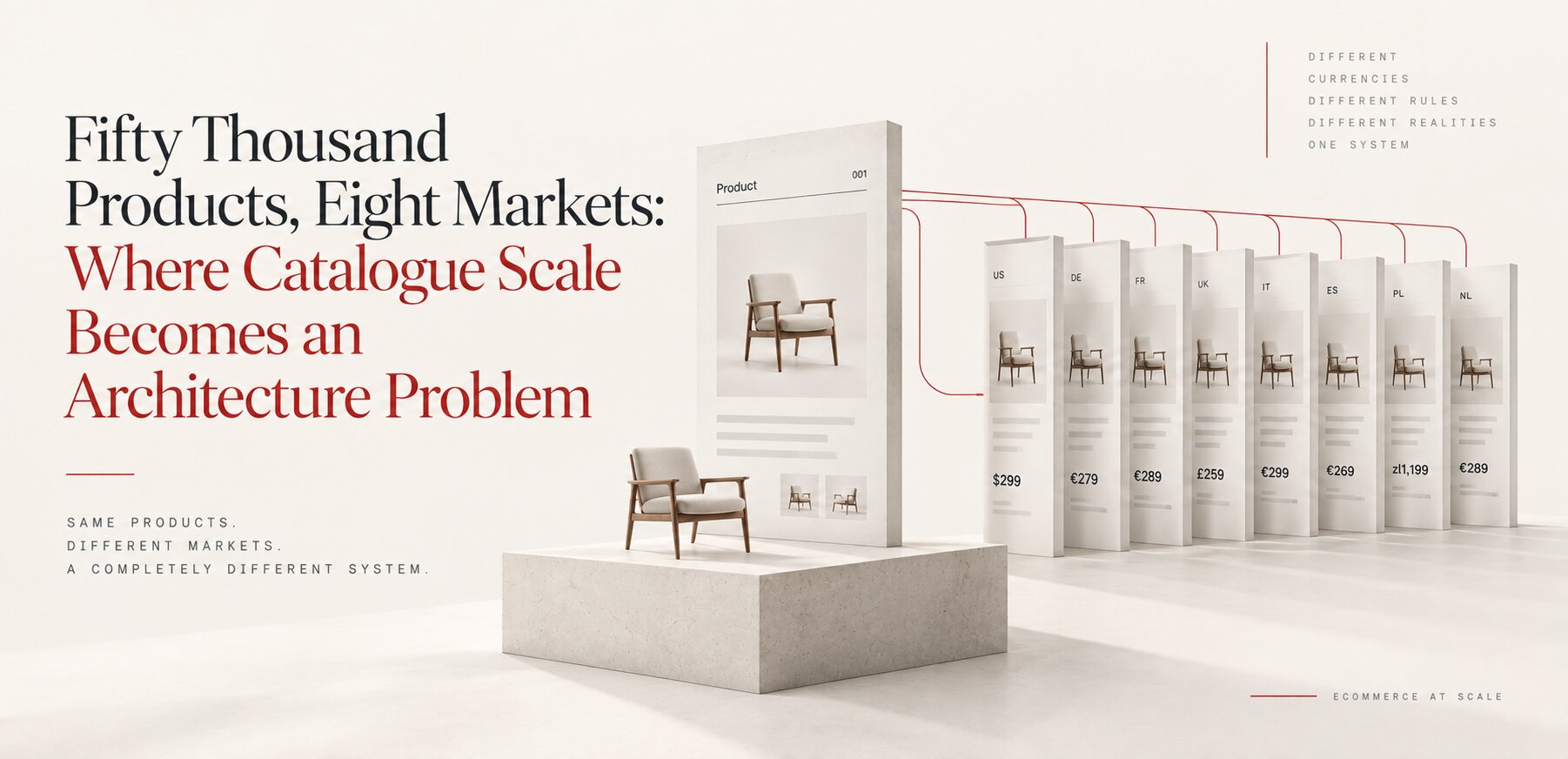
Fifty thousand products across eight markets is not a large store. It is a different system.
A business with a thousand products in one country and a business with fifty thousand products in eight countries are not doing the same thing at different volumes.
The second one is running a distributed data problem that happens to have a storefront attached.
This distinction is usually discovered rather than planned. A catalogue grows, a market is added, then another, and at some point the platform that handled everything comfortably starts behaving strangely. Pages slow down. An import that took minutes takes hours. A price update in one market appears in another. Nobody can say exactly when it changed, because it did not change at any single moment.
Scale rarely announces itself. It accumulates until something visible breaks.
The reason is narrower than it appears, and worth stating before anything else.
Scale does not make e-commerce harder because there are more products. It makes it harder because every product exists in more states, and those states have to remain consistent.
Everything that follows is a consequence of that single sentence. The catalogue grows, the number of states each product occupies multiplies, keeping them consistent becomes an operational problem, and the operational problem turns out to have been an architectural decision made much earlier.
Multiplication, Not Addition
Multiplication, Not Addition
The instinct is to treat catalogue size and market count as two separate problems that can be solved in sequence.
They are one problem, and the relationship between them is multiplicative.
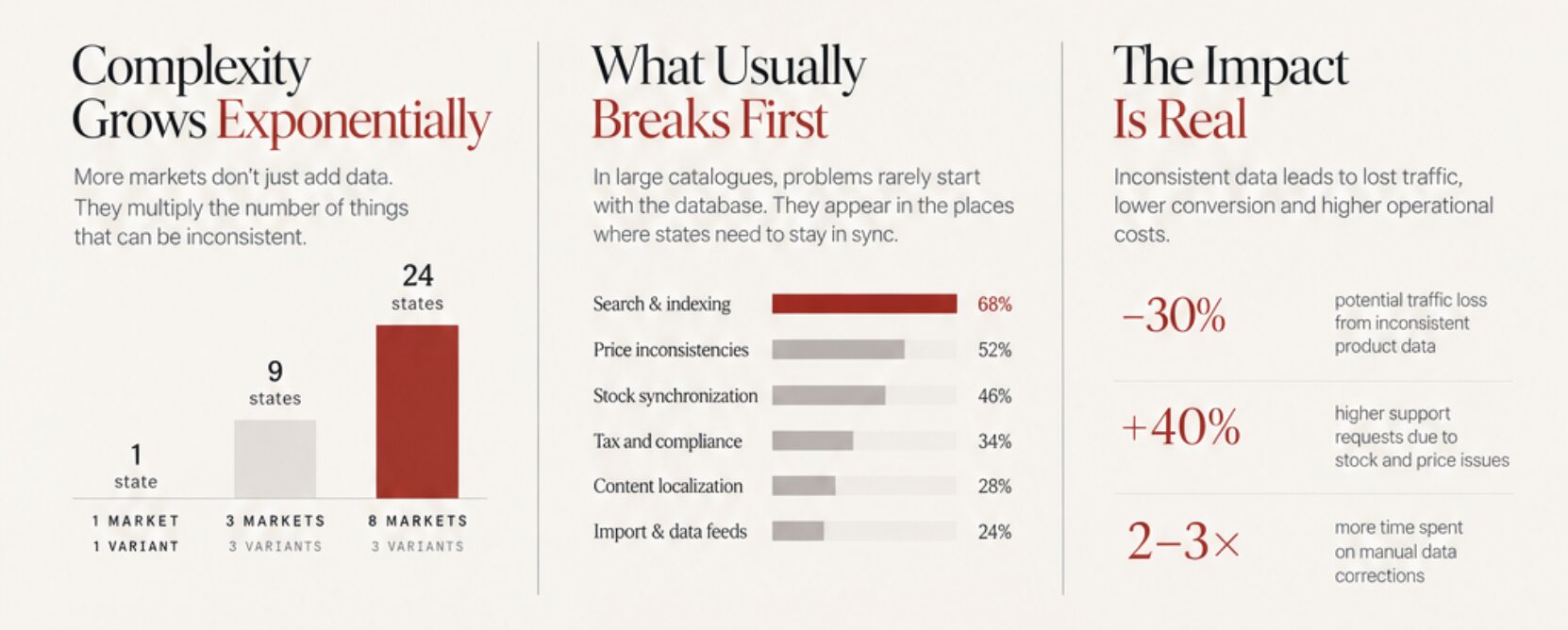
A single product in a single market is one state: one price, one stock figure, one tax treatment, one description. The same product with three variants across eight markets is twenty four commercial states, each of which can be independently correct, independently wrong, and independently out of date.
Across fifty thousand products, that is not a larger database. It is a different category of system, because the number of things that can silently disagree with each other has grown by two orders of magnitude.
The work is no longer storing information. It is keeping states consistent.

This is the point where platform choice stops being the interesting question. Every serious platform can hold fifty thousand rows. The question is what happens when those rows have to agree with each other across markets, currencies and jurisdictions.
The chapters that follow are the same problem seen from different angles. Each one is a dimension along which a product's state can diverge, and each one has to be decided rather than inherited.
Price Stops Being a Field
Price Stops Being a Field
In a single-market store, price is a number attached to a product.
Across eight markets it becomes a calculation, and the inputs are not all in the same place.
There is a base price, which may be set in one currency and converted, or set independently per market because conversion produces figures nobody would print. There are market-specific margins, because the same product does not carry the same positioning everywhere. There are rounding rules that differ by culture and by price bracket. There are promotions that apply in three markets and not the other five, sometimes overlapping with each other.
Then there is the question of who wins when two rules apply at once, which is a business decision that has to be made before it can be coded.
Price becomes a derived value with a defined order of precedence, not a field somebody edits.
Systems that treat it as a field survive until the first promotion that behaves differently in two countries, at which point the exceptions start accumulating in places nobody can audit.
That is the first dimension. Whether those eight figures are stored separately or derived from a rule, each one has to be right in its own market, and the model decides which of the two problems the business is maintaining.
Stock Is Not a Number
Stock Is Not a Number
Inventory follows the same pattern and is less forgiving, because the failure is visible to customers.
One warehouse serving eight markets and eight warehouses serving eight markets are different systems, and most businesses at this scale are somewhere between the two.
The questions that have to be answered are operational rather than technical. What is shown when a product is available in Poland but not in Spain, and the Spanish customer would accept a longer delivery? When is stock reserved, at checkout or at payment, and how long is it held? What happens when two markets sell the last unit within the same minute?
None of these has a default answer, and each one changes the architecture.
Overselling is not a bug that appears at scale. It is what happens when the reservation model was never explicitly decided.
The second dimension, and the one where an inconsistent state becomes a customer's problem rather than an internal one.
Tax Is Architecture
Tax Is Architecture
Across eight markets, tax stops being something applied at checkout.
Rates differ by country and frequently by product category within a country. Thresholds determine when a business must register in a market it is selling into. B2B and B2C are treated differently, sometimes requiring validation of a customer's tax identifier before the correct rate can be applied at all. Prices are displayed with tax included in some markets and without it in others, which changes what the customer sees before anything is calculated.
Handling this properly means a tax service, correct product classification for every one of fifty thousand items, and logic that produces a defensible answer during an audit.
It is invisible on the storefront and unavoidable in the build. It also cannot be added later without touching the pricing model, because tax treatment and price display are the same decision seen from two directions.
The third dimension, and the first one where an inconsistent state has a legal consequence rather than a commercial one.
Fifty Thousand Descriptions
Fifty Thousand Descriptions
The localisation problem at this scale is not a translation budget. It is a production process that has to run continuously.
Fifty thousand products across eight markets is four hundred thousand states that have to be written, reviewed and kept current.
50,000 products across 8 markets is 400,000 states.
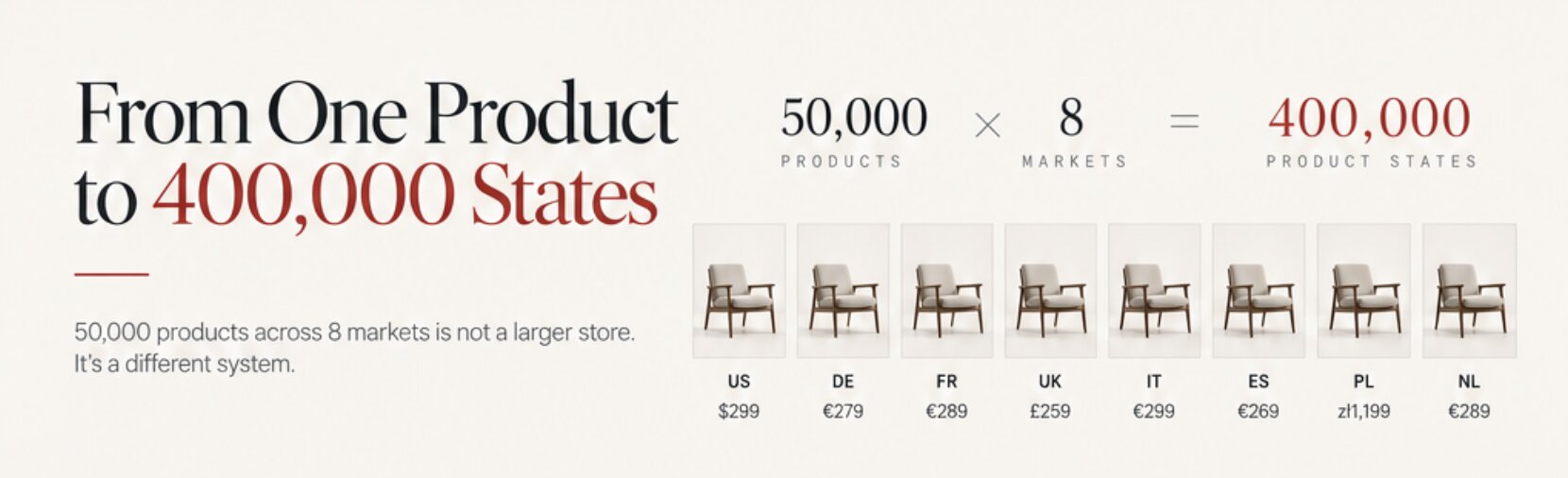
That figure is the multiplication made visible, and it is the reason localisation at this scale behaves differently from localisation on a small site. The catalogue does not hold still while those states are produced. Products are added, discontinued, repriced and reclassified daily, which means the number is not a target to reach but a volume to maintain.
The bottleneck in practice is rarely the translation itself. It sits between raw supplier data and a publishable product card: attributes arriving in inconsistent formats, missing specifications, values that mean different things from different suppliers.
Attributes and filter values need localisation too, and they are frequently forgotten because they do not look like content. A filter labelled correctly in one language and left in the source language in another quietly removes an entire navigation path for that market.
At this scale, localisation stops being a project with an end date and becomes an operational pipeline with a throughput rate.
The question is not what translation costs. It is how many products per week can move from supplier input to published, in eight languages, without the review queue becoming the constraint.
Search Breaks First
Search Breaks First
Among the technical failures, search and filtering usually arrive earliest, and the threshold is lower than most businesses expect.
What breaks is specific. Database-driven search that performs acceptably on a few thousand products becomes slow when it has to handle fifty thousand across eight languages with faceted filtering applied. Agency and platform accounts place the point where this starts somewhere above ten thousand products, though as observations rather than measurements they are better read as a direction than a threshold.
The standard answer is a dedicated search layer, and the significant part is what that means structurally. It is not an optimisation of the existing system. It is a second copy of the catalogue, kept in a different shape for a different purpose, which then has to agree with the first one.
Solving search at this scale adds another state per product rather than removing one.
Search stops being a platform feature. It becomes a component.
Faceted navigation brings a second problem that is invisible until it is measured. Filter combinations generate URLs, and at this catalogue size they generate a great many of them, most of which should never be indexed. Left unmanaged, crawl budget is consumed by filter permutations while the product pages that should rank wait behind them.
Import Becomes Infrastructure
Import Becomes Infrastructure
On a small catalogue, importing products is a task. At fifty thousand items updating daily, it is a system with its own failure modes.
Reindexing a catalogue of this size is an operational event rather than a background process. Done carelessly, a routine price update can degrade performance for every user on the site while it runs.
The practical consequence is that an import can no longer be allowed to write directly. A malformed supplier feed at this scale does not produce one wrong product. It produces wrong prices across eight markets at once, and it does so faster than anyone can notice.
So the system needs a gap between receiving data and publishing it: validation before writing, changes staged rather than applied, and a way back when something gets through anyway.
But the decision that matters most is simpler than any of that. It is where the source of truth lives.
When product data is authoritative in one system and the store consumes it, a conflict has an answer. When both sides can write, the system will eventually disagree with itself, and the question of which version was correct has no answer at all. That is the thesis of this article in its purest form: the states diverged, and nothing in the architecture decided who wins.
Signals Multiply Too
Signals Multiply Too
The search layer facing outward multiplies in the same way as the one facing inward.
Eight language versions of fifty thousand products means every product carries a set of annotations declaring its alternates, and every one of those sets has to be internally consistent. The relationships are reciprocal, so the number of declarations that must agree is substantial and cannot be maintained by hand.
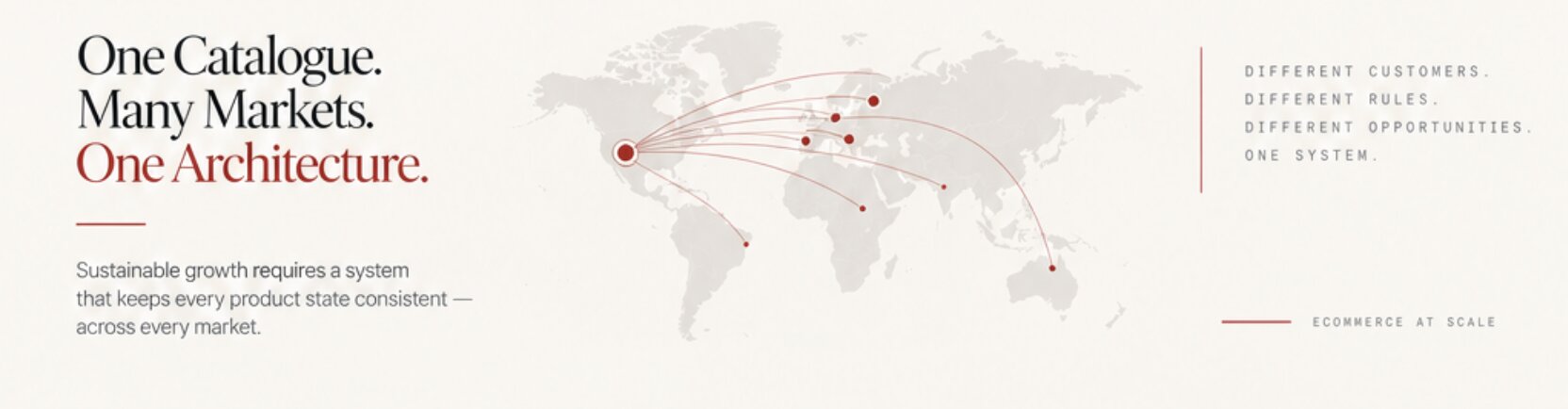
This is generated infrastructure, not content work. Generated correctly, it is invisible. Generated with a systematic error, the error is present on every product simultaneously, and the failure is silent.
The mechanics of how that goes wrong, and how to audit it, are covered in Multilingual SEO: Why Translated Pages Do Not Rank in Their Own Markets, which examines the same failure from the search side. Between them the two articles describe one thing from two directions: an international business breaks at the level of search architecture, and a large multi-market catalogue breaks earlier, at the level of data architecture.
Underneath both sits the strategic version of the same issue. Eight markets do not search for the same product in the same way, and a catalogue translated uniformly is optimised for whichever market the original was written for.
What Actually Breaks First
What Actually Breaks First
Businesses at this scale usually expect the storefront to be the fragile part. It rarely is.
The first thing to fail is normally the administration interface, because it was designed for a catalogue that could be reviewed by a person. At fifty thousand products across eight markets, an interface built around finding and editing individual items stops being usable, and the team responds with spreadsheets and manual workarounds that live outside the system entirely.
Those workarounds are where data quality goes to die, and they are also invisible in any technical audit, because nothing in the codebase is wrong.
The catalogue did not become unmanageable. The tools for managing it did.
What the operational side needs at this scale is different in kind: bulk editing with validation, changes staged and reviewed before they publish, a clear record of what changed and who changed it, and the ability to reverse a bad update without restoring a backup.
A system that cannot be operated safely is not finished, however well it performs under load.
This is where state multiplication stops being a technical description and becomes a staffing problem. Every state that the architecture does not keep consistent automatically becomes a state that a person has to keep consistent manually, and there are not enough people.
Decisions Before Code
Decisions Before Code
Everything above is a consequence of decisions that are cheap to make early and expensive to revisit.
Where product data is authoritative, and what happens when two systems disagree. Whether price is stored per market or derived, and which rule wins when several apply. How stock is modelled across warehouses and markets, and when it is reserved. Which markets share content and which need their own. What the catalogue is expected to look like in three years, because a model that fits fifty thousand products may not survive two hundred thousand.
None of these are implementation details. They are the architecture, and they are settled before the first meaningful line of code, which is also why the discovery phase on a project like this is longer than clients expect and cheaper than the alternative.
At this scale, the expensive mistakes are made in the first month.
Read backwards, the whole sequence is short. A catalogue grows and adds markets. Each product begins to exist in more states. Keeping those states consistent becomes daily operational work. And the amount of that work was fixed, before anyone noticed, by decisions about the data model that were made when the catalogue was small enough for them not to matter.
The architecture does not cause the problem at scale. It determines how much of the problem is automatic and how much is manual.
The relationship between catalogue complexity and what a build costs is set out in What Actually Makes E-Commerce Development Expensive, and the consequences of getting the structural decisions wrong in The Hidden Cost of Choosing the Wrong Architecture.
A business that already understands why this is difficult is usually past the stage of asking which platform to use. The useful conversation at that point is not about features at all. It is about which states the system will guarantee, and who is responsible for the ones it will not.
If you are planning a catalogue at this scale across several markets, the decisions that determine the outcome are made before development starts. A Strategic Session establishes the data model, the market structure and the operational requirements while they are still inexpensive to change.
Explore our E-Commerce Development services.
- Share
-

-

-

-

Related Reading
-
06. 09. 2026

Multilingual SEO: Why Translated Pages Do Not Rank in Their Own Markets

-
28. 08. 2026
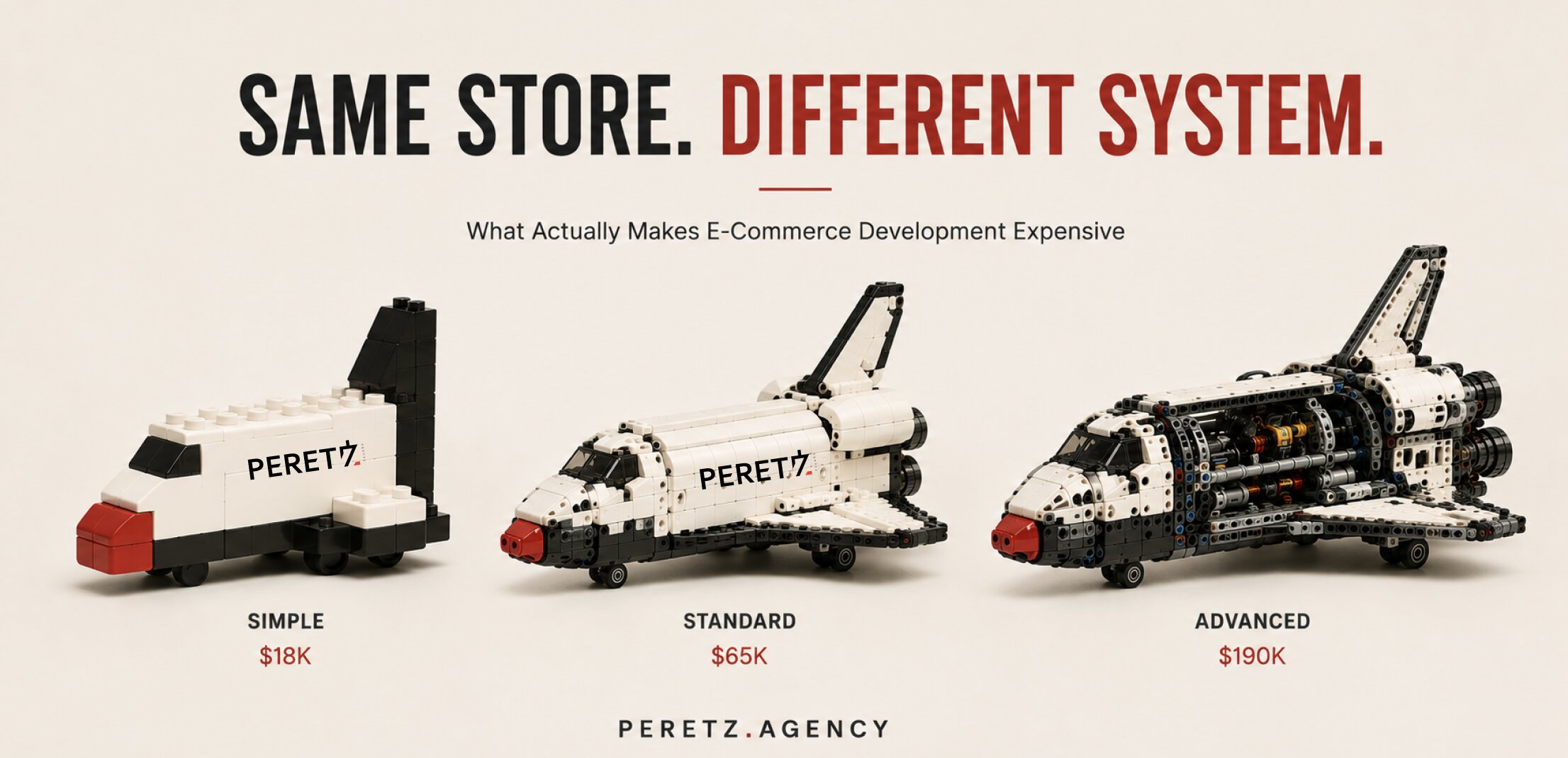
What Actually Makes E-Commerce Development Expensive
-
01. 08. 2026

The Hidden Cost of Choosing the Wrong Architecture
-
01. 09. 2026
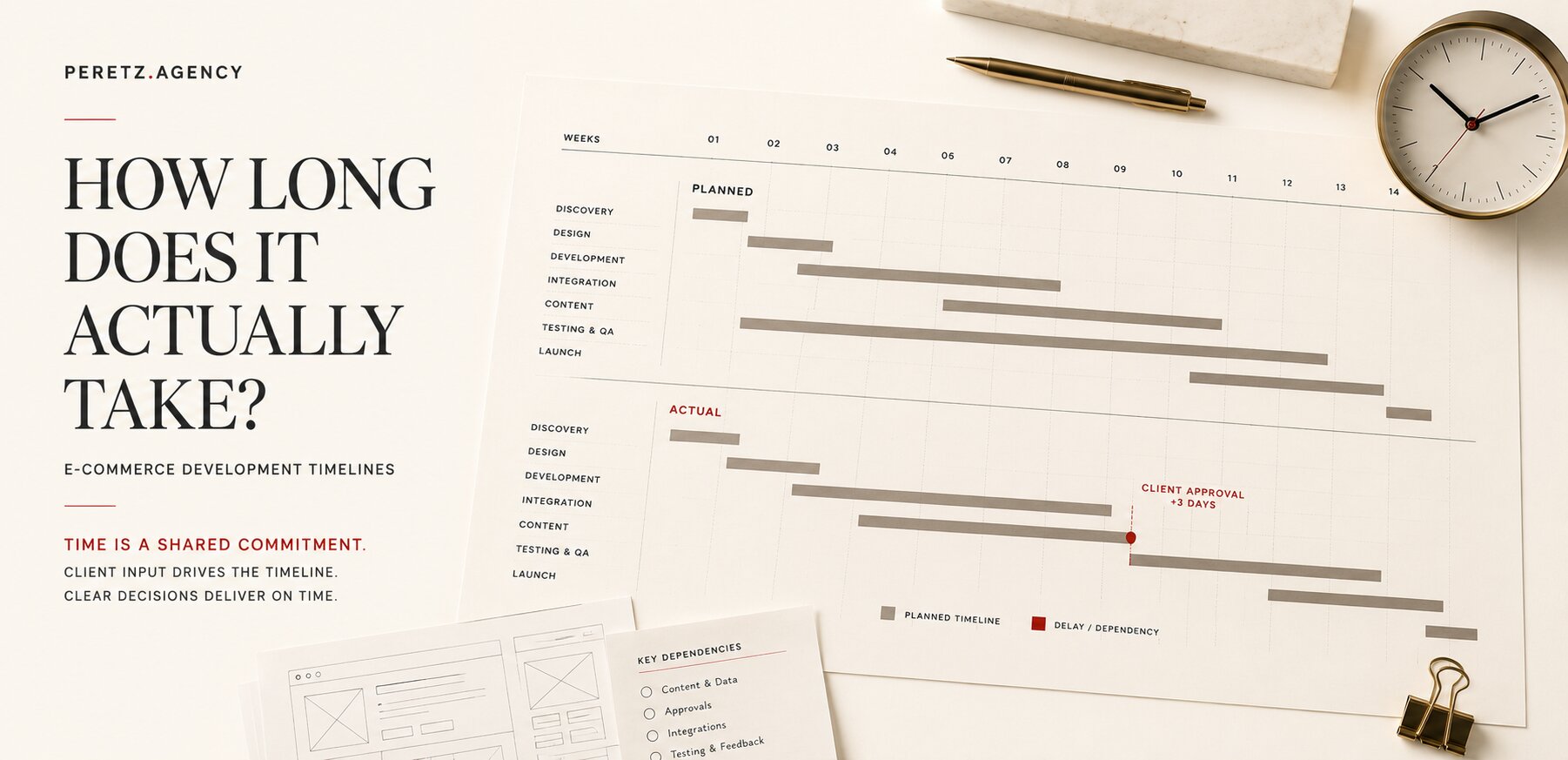
How Long Does an E-Commerce Build Actually Take, and What the Client Has to Do
-
01. 09. 2026

Why E-Commerce Development Quotes in Seattle Range From $25 to $300 an Hour
-
16. 08. 2026

Why Family-Owned Jewelry Stores Outgrow Their E-commerce Platform
-
04. 09. 2026

What Separates a Premium Laravel or Symfony Build From a Merely Functional One