



Examples from our strategic sessions: what clients came with, what we found and what we recommended.
THE PROBLEM
Diagnosis Comes Before the Project
An educational institute came to us to discuss its outdated website. During the session we found that the enquiry forms on several pages had stopped working. Requests were going nowhere, nobody was answering them, and nobody inside the organisation knew.
Some of those enquiries were for training programmes worth around €10,000.
The client came to talk about an old website, and the real problem turned out to be somewhere else. This is why we charge for strategic sessions and why we don't run them as sales calls.
Most agencies offer a free call before preparing a proposal, and there is nothing wrong with that in itself. The trouble starts when the purpose of the conversation is to sell a project, because then the solution gets chosen before anyone has examined the problem. An outdated website becomes a redesign. A traffic problem becomes a marketing campaign. A request for new functionality becomes a development project.
Those answers are often right. Just as often, they are premature.
A free call tends to find the problem the agency already sells.
People regularly come to us for one service and turn out to need another. We work the way a good doctor does: the symptom you describe is where the conversation starts, and the diagnosis comes after the examination.
Our sessions have ended with new platforms, technical upgrades, changes in business strategy and decisions to postpone development altogether. One showed that a company did not fully control its own domain. Another showed that a business planning to spend $100,000 on an online store would do better to start on an existing platform. Below are some of those sessions: what we found in each and why the recommendations differed.
In short
- The introductory Strategic Session costs $500, credited in full toward the project if you go ahead.
- It can end with any recommendation, including an upgrade instead of a rebuild or a decision to wait with custom development.
- In the examples below, the findings ranged from broken enquiry forms to a domain registered to a former developer.
- You leave with a written plan and a summary of the discussion, including our recommendations.
- A checklist near the end shows what a business can verify in its own digital assets before any session.
WHO
Who Is a Strategic Session For?
The session is for business owners and directors who have a decision to make and want to avoid committing to the wrong solution.
You might be deciding whether to rebuild your website or improve the existing one. You might be planning to introduce an ERP or CRM, enter new markets, launch additional language versions, or prepare the business for investment or a sale.
These decisions usually involve several teams, systems and budgets, and getting the sequence wrong can cost more than choosing the wrong technology. We explain why the order of decisions matters in The Website Design Process Most Agencies Show You Is Wrong.
We start with what the business needs to achieve. The website, software or campaign comes into the discussion once we understand what role it has to play.
THE FEE
Why It Costs $500
The introductory Strategic Session costs $500. If you proceed with a project, the full amount is credited toward its cost. If you don't, you keep the recommendations and the plan.
The fee covers the work before the meeting as well as the session itself. We review your request, examine the website and its technical foundation, look at competitors and study whatever analytics you can share. By the time we meet, we have questions and working hypotheses to test with you.
The other reason is simpler. We want to be free to recommend a smaller project, a different approach or no development at all, without needing a sale to cover the cost of the conversation.
For larger or more complicated questions there is an extended format: several days of internal work followed by a full day with you. It starts at $5,000 and is scoped separately.
PEOPLE
Who Takes Part
Yevhen Borovoi, founder of Peretz Agency, attends every Strategic Session.
The other participants depend on the question. Valeriya Chumachenko joins discussions involving technology M&A, valuation, a business sale or preparation for investors. Iryna Nechaeva takes part when the work involves marketing, paid social or lead generation. Developers join when the answers depend on code, hosting, integrations, ERP or CRM.
For very complex projects, or when a large volume of work lies ahead, we also bring in external partners with the right expertise, so the people in the meeting are the ones who would carry the work.
Before the session we ask for a short description of the problem. A few paragraphs are enough: what you think is wrong, what you have already tried and what you plan to do next.
The meeting takes two to three hours, is held online, and can be conducted in English, Ukrainian or Russian.
CASES
Different Requests, Different Answers
Every session began with a specific request. What we recommended depended on what we found.
| The client came with | We found | Recommendation or result |
|---|---|---|
| An old OpenCart website on PHP 5 | The platform could be upgraded, but several enquiry forms were broken | Upgrade the platform and rework only what needed it; 84 additional enquiries over the next two months |
| A website the business had outgrown | The company needed an ERP, a CRM and separate B2B and B2C journeys | Build the new website around the business systems |
| A request to discuss a website | The domain and hosting were controlled by other parties | Transfer control to the company before starting design |
| A publishing website losing ground in search | Structural problems, blocked crawlers, empty language pages, missing calls to action | Fix the foundation; 350 pages entered the index |
| A new website already in development | Its structure had not accounted for AEO and GEO | Settle the architecture before building further |
| A large brand project | The decisions involved could not be resolved in one meeting | Continue through a series of working sessions |
| A plan to spend $100,000 on a US clothing store | Acquisition costs, development requirements and zero search visibility made a custom build too risky | Start on an existing platform and postpone custom development |
| A plan to win AI search with ten articles | Competitors had a long head start with carefully edited content | Rework the strategy and set a realistic timeline |
1. An upgrade instead of a rebuild
An educational institute came to us with a website running on an old version of OpenCart and PHP 5.
For readers who don't deal with this every day: OpenCart is the CMS, the system that manages the site's pages, catalogue and forms. PHP is the programming language the server uses to run it. Version 5 stopped receiving security updates at the end of 2018 (PHP: unsupported branches). A site on it can look perfectly fine to visitors while known vulnerabilities stay open, hosting providers phase out the old version, and current modules for payments, analytics or forms no longer install. The longer such a site waits, the further its code drifts from current versions and the more the eventual upgrade costs.
A new website would have been an easy recommendation. We upgraded the platform and PHP to supported versions instead, then reworked the parts that genuinely needed attention.
An upgrade also keeps what the site has already built up: its content, page addresses and search history. A rebuild would have put much of that at risk to solve a problem that lay elsewhere.
During the session we also found that enquiry forms on several pages had stopped working. Potential students were sending requests that nobody received, and the institute had no way of knowing.
After the forms were fixed, the institute received 84 additional enquiries over the following two months. Three of them were for courses costing around €10,000 each, others for programmes worth several thousand euros, and the rest for smaller courses.
A website can look fine to visitors and still lose every enquiry.
The cost went beyond lost revenue. Every unanswered request left someone who had wanted to study there and concluded that the institute simply did not bother to reply.
2. A business that had outgrown its website
SHTAYER, a premium bedding business, had the opposite problem.
Its website still worked, but the business had moved beyond what the platform could support. The company needed an ERP and a CRM, and retail customers needed a different experience from trade buyers.
An ERP is the system that runs the operational side of a business: stock, purchasing, production and orders. A CRM keeps customers and the history of every contact with them. When a website is connected to neither, orders and enquiries are retyped by hand, stock shown on the site drifts away from what is actually available, and trade buyers cannot see their own prices, terms and order history.
Here a new website was the right decision, and the session established what the new system had to do and how the website would fit into it. We designed the new site around the ERP and CRM, with separate B2B and B2C paths, so that the company would not end up with another website it would outgrow in a couple of years.
The new platform is now being configured and filled with content. The company is building a new team, and its people are learning the integrations, services and tools that come with the system. Meanwhile we launched a blog on the existing website. It lets the company start building its knowledge graph now: a connected body of content about its products and expertise that search engines and AI assistants can read and attribute to the brand. That work will move to the new platform later.
3. Ownership before design
A furniture and interior company approached us to discuss its website.
Before any talk of design, we established that the company did not fully control the digital assets it depended on. The domain was registered to a developer who had worked with the business years earlier, and the hosting ran through someone else's account.
Had that developer let the domain lapse or refused to hand it over, the company could have lost its web address, its search history and possibly its email, along with whatever it had spent on a redesign. None of this makes an impressive portfolio screenshot, but it was the first thing to fix.
We moved the domain and hosting under the company's control, and only then started work on the website.
4. Fix the structure before publishing more
A publishing platform had been producing articles in several languages, yet its pages kept losing ground in search. The obvious response would have been to publish more, and the session showed why that would not help.
The article structure needed work, and the site had not been prepared for answer engines and AI assistants. Some useful crawlers were blocked at the hosting level. Articles also had no clear calls to action, so visitors had little idea where to go next.
Crawlers are the programs that search engines and AI services send to read websites. If the hosting firewall turns them away, the content effectively does not exist for those systems, however good it is. A page that is never read cannot enter the index, the database that search engines draw their results from.
The older content held another problem. Some language versions had been indexed even though the pages contained little more than a note that the article was available in another language. Search engines treat pages like that as empty, and a large number of them weighs on the whole site.
Every new article published on top of that would have run into the same problems, and the money spent on content would have bought very little.
After the structural and technical issues were fixed, 350 pages entered the index. Search Console has shown steady growth since, with around 10 to 20 more articles indexed each week. We wrote about what has changed in search in our article on SEO, AEO and GEO in 2026.
5. Architecture before development
A new brand had already started building its website when the team came to us.
The question was how to continue. We found that the structure had not accounted for AEO and GEO, so the site risked being hard for AI-driven search to interpret and cite.
AEO (answer engine optimisation) and GEO (generative engine optimisation) cover how a site is built and written so that AI assistants such as ChatGPT, Gemini or Google's AI answers can understand it, trust it and quote it. Much of that is decided in the architecture: how pages are organised, how products and services are described in structured data, and how content links together.
We worked through the architecture before more was built. At that stage the changes lived in plans and structure. After launch, the same changes would have meant rebuilding sections and moving content that was already live.
6. When one session becomes a series
Schoeffel, a luxury pearl brand, was a larger project than one strategic session could cover.
The first session led to a series of working meetings, each dealing with decisions that had to be settled before the next stage could begin.
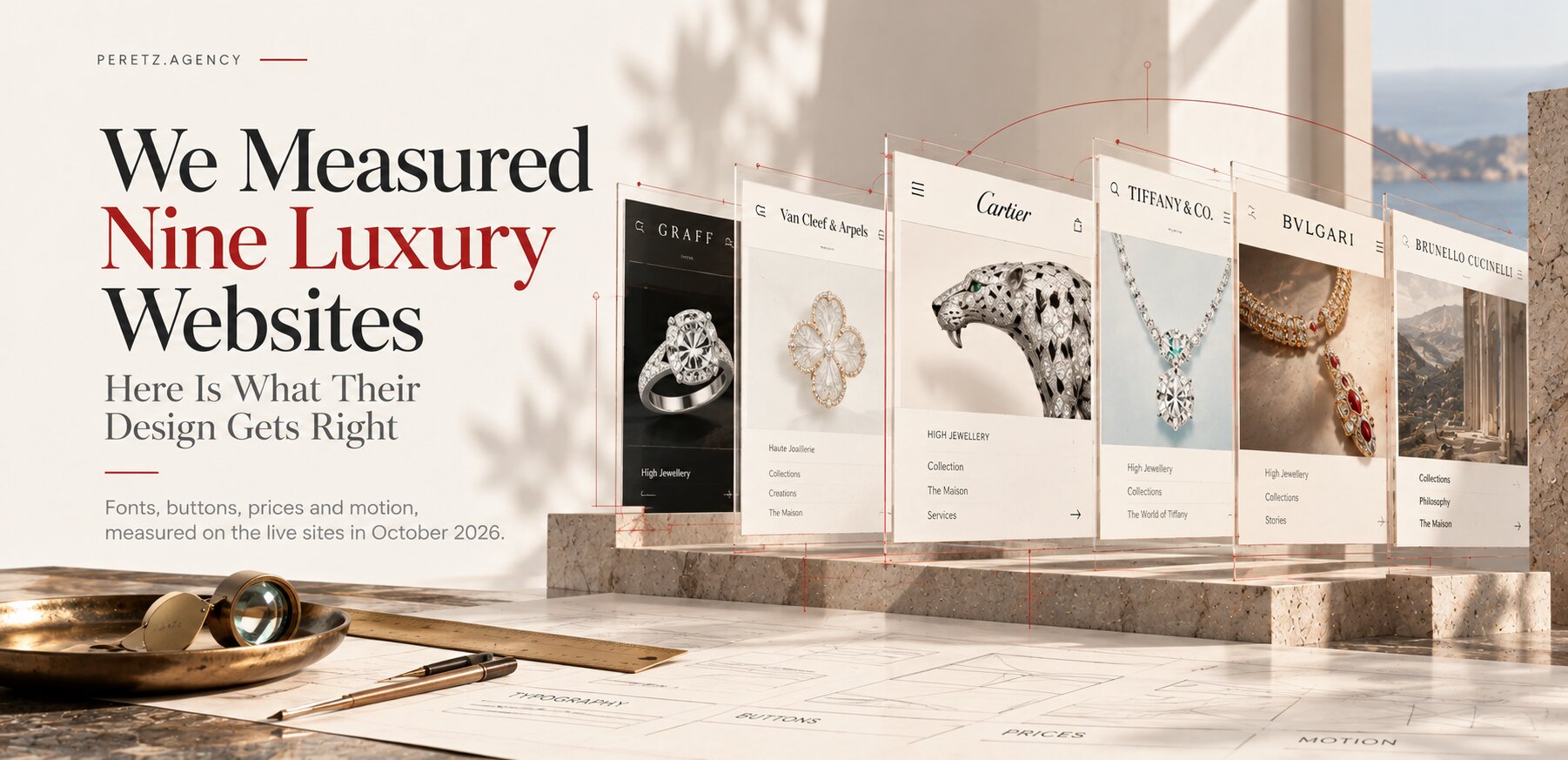
That work included research before design started, among it a measured study of nine luxury brand websites, which we published as We Measured Nine Luxury Brand Websites. On a project of this size, the sessions keep the important decisions in the right order and give the team a sound basis for everything that follows.
7. When the right recommendation is to wait
A founder wanted to launch an online clothing store in the United States, with $100,000 for the first year to cover development and marketing.
That sounded substantial until we looked at the requirements.
In his market, clicks cost around $3 to $5 and competition was strong. A new site would have no search visibility, so organic traffic would take six to twelve months to produce its first small results. On the development side, the store needed complex integrations, filters and product data.
A custom platform would have taken a large share of the budget, and paid advertising would then have had to carry the business while search caught up. The risk was simple: spend too much on development, leave too little for customers, and run out of money before the business could prove itself.
The budget has to last until the business can prove itself.
We recommended starting on an existing e-commerce platform and postponing custom development until sales and customer data justified it. That meant proposing a much smaller project than the one he came with, and it gave the store a realistic chance to start selling.
8. Ten articles would not be enough
Another business owner had read about AEO and GEO and expected ten articles to settle the question.
We began with his competitors. They had been working on their content for a long time and publishing a lot, and their articles were well researched and carefully written, with AI used as an editing tool.
There was a second issue. Much of what he had read, including the answers he had got from AI assistants, had simply echoed his own expectations. The assistants picked up the tone of his questions and answered with the same optimism he brought to them.
We revised the strategy and the scope of the work to match the position of the business and the quality of the competition, and set a realistic timeline for the first results. Without that, he would have spent the budget on ten articles and waited for results that were never going to come at that scale.
Results don't always arrive at once
Some of these cases produced measurable results within two months. Others involved decisions whose value shows up over time: fixing broken forms brings enquiries, recovering control of a domain removes a risk, and settling the architecture before development avoids expensive changes later.
Not every result can be reduced to a number straight away, and we would rather say so than invent one to make a case look better.
WHAT YOU GET
What You Leave With
After the session you receive a written plan and a summary of the discussion, including our recommendations. It covers the problem we found, the order in which we recommend tackling it, which parts need specialist help, and what you can handle internally or with your existing developer.
If you decide to work with Peretz, the session becomes the starting point of the project and the $500 is credited toward its cost. If you take the recommendations elsewhere, the plan is yours to use.
Some problems don't need a session at all. A known bug, a single landing page or a routine content update can usually be scoped in a short exchange, and we won't ask you to book a session when the problem is already clear.
CHECKLIST
What to Check Before Committing to a Digital Project
Some of what we find in strategic sessions a business can check for itself. Other questions need an outside view and experience across many projects. Start with the basics.
Ownership and access
- Is the domain registered to the company?
- Does the company control its hosting, analytics and advertising accounts?
- Who has administrative access, and have former employees and contractors been removed?
- Are recent backups available, and has anyone actually tested restoring one?
Does everything work?
- Send a test enquiry through every important form, then check where it goes, who receives it and how quickly someone replies.
- Are the CMS and PHP versions still supported and receiving security updates? Unsupported versions get no security fixes, and every year of delay makes the upgrade more expensive.
- What does Search Console, Google's free tool for site owners, show for indexed and excluded pages, duplicates and empty language versions?
- Can useful crawlers, including the ones AI assistants rely on, reach the website? If the hosting blocks them, search engines and AI assistants never see the content.
Can the current setup support the next stage?
- Do important pages give visitors a clear next step?
- Do orders and enquiries move automatically between the website, CRM and ERP, or does someone copy them by hand?
- If the business depends on paid traffic, is there enough budget to sustain it while organic visibility grows?
- Is the development plan based on what the business needs now, or on guesses about what it might need later?
- When you test a plan with an AI assistant, do you ask it to argue against you?
Where an outside view helps
Some questions are hard to answer from inside the business. Is SEO producing enquiries and sales, or only traffic? Are several pages competing for the same search terms? Does the content give AI search a reason to cite the business?
Are marketing budgets right for the market and the results you expect? Does social media bring leads at a cost the business can sustain? And when a website has accumulated years of pages, features and integrations, what should be improved, what removed and what left alone?
These are the decisions we work through in a Strategic Session, and the answers depend on the business, its market and its goals. Where enquiries get lost on the way from an ad or a search result to a sale is a subject of its own, which we cover in why a business isn't getting leads.
DEALS
When the Question Is a Deal
Some digital questions come up because a business is being bought, sold or handed to new owners. For those, Peretz offers two formats led by Valeriya Chumachenko, who has more than ten years of experience in technology M&A:
- Technical Due Diligence Session, for buyers and investors who need to understand the digital assets and technical risks before a deal closes;
- Exit & Succession Readiness Session, for owners preparing to sell a business or pass it to new leadership.
For everything else, from a website that has stopped producing enquiries to a platform the business has outgrown, start with the Strategic Session.
FAQ
Frequently Asked Questions
Is the session only about the website?
No. The website is often where the conversation starts, but the session can cover the wider digital side of the business: SEO and AI search, marketing budgets, social media, ERP and CRM systems, entering new markets, and preparing for investment or a sale. The scope depends on the question you bring.
Is the $500 credited toward a project?
Yes. If you proceed with a project, the full $500 is deducted from its cost.
What if you conclude that I don't need a new website?
Then we will tell you. As the examples above show, the right answer may be an upgrade, a technical fix or a change of plan.
Who attends from Peretz?
Yevhen Borovoi attends every session. Depending on the subject, he is joined by Valeriya Chumachenko, Iryna Nechaeva, our developers or external partners with the relevant expertise.
How long does a session take?
The introductory session takes two to three hours and is held online. The extended format adds several days of internal work and a full day with you.
What should I prepare?
A short description of the problem, what you have already tried and what you plan to do next. Access to analytics helps if you can share it.
Which languages do you work in?
English, Ukrainian and Russian.
You don't need a perfect brief or a chosen technology to start. Tell us what you are trying to achieve and what is getting in the way, and we will come prepared.
The introductory session costs $500, credited toward a project if you decide to proceed.
- Share
-

-

-

-

Related Reading
-
09. 10. 2026
The Website Design Process Most Agencies Show You Is Wrong

-
10. 10. 2026
We Measured Nine Luxury Brand Websites. Here Is What Their Design Gets Right
-
08. 10. 2026

Do You Need a Website Redesign? Start With a Usability Audit
-
17. 06. 2026
Why Your Business Isn't Getting Leads From Its Website (And How to Fix It in 2026)